

How The Detroit Diesel 2-Stroke Engine Got Its 'Screaming Jimmy' Nickname
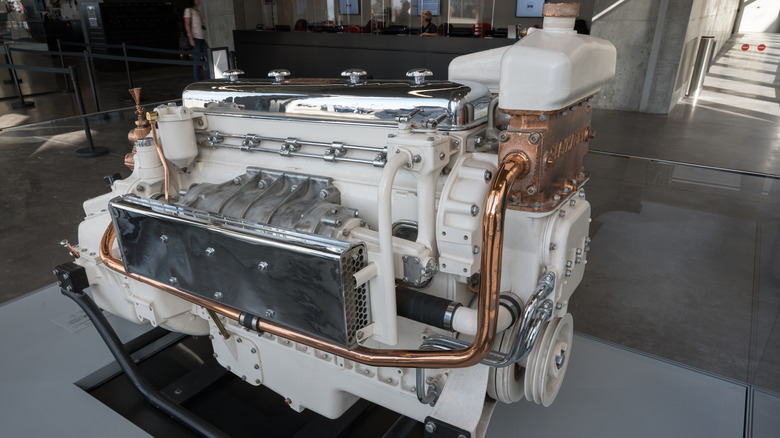
If you hang around the industrial diesel engine crowd much, you've likely heard the name "Screaming Jimmy" when referring to a variety of Detroit Diesel engines, specifically, the Series 71. The Series 71 (and its different configurations) was notable for its heavy use in World War II, and its healthy post-war life powering anything from industrial equipment, farm implements, to generators.
The "Screaming Jimmy" name is pretty straightforward when you break it down. "Jimmy" refers to the fact that Detroit Diesel was owned by General Motors for a number of years. "GM" to "Jimmy." The "screaming" part of the sobriquet refers to the layout of the engine and function.
The Series 71 is a two-cycle, meaning that it only requires two-strokes of the piston to produce power, as opposed to four-strokes in most modern engines (the Series 71 was designed in 1938 after all). As such, the compressed air is supplied by a blower. The compression/combustion cycle, paired with a blower produce the wonderful cacophony that is the sound of a Series 71. This orchestra of parts moving in unison gives you the "Screaming" nomenclature.
Why the Detroit Diesel 71 is so significant
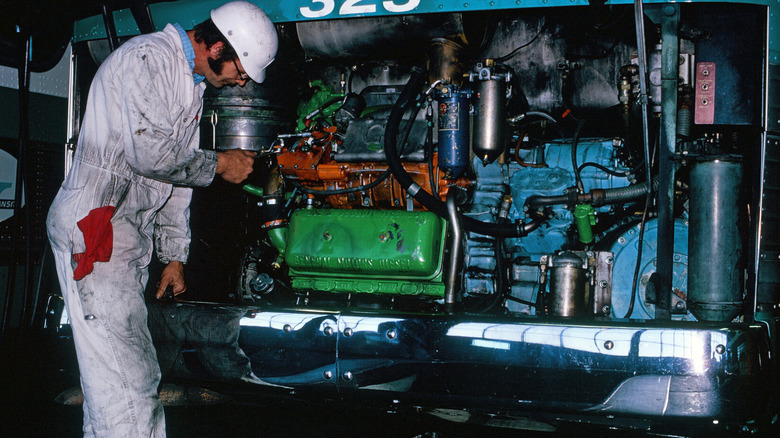
The Detroit Diesel 71 (or 6-71) is one of the most iconic names in engine technology, and unquestionably the longest-lived diesel engine ever produced. The first part of the code indicates the cylinder count, and the second specifies the cubic inches per cylinder. The 6-71, then, is a six-cylinder engine with 71-CI cylinders. The engine was built from 1938 to 1995 and powered an astonishing number of vehicles, from WWII tanks to modern construction equipment and marine applications. Detroit Diesel manufactured the 71 in various configurations, from single-cylinder engines to V24s.
These engines came before modern metallurgy allowed for reliable four-stroke designs with similar power and torque figures, meaning the Jimmys powering GMC trucks represented the best of their era, producing respectable torque figures of around 525 lb-ft. Coupled with the engine's scalability, you had an engine that could be assembled to order that was powerful enough to drive loaded commercial trucks at highway speeds. Sure, it's not the most powerful Detroit Diesel out there, but by 1930s standards, the engine was incredibly versatile.
The Screaming Jimmy's popularity soared during and after WWII, with the post-war growth in America's highway infrastructure demanding more robust logistics networks. Many early examples of 71-series advertisements prominently featured construction equipment and trucks hauling oversized loads. The 6-71's compact size and high torque rating also made it great for other uses, including watercraft. One example was the "Quad" setup: four 6-71s linked to a common shaft, which was also used for power units.