

Mysterious Fireball Over Europe Left Viewers In Awe & Damaged At Least One Home
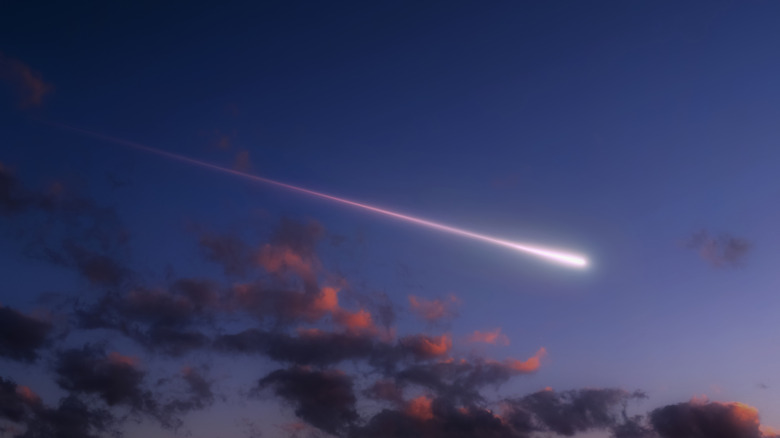
The European Space Agency is now looking into the fireball that flew over Central Europe back on March 8. The strange event was seen by countless thousands of onlookers and damaging at least one person's home in Western Germany. According to local reports, one of the meteorites smashed a football-sized hole through the roof and landed inside a bedroom. Luckily, no one was in the room and no injuries were reported. Whether any other nearby buildings were damaged remains unclear.
It shot across the sky just before 7 PM local time, burning brightly for about six seconds before breaking apart below the atmosphere. The glowing object was seen (and, in some cases, heard) as far and wide as France, Belgium, Luxembourg, the Netherlands. Meteor-tracking organizations got more than 3,000 eyewitness reports in all; an impressive figure, considering how short it lasted. Some scientists believe the object could've measured as much as ten feet across before it disintegrated into smaller meteorites. (Far from the biggest to ever hit Earth, to be clear.)
Fireballs are rare, but they're not unusual
Images circulating the internet reveal multiple golf ball-sized stones that were supposedly collected after the event, but you never really know if you can trust those kinds of pictures. Nevertheless, experts from the European Space Agency are analyzing what they can to figure out more about the object's trajectory, its composition, and its origin.
They say its relatively small size is the reason why the meteor went undetected. They're a lot harder to see than those thousands of near-Earth asteroids. According to the ESA, only a small number of incoming space rocks of this size have ever been identified before entering Earth's atmosphere. Even though it couldn't have been predicted, it shouldn't come as too much of a shock: The ESA says objects like this one strike Earth every few weeks to every few years or so. The U.S. witnessed one back in 2022, if you remember.
While the original origin isn't known just yet, we do know that most fireballs form when meteoroids enter the atmosphere at high speeds. As they make friction with Earth's air molecules, they get superheated and explode in midair. Hence, the bright flash, loud noise, and scattering fragments. In most cases, the debris either burns up completely or lands undetected because of to its small size. (Unfortunately for that one German household, that wasn't the case here.)