

What Are Atkinson Cycle Engines, And When Did Cars Start Using Them?
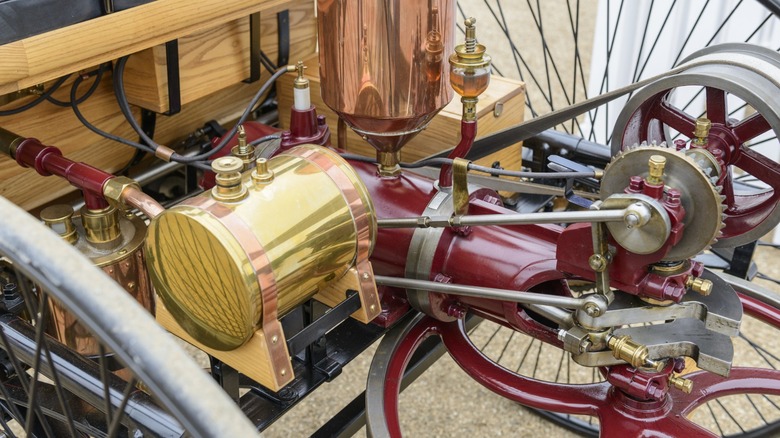
The four-cycle, or Otto cycle, engines that powers today's cars derived from designs attributed to pioneers like Nicholaus Otto, for whom the Otto cycle is named. Otto received a patent for his design, featuring four equal length strokes, in 1887. At that time in history, many others, like Gottlieb Daimler and Wilhelm Maybach were involved with Otto's, and some other designs as well.
While the Otto cycle engine was powerful for its time, it had very low thermal efficiency — the net power an engine produces from the fuel it burns. The heat produced by burning fuel, and its resulting expansion during the combustion cycle is what actually drives the engine. James Atkinson patented his design for a modified-four-stroke engine in 1882. The Atkinson cycle engine had similarities to the Otto cycle, but with higher thermal efficiency. However, it was far less powerful at lower rpm, and too complex to allow worry-free operation at higher speeds.
Both designs have the same four operating strokes — intake, compression, power, and exhaust. The difference is the Atkinson cycle engine employs a complex connecting rod contraption that delivers intake and compression strokes that are shorter than its power and exhaust strokes. Efficiency gains are attributed to the Atkinson cycle's shorter compression wasting less energy trying to achieve optimum compression. The Atkinson cycle engine was never widely used by automakers, but the theory behind its efficiency likely inspired the invention of the Miller cycle engine 70 years later. Mazda used the Miller-cycle engine for a couple of model years starting in 1994.
Instead of the complexities of the variable piston stroke found in the true Atkinson cycle, Miller's design approximated the Atkinson cycle by keeping the intake valve open well into the compression stroke to achieve its efficiency gains. Then Miller added a supercharger to offset the design's inherently low power.
Do cars use Atkinson-cycle engines today?

While today's cars don't use the variable piston stroke length found in Atkinson's original design, many of them advertise Atkinson cycle engines powering their cars. Instead of the original complex connecting rod linkages, modern automakers employ one of several variable valve timing systems (VVT), one of the most effective fuel efficiency technologies ever made, to open or close intake and exhaust valves sooner or later to provide optimum circumstances under various conditions.
Fiat is often credited with patenting the first viable VVT system in the 1960s, but Alfa Romeo gets credit with mass producing the first engine to feature a game-changing variable valve timing system in 1980. Toyota, like many other automakers, often combine Atkinson-style VVT engine designs with battery-electric drive motors in hybrid vehicles, in order to take advantage of the best attributes from both power types. The electric motors provide torque and horsepower when it's needed, and the efficient Atkinson cycle engine charges the battery when it's needed and/or provides propulsion when acceleration isn't a concern.