

How International Harvester Tried (And Failed) To Kill The Diesel Engine
It's no exaggeration to say that diesel engines basically run American commerce. If there's anything heavy that needs to move a long distance, there's a good chance of diesel being involved. But back in the 1960s, many engineers actually believed that they were on borrowed time. The thinking was that diesel engines were too heavy and too finicky — almost too quaint for the burgeoning demands of commerce.
Somehow, the gas turbine emerged as the obvious heir — after all, it spent World War II powering aircraft. And if it could power planes, it could drive heavy trucks too. The military was thinking along the same lines. For instance, the M1 Abrams tank later became one of the most well-known wins of turbine power over diesel.
Most of the trucking industry was sold on the turbine dream. Ford, GM, Mack, Kenworth, Freightliner, and even the Chrysler turbine car program were all onboard. The wave also included International Harvester, one of the biggest names in American trucks and farm equipment at the time. However, its approach was a bit different. While many of the aforementioned companies tried to develop their own turbine, IH actually took a shortcut — it acquired San Diego-based Solar Aircraft Co. in 1960, as reported by The Autopian. Solar had been building gas turbines for stationary and marine applications for decades and had racked up 10 million collective operating hours across its product line. By 1963, it became a full IH subsidiary.
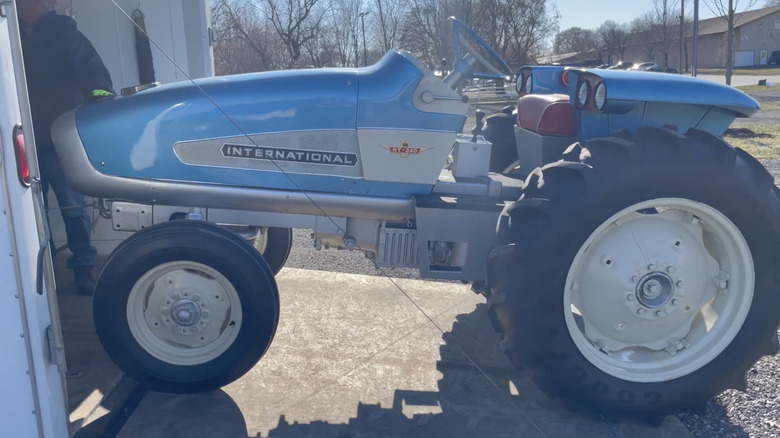
IH's first turbine experiment involved strapping a Solar engine to a farm tractor – the HT-341. While it made plenty of headlines, it wasn't very practical. It was loud, complicated, and drank way too much fuel. IH shelved it by 1967, but it wasn't done with the idea.
The truck of the future that wasn't
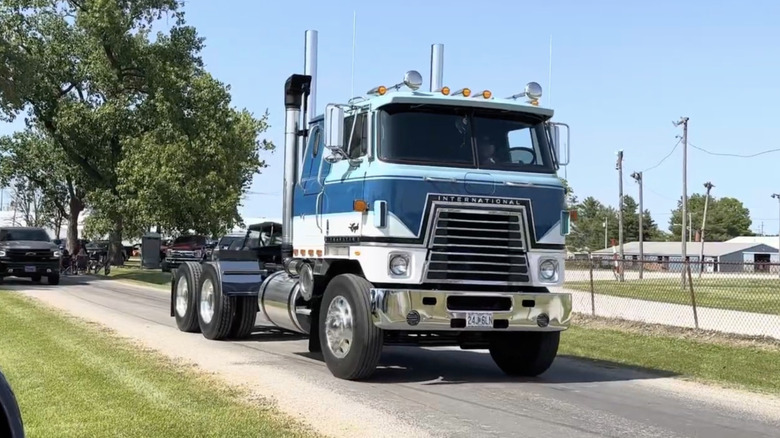
That same year, it decided to mate an actual semi with a turbine. Development on what would become the Turbostar began in 1967, and the truck made its public debut on January 11, 1968. The base for it was a CO-4000 cabover — a 6×4 configuration that IH also sold under the TranStar name. That said, the new turbine version did get a few tweaks. This included a smaller grille opening, a slightly raised ride height, and quad headlights — though there's nothing that would make you do a double-take.
What sat under that cab was interesting, though. Solar's B-series turbine weighed in at around 1,585 pounds, which was just half the mass of a comparable diesel of the period. It made 300 horsepower, spun at 34,000 RPM internally, and stepped that down to 4,000 RPM at the output shaft. A custom recuperator captured waste heat from the exhaust and recycled it to improve fuel economy. IH also dropped the standard 10-speed transmission in favor of a five-speed. Moreover, because the turbine ran cool enough to skip a radiator entirely, that whole cooling system simply didn't exist. IH called it the "Truck of the Future" and told the press turbines would be commercially ready by the early 1970s.
Unfortunately, revolutionary as it was, the turbine truck never really caught on. Diesel engines just continued to improve, getting lighter, cheaper, and more powerful. Truckers, being practical people, just did not see a reason to switch to something unproven. Eventually, IH pulled the plug. As for Solar, well, it actually stuck around. It found a comfortable home in oil field operations — and that business was thriving.