

Which Pressure Washer Hose Type You Should Buy For Best Performance
We may receive a commission on purchases made from links.
Many people spend a whole lot of time researching which pressure washer to buy only to grab whatever hose comes bundled with it. It doesn't matter if you've compared every major pressure washer brand out there — if you skip the hose, you're still leaving performance on the table. That's a mistake, because that hose is the part you're actually holding, dragging around, and wrestling with for the entire job. Knowing what's a good PSI for your pressure washer is also worth figuring out first, since that determines the minimum rating your hose needs.
And once you start actually shopping for one on its own, you'll find three main materials to choose from when it comes to pressure washer hoses. There's rubber, the classic choice; then there's PVC, which is the most budget-friendly option, best suited for lighter tasks; finally, there's polyurethane, which is arguably the best of both worlds. We'll get to the whys in a bit.
Each one of these hose types is built differently on the inside, too. Still, most follow a similar three-layer approach. There's typically an inner tube for water flow, a middle reinforcement layer to handle the pressure, and an outer jacket to protect against wear. But depending on the main material you opted for, those layers can come together in different ways. That's when things start to diverge in terms of weight, flexibility, durability, and price. Below, we'll help you pick the best kind of hose for your needs, while also informing you why there's a winner.
The case for each hose type (and why one wins)
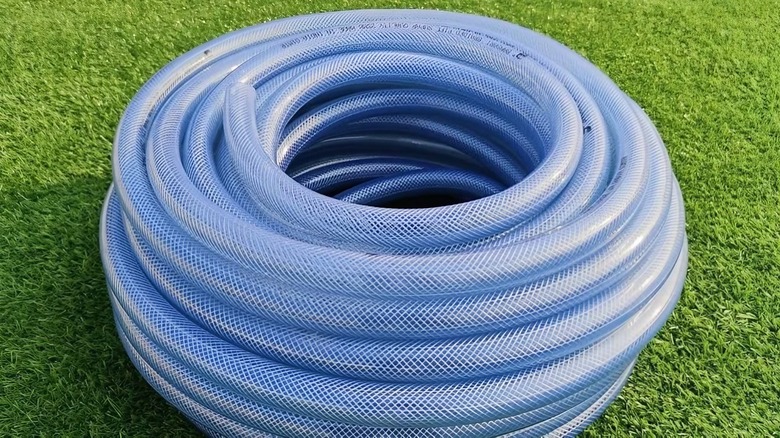
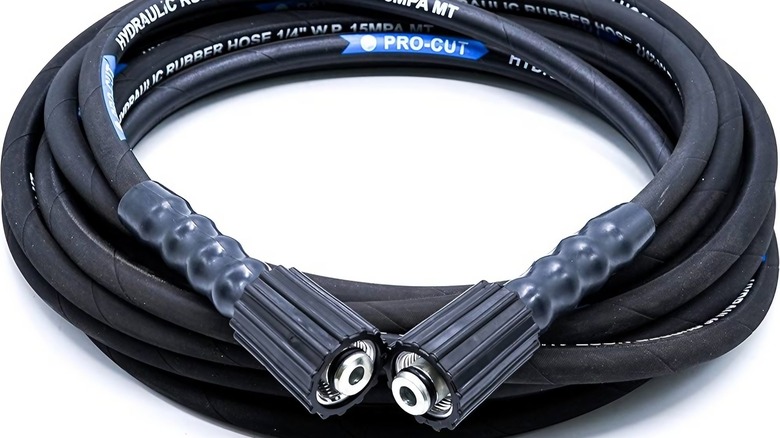
Rubber hoses have been the default for many years, and there's a good reason why. They're flexible even when temperatures drop. They're also quite resistant to abrasions, so they hold up well when dragged across rough surfaces. That toughness is also why rubber tends to ship with the most powerful pressure washers from most major brands. But there are downsides as well. Rubber hoses are noticeably heavier than the alternatives, which matters when you're lugging one around the yard for an hour. They can also leave scuff marks on more delicate surfaces, like a polished garage floor.
Then there are PVC hoses that sit on the opposite end of the spectrum. These are lighter than rubber and run cheaper, though they may not necessarily offer the same durability. Brands like YAMATIC, Westinghouse, and Karcher sell residential PVC hoses in the $25 to $45 range for a standard 50-foot length. That said, these types of hoses tend to need replacing more often. PVC is also stiffer than the other options and can't handle hot water without risking deformation.
Polyurethane is possibly the most interesting option. These are lightweight, just like PVC, but also closer to rubber in terms of durability. Unlike rubber, they're non-marking, meaning no streaks across cleaned surfaces. They stay fairly flexible in cold weather, too. Brands like Giraffe Tools, Flexzilla, and Uberflex by Propulse are popular residential picks. The only real downside is cost — a 50-foot polyurethane hose typically runs $45 to $90, roughly double what you'd pay for PVC. But they also last significantly longer, which may actually help offset that price over time. When you weigh all of that together, polyurethane comes out ahead as the best all-around choice.
Methodology
We looked at this from the perspective of someone who wants the best balance across every factor that actually matters in daily use. Weight was a big consideration, because a hose that wears you out defeats the purpose. Durability was obviously important too because nobody wants to replace their hose twice a year. We also considered surface safety, since marking up the thing you just cleaned is a non-starter for a lot of applications. And finally, we factored in temperature tolerance, flexibility, and long-term cost of ownership. As you can see above, rubber excels in toughness but falls short on weight and marking. PVC wins on pricing but doesn't last as long. Polyurethane consistently scored well across all of these categories, with its added cost justified by its performance.