

What's The Difference Between A Snow Thrower And Snow Blower?
People often use the words snow blower and snow thrower interchangeably. After all, blower and thrower do sound like they do the same thing. But while both are built for the same function, which is clearing snow, they're still pretty distinct in the way they work. Knowing which is which can help you get the right one for your needs.
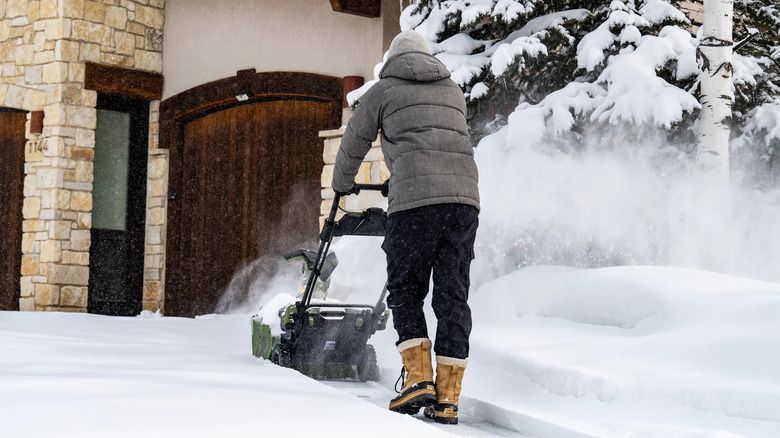
First up is the snow thrower. Its main characteristic is that it's a single-stage machine, meaning it does everything in one motion. Inside it is a spinning auger that grabs snow off the ground and flings it through a chute. The snow lands somewhere between 15 and 25 feet away. Most of these are designed for lighter snowfall so they tend to be on the smaller side, which makes them pretty easy to store. And because of their size, they're well-suited for clearing paths between 11 and 22 inches wide. For juice, while some run on a power cord, others use rechargeable batteries. A handful are also gas-powered.
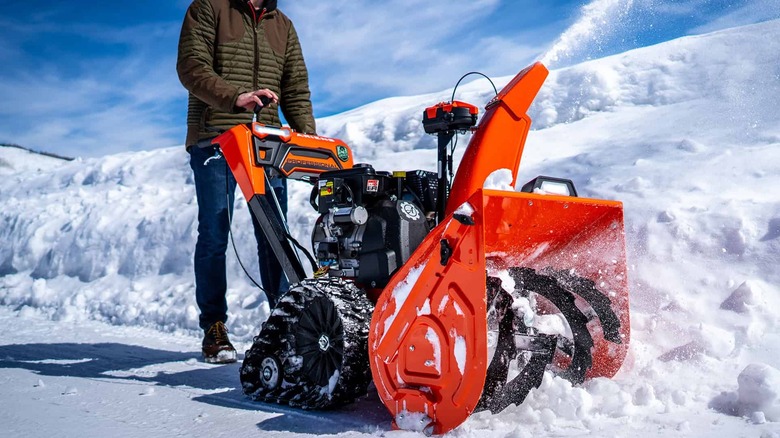
Then we have the bigger and meaner snow blower, which operates in two or three stages. These still use an auger to scoop snow up, except it's paired with an impeller — a fan with a lot more force behind it, capable of launching snow anywhere between 35 and 50 feet away. Three-stage versions exist as well, with an additional accelerator that can chew through compacted snow and ice before blasting it out. They also clear wider paths; while two-stage models typically top out at 26 inches in a single pass, three-stage ones stretch that to 30. Because they are larger, they need more power, running mostly on gas or diesel. Most three-stage blowers are self-propelled, too, so you don't have to muscle them through deep drifts by hand.
How to determine if you need a snow thrower or a snow blower
It's worth noting that even plenty of manufacturers use "snow blower" and "snow thrower" interchangeably, so don't get too hung up trying to figure out which is which. The more important bit you need to pay attention to is whether you're looking at a single-stage unit or one with multiple stages.
As for which type to go for, it all depends on where you live and what you're dealing with. If your area gets light, fluffy snowfall and all you're dealing with is a standard driveway, a snow thrower should do just fine. Those can handle accumulations up to about 8 or 9 inches. They also cost less. Corded electric models start at just $100, though battery-powered ones can top out at around $900. There are actually some solid options if you're looking for the best snow blowers under $1,000.
That's a pretty wide pricing range, but it's still lower on average compared to two-stage blowers. These range from about $600 up to $2,000, while three-stage models can cross $2,500. Of course, pricing also varies depending on the snow blower brand, and not all of them are created equal. But then they're also designed for heavier requirements, like the kind of wet snow that packs down hard. They can also handle drifts of 15 inches or more, thanks to their taller intake openings. The pricier models also get you premium goodies like heated grips, power steering, and even track drives for better grip on icy surfaces. But besides the higher price, these gas-powered models also need more storage space and require engine maintenance like oil checks. Ultimately, the choice really comes down to how much snow you're dealing with.