

Another Navy Ship Is Getting Upgraded To Bring F-35s On Board
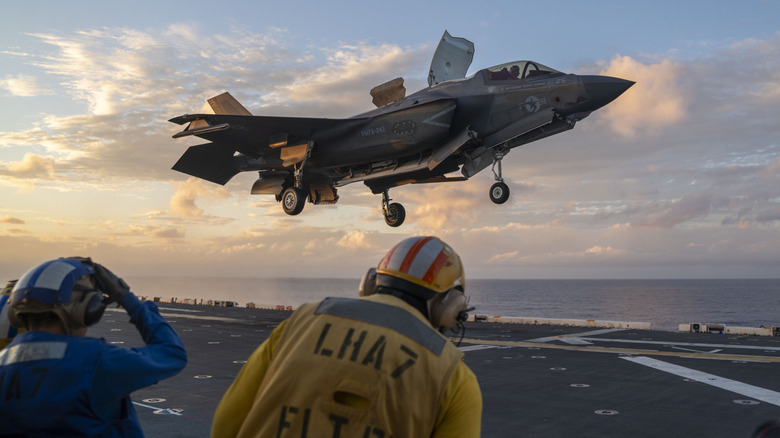
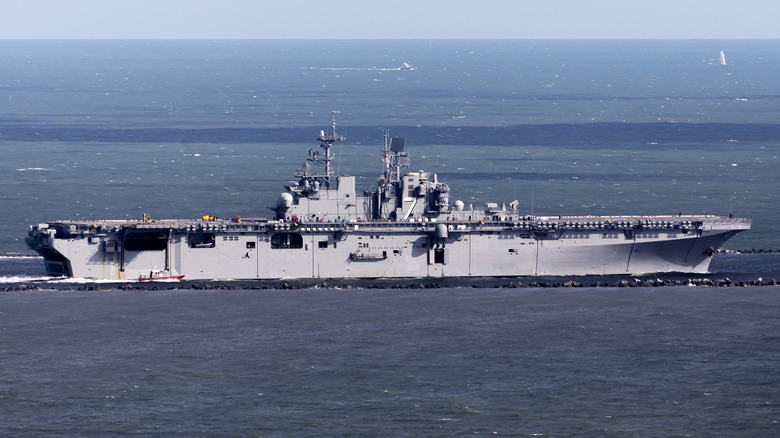
U.S. Navy ships, at least from a distance, appear to be multi-purpose and capable of carrying every type of fighter jet. But the truth is that certain vessels are designed to carry specific planes, and must be upgraded to accommodate other types. This is the case for the USS Iwo Jima, which will be modified to support F-35B operations. The work will be done by BAE Systems, a major defense contractor, which was awarded a $204.1 million contract in February 2026.
This upgrade will modernize the ship's onboard systems to accommodate F-35s. These include updates to the flight deck, which will receive support equipment and other systems to ensure the jets are fully supported during their operations. BAE will perform the work at Norfolk Naval Shipyard in Virginia. Work is scheduled to begin in 2026 and is expected to be completed by early 2028. The initial contract, already a hefty amount, could rise to $255 million by the time the ship is finished.
Classified as an amphibious assault ship, the Iwo Jima isn't the first of its kind to be upgraded for the F-35B, a variant of the original F-35. The USS Essex was modified in 2016 for the F-35B, and the USS Kearsarge's upgrades were completed by early 2026. The USS Boxer has also been upgraded, and the USS Bataan is expected to be finished by the end of 2026. Other amphibious ships, like the USS America, were designed from the start to operate F‑35B aircraft.
Why amphibious assault ships are ideal for F-35 operations
The F-35B, also known as the Lightning II, is a U.S. Marine Corps aircraft and a perfect addition to the U.S. Navy's amphibious assault ships. That's because they're designed with short-takeoff and vertical landing (STOVL) technology. STOVL aircraft, just as their name suggests, can take off and land vertically, instead of horizontally. This means they don't need the amount of runway that traditional jets would need. Since amphibious ships are smaller than aircraft carriers, using them for F-35 operations is a logical move.
Additionally, amphibious assault ships can serve as flexible launching and landing points for the F-35B Lightning II. That's because these jets don't need to operate from airbases, which can give them an operational advantage, depending on the mission. The Lightning II's sensors and radar systems allow for quick threat detection, and crew members can share this data with other ships and nearby bases in real time.
In contrast, aircraft carriers are built to deploy a wide assortment of much larger planes, meant for more extensive missions. But while this means carriers are better equipped than amphibious assault ships, it could actually be too much capability for some operations. Assault vessels are ideal for smaller conflicts, like Operation Odyssey Lightning in 2016, where an amphibious assault ship, the USS Wasp, served as a launchpad for precise strikes against specific ISIS targets in Libya.