

The US Military Is Getting A New Experimental Plane, And It Looks Seriously Cool
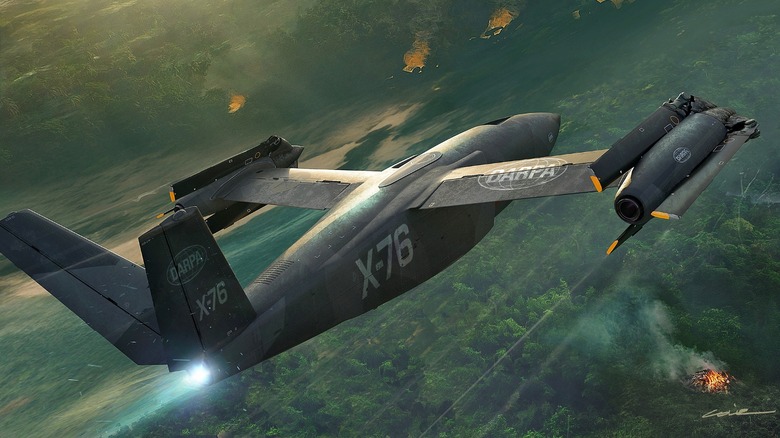
The Defense Advanced Research Projects Agency (DARPA) has long been the source for some of the world's most amazing aircraft, and its newest one is keeping that trend going. On March 9, 2026, DARPA officially unveiled the SPRINT X-76, a proof-of-concept tech demonstration that would take military aircraft into runway-independent high-speed flight. DARPA approached the concept with the idea that one of a battlespace's most difficult problems is weighing the need for high-speed aircraft with the "go-anywhere flexibility of a slower helicopter."
SPRINT stands for "SPeed and Runway INdependent Technologies," which is all about creating a new aircraft that employs jet aircraft speeds with the landing and takeoff versatility of a chopper. While DARPA revealed the X-76 in the form of artist's renderings of what it will look like, it's already being built. Bell Textron Inc., the company responsible, alongside Boeing, for the V-22 Osprey tiltrotor aircraft and several military helicopters, has already begun construction of the prototype. This came after a successful Critical Design Review, which allowed for the official designation of SPRINT as an X-aircraft.
SPRINT is a joint program between DARPA and U.S. Special Operations Command (USSOCOM), aiming to "break the long-standing military trade-off between the high speed of fixed-wing aircraft and the agile, runway-independent operations of vertical takeoff and landing platforms." DARPA calls this aviation's oldest trade-off, and while there are vertical-take-off and landing aircraft, as well as hybrid vehicles like the V-22, the X-76 aims to exceed the capabilities of everything that came before, driving military aviation into the future.
Everything known about the SPRINT X-76
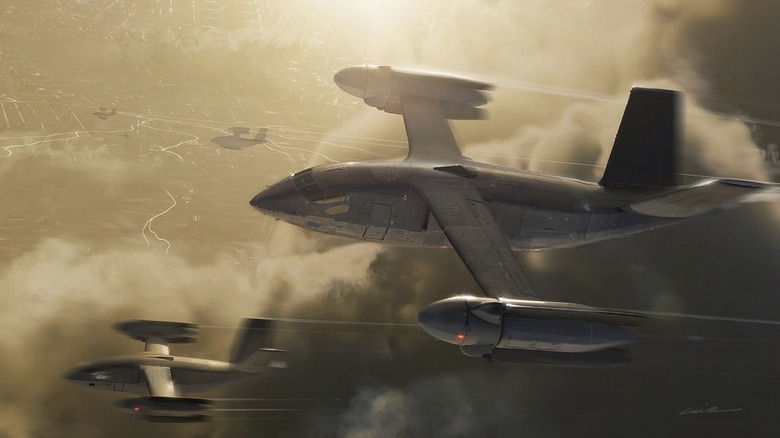
Bell is moving forward with manufacturing and ground testing of the X-76 demonstrator, which could take some time to fully develop. If the aircraft proves its worth, it could be acquired by the Department of War, but these things take time and a lot of money, so it's anyone's guess when an X-76 might receive a proper military designation and join the inventory. Looking past that aspect of military vehicle acquisition, everything DARPA and Bell have released about the X-76 suggests that it doesn't only look cool; it will be a significant force multiplier for SOCOM.
The aircraft is expected to possess the following capabilities: achieve a cruise speed of 460 mph or faster, have the ability to fully hover in austere environments, and operate from unprepared surfaces. For comparison, the relatively expensive Bell Boeing V-22 Osprey has a cruise speed of 276 mph, so the aim of the X-76 is to improve speed by a wide margin over legacy rotor-driven aircraft. DARPA SPRINT program manager, Cmdr. Ian Higgins, said of the X-76:
"For too long, the runway has been both an enabler and a tether, granting speed but creating a critical vulnerability. With SPRINT, we're not just building an X-plane; we're building options. We're working to deliver the option of surprise, the option of rapid reinforcement, and the option of life-saving speed, anywhere on the globe, without needing any runway." Flight testing is expected to begin in early 2028 and could follow Bell's longstanding history of successful X-aircraft programs.