

This Might Be The Worst Way To Mount Your TV
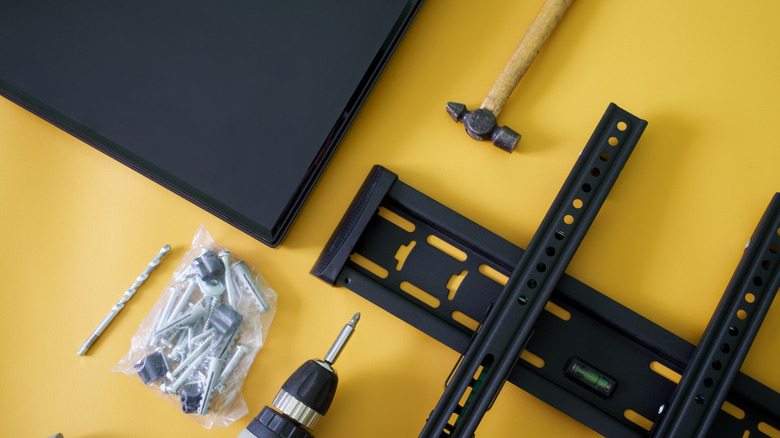
Now that the average TV isn't a massive, heavy behemoth that's as deep as it is tall and wide, it's easier than ever to mount one on a wall. This can be both an aesthetic choice as well as a functional one if you don't have somewhere sturdy to set it down. However, mounting can be done wrong, resulting in a TV that won't stay in the wall and a wall damaged by poor planning. The worst way to mount a TV on the wall involves choosing a spot on your wall that lacks the proper support for it and using hardware that's ill-equipped to keep your TV on the wall securely.
It's easy to make lots of mistakes when mounting a TV, with the two aforementioned missteps combining to create a worst-case scenario. Looking at the wall situation, not taking the time to find a stud to drill the mount hardware into can end disastrously. Studs connect the TV bracket to the frame of the home, providing a secure, lasting grip. Without studs, lone screws won't have a strong hold on the wall and will sooner or later fall right out, thanks to the TV's weight and the power of gravity pulling them past their limits. Thus, a new TV and a wall patching kit will be needed.
Fortunately, avoiding this worst possible TV mounting scenario is not only possible, but easy and affordable. Here's how to mount a TV the right and safe way.
Mounting a TV the right and safe way
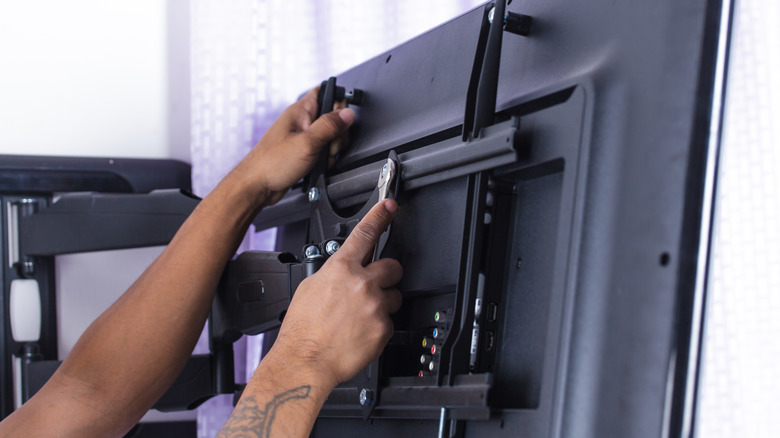
Getting a TV mounted right takes a little time and effort, but it's better to be safe than sorry. The first thing to do is to use a stud finder, which, as the name implies, is a tool that helps locate structural beams behind your walls for mounting. It's worth it to spend on a high-quality, highly-rated unit, this way you know it's finding the center of the stud for maximum strength. Once the studs are spotted, you can mark your mount's drill holes, ensure your marks are level, and drill the screws and mount in. So long as it's the right mount for your TV in terms of size and weight capacity, you shouldn't have any looseness issues to speak of.
At the same time, what if the studs are in some of the worst places to mount a TV? Technically, you don't have to compromise, but you'll need to do some research and additional piece-purchasing. After making note of the weight of the mounting bracket and TV, you need to source screw drywall anchors. These provide the screws something to hold onto in the absence of studs, thus providing a stronger attachment between the mount and the wall. If a regular drywall anchor doesn't feel sufficient, there's the toggle bolt option as well. These are intended to hold much heavier loads, so if you have a bigger TV to mount, this support type is likely the best.
On paper, TV mounting looks fairly simple, but it shouldn't be done without care and planning. The last thing anyone needs is to attempt TV mounting in the wrong spot with the wrong hardware, only to end up with a big cleanup job and an even bigger TV and wall repair bill.