

FL House Passes Noisy Car Ban Bill – Here's What That Could Mean For You
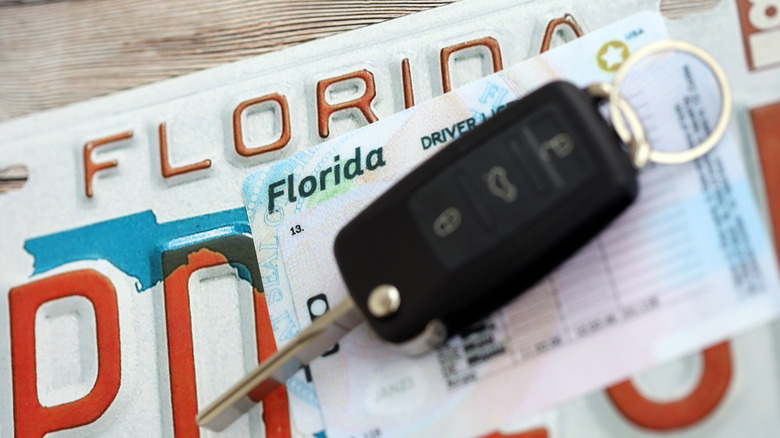
While the increasingly common electric car is impressively quiet thanks to its motor, most cars still feature combustion engines that are quite noisy. Still, most cars on the road aren't considered illegal nuisances due to their noise level. However, some may find themselves on the wrong side of Florida law if new legislation is passed and signed by the governor. According to Florida House Bill 543, Florida drivers aren't allowed to hit their gas pedal in a way that rapidly increases RPMs or accelerate in any way that produces "excessive or unusual noise."
On top of this, Florida drivers must have an exhaust system that is in good working order. This means it's complete, free of leaks, and operates at a reasonable noise level. Florida law currently calls for specific decibel levels to be maintained at specific speeds, though ClickOrlando notes that these proved difficult for police to enforce. Thus, Bill 543 would remove these decibel requirements in favor of a more common sense approach based on revving noise level. The bill also brings several other changes to traffic law, including edited license plate rules, golf cart reclassification, and updated parking guidelines.
This is the latest chapter in the story of Florida's battle against noisy vehicles. The state has previously passed legislation in hopes of reducing excess car sounds of all kinds.
Other vehicle noise guidelines Florida has put in place

This is hardly the first time Florida laws have taken aim at noisy vehicles. For instance, it has been on the books for some time that vehicles in the state aren't allowed any kind of exhaust modifications that dramatically increase noise. The 2025 Florida Statutes specifically name muffler cutouts, bypasses, and add-ons that have a similar noise-amplifying effect as outlawed. As far as punishment for altering the exhaust system goes, a first offense can land drivers a $313 fine, while subsequent offenses bump the amount to $613.
In addition to engine revving and exhaust, Florida has made its stance clear on in-vehicle noise. The aforementioned 2025 statutes outline that sound amplification from a radio, tape, CD, or MP3 player, phone, or other music or audio-producing devices in a motor vehicle have their limits. The audio level shouldn't make the media plainly audible to the surrounding area, specified as 25 feet or more around the vehicle. Also, the vehicle audio shouldn't exceed the driver or passenger's ability to reasonably hear it while the vehicle is in proximity to homes, churches, schools, or hospitals.
Even if you drive one of the best-sounding cars ever made, if it's too loud for the ears of the law, punishment is sure to follow. Florida isn't messing around with its vehicle audio requirements, and if Florida House Bill 543 is signed into law, they're only going to get stricter.