

One Of The US' Most Powerful Supercomputers Is No Longer Operating
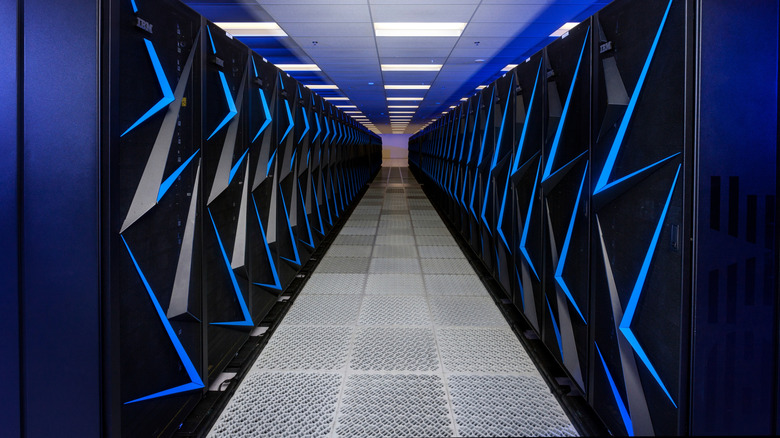
Any computer you own today will probably die an unremarkable death in either a closet or a landfill. But supercomputers are a lot more expensive and tend to go out with a bit more ceremony. Take Sierra, for example. This supercomputer, which once ranked as the second-fastest on the planet, was shut down in October 2025 and subsequently ripped apart at a government lab in California.
Supercomputers are essentially thousands of processors and graphics chips all working in concert inside racks resembling tall cabinets lined up in rows. Sierra had 240 of those racks, with a footprint of approximately 7,000 square feet. Powering it all were a bunch of Power9 CPUs and Nvidia's Volta V100 GPUs, which at peak output could reach 94.64 petaflops. Before disassembly, the Sierra lived at Lawrence Livermore National Laboratory, where it spent roughly seven years running classified nuclear simulations for the National Nuclear Security Administration, the agency responsible for maintaining America's nuclear missiles.
When it debuted in 2018, it was number three on the TOP500 list — the ranking system for the world's most powerful supercomputers. And in its prime, Sierra was quite the hotshot — the same year, it climbed to the second place. The top spot was held by a machine called Summit over at Oak Ridge National Laboratory in Tennessee. Both supercomputers earned HPCwire's Top Supercomputing Achievement award that year, and together they pretty much represented the pinnacle of American high-performance computing. Of course, nothing stays at the top forever. By the time the government decided to pull the plug, Sierra had dropped to 23rd in the global rankings. All in all, the US reportedly spent at least $325 million on Sierra and Summit combined.
Why axe something that was still working okay?
So why shut down something that still technically worked? Well, some of it has got to do with the "bathtub curve," which refers to the process of components failing early due to manufacturing defects, stabilizing for a while, before eventually breaking down again as the hardware ages. Now, Sierra never quite reached that final stage, but it was headed in that direction, according to the lab's associate director for weapons simulation and computing, Rob Neely, who spoke to Wired.
Moreover, neither IBM nor Nvidia still manufactures the specific chips inside it, so if anything broke, it's not like they could've fixed it. On top of that, the specific Red Hat Enterprise Linux build that Sierra ran on had lost IBM support entirely. That said, the biggest factor was that, in 2024, Sierra got its successor in the form of the El Capitan at the same facility. It uses AMD's MI300A chips and can draw up to roughly 35 megawatts of power, over three times Sierra's 11. At 1.809 exaflops, El Capitan is roughly 19 times faster and is currently the world's fastest supercomputer. With that sitting right next door, keeping Sierra running just didn't make financial sense anymore.
With everything pointing in the same direction, it was time for Sierra to go. Now, disposing of old electronics is complicated enough, but since Sierra handled classified nuclear weapons data, the confidential status made things exponentially harder. According to Wired, staff removed lithium-ion batteries by hand, had system boards and processors industrially shredded, and turned flash memory components into powder.