

US Air Force National Guard Worries Grow After Aircraft Removed From Units

At least four United States Air National Guard units are worried as the aging F-16 Fighting Falcon fighter jets assigned to them are being retired with no immediate plans for future replacement aircraft. Aviation Week reports that the affected Air National Guard units are based in Arizona, Colorado, New Jersey, and Texas. Air National Guard units primarily operate under the control of the governor in the state, or U.S. territory, in which they reside. However, the federal government has the option of taking control when the need arises.
Uncertainty is causing concern among Air National Guard and Air Force leadership, as moving any or all four Air National Guard units away from fighting roles to other mission profiles could limit the nation's ability to keep aircraft at the ready.
The first F-16A fighter jets were built in Fort Worth, Texas, by General Dynamics, later acquired by Lockheed Martin, and became operational in January 1979. The F-16C/D Block 25-30 aircraft came online two years later with Block 40-42 F-16C/D fighters following in 1989 and Block 50-52 in 1994. It's normal to retire older aircraft; the average lifespan of the F-35 fighter jet, for example, is 8,000 hours of flight time. The F-16 fleet has an average service life of 17.2 years.
Are all F-16 fighter jet squadrons in jeopardy?
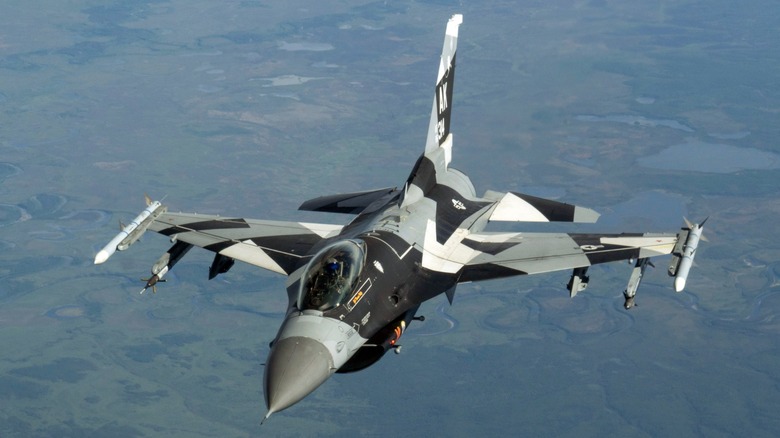
The United States isn't the only country retiring the aging fighter jets; Denmark is retiring its F-16 fleet, too. However, the F-16 Fighting Falcon still has a bright future with the United States Air Force and other militaries around the world.
As of September 2021, the U.S. Air Force reported an inventory of 1,017 F-16C/D fighter jets. That number is in flux due to scheduled retirements and Lockheed Martin continuing to produce F-16s. Lockheed Martin reports deliveries of 37 Block 70-72 aircraft, the newest generation F-16, and a backlog of 111 in queue. Overall, an estimated 2,800 F-16 fighters are operating in 29 different countries with total flight hours approaching 20 million.
An F-16C/D fact sheet provided by the USAF describes the fighter jet's primary function as a multirole fighter flying sorties to "attack airfields, military production facilities, Scud missile sites and a variety of other targets" in the Persian Gulf in support of Operation Desert Storm. More advanced missions followed during Operation Allied Force and post-September 11, 2001, operations such as Noble Eagle, Enduring Freedom, and Iraqi Freedom. More recently, the 2026 Iran conflict has prompted Turkey to deploy six of its F-16 fighter jets to bolster the defense of a Turkish community in northern Cyprus on March 9, 2026.