

What Are The Breather Bolts On Harley-Davidson Motorcycles For?

Harleys are easily one of the most customizable motorcycles you can buy today, thanks to their massive aftermarket ecosystem. One of these options is breather bolts. These are small, CNC-machined aluminum or stainless steel bolts, usually sold in pairs. They replace the factory breather hardware on the engine's air assembly. As for why you'd want to do that, it'd help to know what the stock system is doing in the first place. Every engine produces blow-by gases as leftovers of the combustion process. These leak past the piston rings — and the process is no different on Harleys. And if the gases escape into the atmosphere, they contribute to emissions.
That's why the factory setup on Harleys captures all of that and routes it back into the air cleaner. Along the way, the blow-by passes through one-way umbrella valves and filter screens in the rocker boxes, designed to separate oil mist from the crankcase air. From there, it re-enters the intake to be re-burned. That sounds responsible enough on paper. But the system still has its limits. Blow-by gas isn't just stale exhaust. It's a mixture of unburned fuel, exhaust gases, and oil mist. Over time, oil vapour that makes it past the stock separation can leave a film on intake valves, which can bake into carbon deposits. This buildup can eventually cause engine knock or impede valve sealing. The recirculated gases also displace fresh air and fuel in the intake charge, resulting in less power per stroke.
Breather bolts basically cut all of this out. Rather than looping crankcase air back through the intake, they vent it directly to the atmosphere, filtering debris through tiny built-in mesh screens. The result is a cooler, denser air charge and a combustion chamber that stays significantly cleaner over time.
Easy to install, but there's a big catch
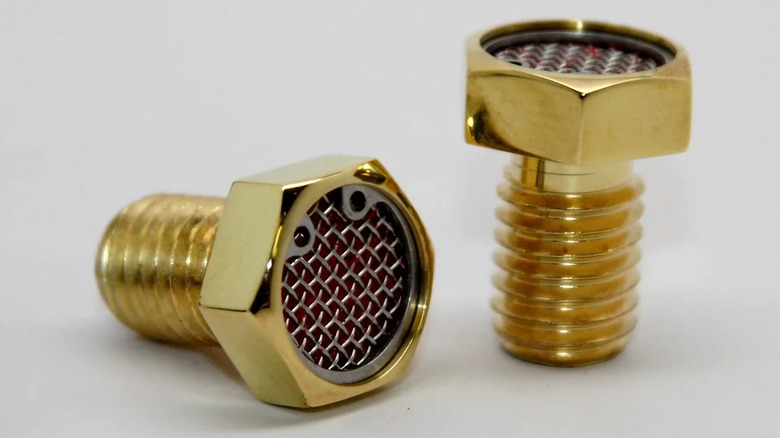
Making breather bolts an attractive option is the fact that they're one of the easier bolt-on modifications you can do. Most kits on the market include everything you need to swap out the hardware: the two bolts, mesh screens, and snap rings. You usually don't even need a retune. Just don't miss out on this one extra step: installing an aftermarket support bracket. That said, this is only necessary if your new air cleaner doesn't include a rigid backing plate of its own (like when installing a minimalist velocity stack).
But there are downsides. Breather bolts vent crankcase air into the open, and that oil mist has to go somewhere. Riders who've run these on long highway stretches at high RPM sometimes report a fine, oily film on nearby surfaces. Wiping all that down from time to time can quickly turn annoying. It may even be a deal-breaker for many. To avoid this nuisance, riders often use catch cans.
Then there is the legal reality, and it's also the exact reason Harleys don't come stock with this setup. Under the U.S. Clean Air Act, it is a federal offense to tamper with or bypass a registered vehicle's factory emissions controls. This includes the crankcase ventilation system. The government takes this seriously; in 2016, the DOJ and EPA hit Harley-Davidson with a $12 million civil penalty over aftermarket "super tuners" that defeated emissions systems. While breather bolts aren't tuners, altering the factory emissions routing means these parts are technically federally illegal for street use. As a result, they're often sold strictly for off-road or show use only, and an aftermarket mod like this could affect your Harley-Davidson's warranty.