

OLED Or LED – Which TV Type Lasts Longer?
While Smartphone manufacturers have conditioned a significant chunk of their consumers to buy into the yearly upgrade cycle, people are more fiscally conservative with TV purchases. It isn't uncommon for the average TV buyer to have their televisions for five years or even an entire decade. Longevity is an important consideration in purchase decisions between OLED and LED TVs, the two dominant TV technologies vying for your wallet.
If you're in the mood to entertain manufacturer's claims, Sony assures us that their OLED TVs are just as durable as their LCD offerings, which also includes LED TVs since these use the same LCD panels with LED backlights. This lines up with the manufacturer's claimed OLED and LCD panel life, which typically range from 30,000 to 50,000 hours, with newer OLED and quantum dot LCD models hitting a claimed 100,000 hours.
You'd be right to take these longevity claims with a pinch of salt because these numbers rarely align with real-world conditions. These longevity claims are based on a narrow definition. That is, based on the display panel brightness diminishing to 50% of its original value. That doesn't include unique failure modes such as burn-in for OLED panels and quantum dot degradation for their QLED counterparts either, which is often a dealbreaker even when the TV isn't technically considered end of life. That's why we are looking at several real-world TV torture tests to understand the finer nuances of TV longevity.
Steer Clear of Edge-Lit LED Televisions
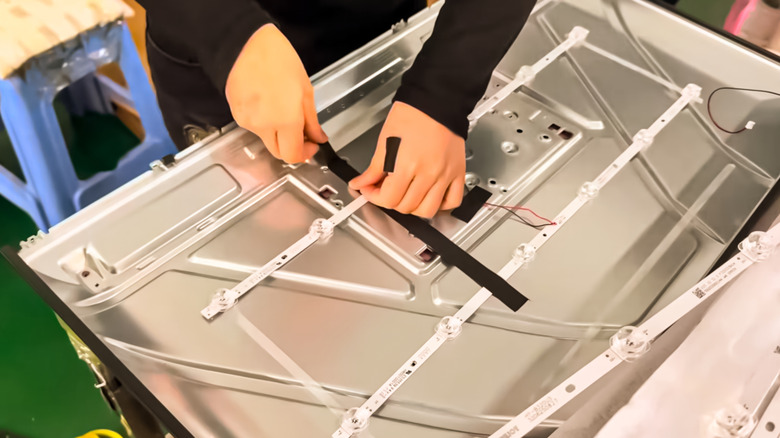
OLED burn-in is no secret, but few are aware of how LED TVs degrade over time. Long-term tests conducted by RTings reveal how this display type exhibits screen uniformity defects at a damning rate of more than 25% in their large sample size of 82 LED-backlit LCD TVs. Over the course of RTings' 10,000-hour TV endurance test, a colossal 64% of edge-lit LED TVs had uniformity issues, whereas those employing direct-lit and full-array local dimming (FALD) backlight technologies fared significantly better at an incidence rate of only 20%.
Worse yet, the edge-lit LED televisions in RTings' endurance test didn't even need the full 10,000 hours to develop visible uniformity defects. A good 40% of those developed the symptoms within 2,200 hours. That's roughly a year's worth of typical TV viewing. Not only does this large-scale TV longevity test reveal that LED TVs are just as susceptible to degradation as their OLED counterparts, but the more expensive LED TVs employing direct-lit and FALD backlighting are expected to last longer.
This disparity is down to simple laws of physics. Whether the TV is edge-lit or not, the backlight must produce roughly the same amount of brightness. Direct-lit or FALD LED TVs are thermally efficient because the total backlight wattage (and consequently the heat generated) is distributed across a large number of LEDs dotting the panel. Edge-lit LED TVs, however, concentrate a lot of heat along a single long edge of the panel. This manifests as overheating that eventually degrades the LEDs enough to affect screen uniformity and even cause outright failure.
Avoid OLED Burn-In With This Simple Trick
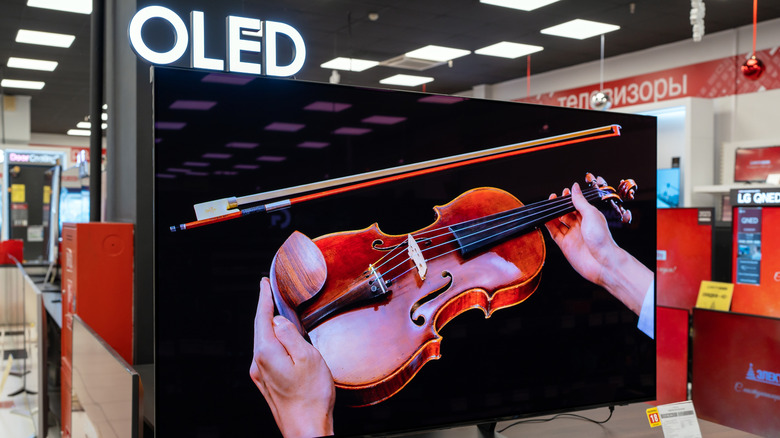
OLED TVs get a bad rap due to the widely publicized burn-in issue, but that's the trade-off for superior color fidelity. Each pixel on an OLED panel is its own light source that can be turned off completely, delivering true, inky black levels. OLED TVs don't have dimming zones because every single one of the eight-odd million pixels (and the sub-pixels too) is a "local dimming zone".
Uniformity issues plaguing LED-backlit TVs are caused by the individual LEDs degrading at slightly different rates over time. LED backlights operate fairly consistently compared to OLED pixels and subpixels, which wear out at different rates. For example, static elements, such as the red CNN news banner on RTings' OLED burn-in tests, caused the red subpixels to wear out substantially. This permanently burned the CNN logo onto the panels over time due to the worn-out red subpixels.
OLED burn-in isn't a huge problem anymore because all recent OLED TVs are equipped with burn-in compensation algorithms like automatic pixel refreshers. These restore screen uniformity by reading and adjusting various parameters like pixel-level transistor voltages. However, the compensation systems are only triggered when the TVs are left in standby mode for a few hours. RTings learned this the hard way when their OLED test samples suffered severe burn-in because their test process left no downtime for the pixel refreshers to run. This was resolved after they tweaked their test schedule to allow the automatic wear levelling systems to kick in.
Your Viewing Habits Should Dictate Your TV Choice
OLED and LED camps quote similar panel lifetimes, but large-scale, real-world longevity tests conducted by the likes of RTings reveal that LED TVs also develop annoying uniformity issues and suffer outright backlight failures in significant numbers. Not surprisingly, the more expensive FALD and direct-lit LED TVs fare much better in this respect.
Speaking of expensive, modern OLED TVs feature burn-in compensation systems that actually work, provided they are kept on standby and given enough downtime for these wear-leveling systems to initiate. High-end OLED TVs also feature integrated heatsinks that further reduce heat-induced degradation. Meanwhile, quantum dot technology is being employed to improve uniformity and reduce wear in both OLED and LED TVs.
Having said that, extended torture tests reveal that even quantum dot layers used in these new TVs have a finite lifespan. And this new technology is also prone to uniformity issues and outright failures. Unsurprisingly, RTings' comprehensive long-term durability test involving OLED and LED TVs ended up in a tie, with no clear winner or loser. Instead, we recommend figuring out if you really need an OLED TV or if a traditional LED TV would better serve your needs.