

What Are Those Little Fins On Jet Engines For?

There are many components that go into a jet engine, from combustors to compressors to those gigantic fans that are a staple of engine design. Many of these things are also found in the engines of other vehicles, but some are pretty specific to jet engines. One of those isn't mechanical at all. It's a small fin placed on the outside of the engine. You can see it from your passenger window if you're overlooking the wing.
These engine fins are called nacelle strakes. A nacelle is the big, round fixture underneath the wing that houses the engines. Strakes are those fins placed on the outside. The reason for these strakes is quite simple: they're there to help minimize airflow separation for the airplane wings, particularly when at lower speeds.
For a plane to take off, the wings need to be working with airflow rather than against it. When you are making a steep climb into the air, you don't want the wing to separate the airflow. Just as with inclement weather, jet streams, and more, airflow separation can cause tremendous turbulence. You need to have an incredibly steep angle of attack to get into the air, which is tough when you're at your lowest speed. Not helping matters is that nacelle itself, which increases the chances of airflow separation at the wing. This is where the nacelle strakes come into play. They act as a vortex generator, pushing airflow to the surface of the wings to reduce the chance of separation as much as possible.
There are many different types of strakes
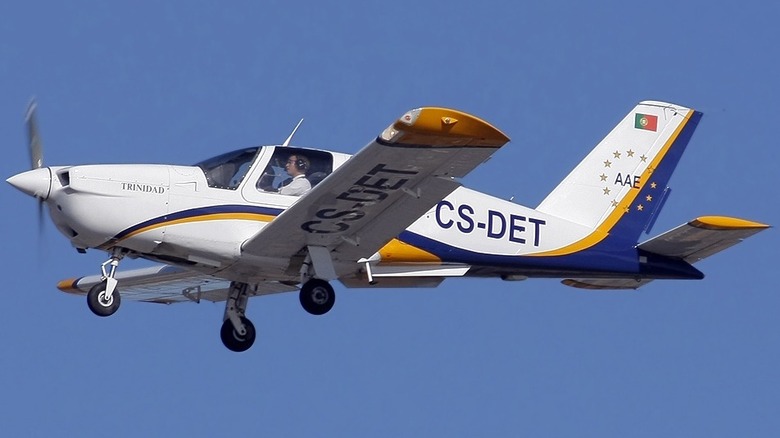
Nacelle strakes aren't a novel concept in aviation. They are simply an extension of the principles of flight that have been around for many, many years. Nacelle strakes are just one of the many different kinds of strakes that can be found on an airplane, whether it has a jet engine or not. All of these strakes serve the same purpose: to improve airflow for specific parts of the aircraft.
Some of the most common strakes are Leading Edge Extensions, or LEXs. The leading edge of a plane is the front of a wing, and a LEX is an appendage affixed to that front, either permanently fixed or adjustable by the pilot. There are several different types of LEXs, such as a dogtooth or cuff, and each of them has a specific purpose. For instance, dogtooth LEXs help with lift and reducing stalling.
Another type of strake is a ventral strake. These are long blades on the underside of an airplane, either on the rear fuselage or the tail. Ventral strakes are incredibly important, especially for smaller aircraft, as they help improve the lateral stability of the plane. Nobody wants the plane they're in to be rocking back and forth, and redirecting that airflow with these strakes helps reduce that possibility. Strakes can also be found at the nose of the plane for airflow manipulation towards the front of the fuselage. You can also see strakes on the tail, some of which can reduce the chance of your aircraft spinning. Flight is all about controlling airflow. Strakes are an excellent tool for doing just that.