

Apple's First Touchscreen MacBook Could Redeem Liquid Glass
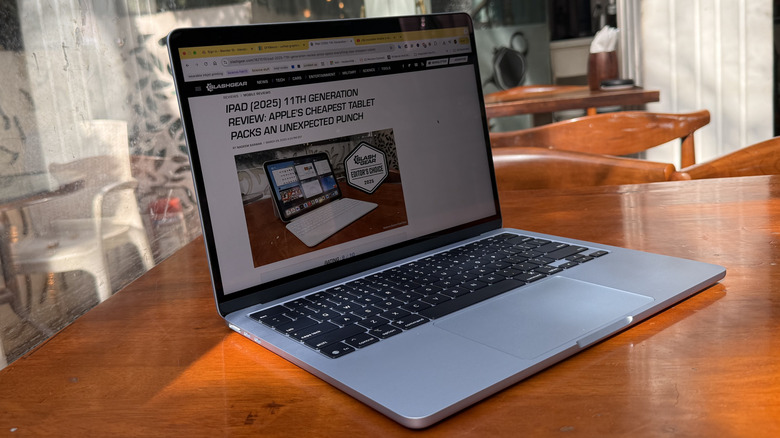
Apple has cultivated a reputation for its meticulous attention to detail, both in software design and hardware polish. But not all the big swings taken by the company have quite landed as the company had expected. Over a decade ago, Scott Forstall was famously fired from Apple following a disastrous Apple Maps launch. In 2025, Apple divided opinions with its ecosystem-wide Liquid Glass design. The new design language, inspired by the clarity of glass and motion of liquid, was criticized for inconsistencies and legibility problems, forcing the company to make multiple changes and eventually offer dedicated controls to minimize the glass effect on the UI.
But it seems the whole Liquid Glass makeover was an exercise that preps the Apple hardware for the future, especially for the MacBook and its highly-anticipated OLED refresh with a touchscreen display. According to Bloomberg, Apple's overhauled MacBook Pro should arrive towards the end of 2027, rocking a touch-sensitive panel with an iPhone-inspired Dynamic Island cutout at the top. Now, there are two ways to look at it. The ugly and mostly unused notch is going away. Its place will be taken by a pill-shaped camera cutout that will now become interactive, expanding to show activity progress and offering a whole host of functionalities woven around it.
If you take a look at the Mac developer community, there are plenty of apps out there that have turned the notch into a calendar hub, a playback zone, a clipboard slot, and a lot more. But fundamentally, you can only do so much with a mouse click or trackpad. Imagine the level of interactivity that can be baked into it if it supports long and short finger presses or swipe-based gestures, similar to widget stacking. Both these ideas have been implemented on iPhones and iPads already.
It's already here in spirit
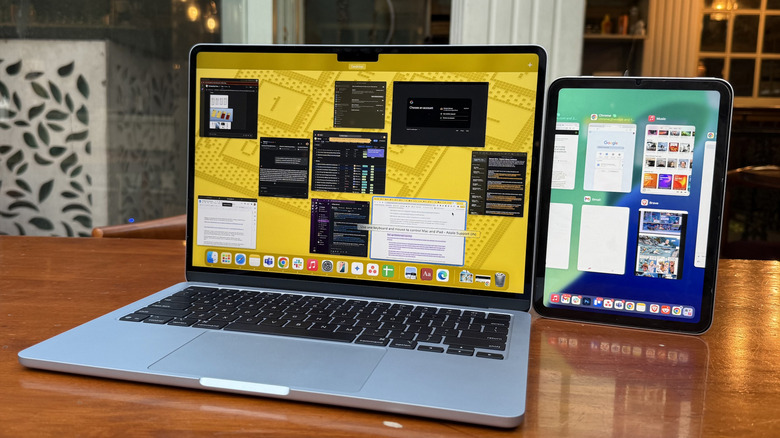
A touch-sensitive screen on MacBooks is going to be a lot more than just a showcase of Dynamic Island interactions. And it seems the Liquid Glass design was merely a preparatory phase in gradually shifting macOS away from a vanilla keyboard and mouse input to a hybrid format. "The update includes more padding around some icons and notifications, as well as sliders in the control center menu that look optimized for touch," reports Bloomberg. I've repeatedly felt this in my own time spent across Apple's laptops and tablets.
I use my iPad Pro nearly as much as my trusty Apple laptop, and I prefer the Liquid Glass look on it far more than the MacBook Air, and it's not just because the tablet has a better OLED screen. The mix of touch and keyboard-based inputs actually feels more productive, especially when I am editing design assets for my sister's garments website or editing videos. In iPadOS 26, Apple actually ported plenty of macOS elements, such as the Menu Bar, and they feel pretty much at home on the iPad.
That's not a coincidence. Apple will likely never let the iPad dual-boot macOS, but the recent makeover of its design with desktop-grade utilities such as Stage Manager is a clear sign that Apple is using the increasingly computer-like iPad (Air and Pro) as a testbed for transitioning macOS to a touch-friendly operating system. Just take a look at the pro-grade apps that have recently landed on the iPad, including Apple's Creator Studio bundle in 2026, to see how well they integrate traditional keyboard and touch-based inputs. I strongly believe there won't be a functional shock or learning curve when Macs become touchscreen-friendly. On the contrary, it will be a redemption for Liquid Glass.