

The Clever Reason Why The US Navy Still Uses Ships With Wooden Hulls
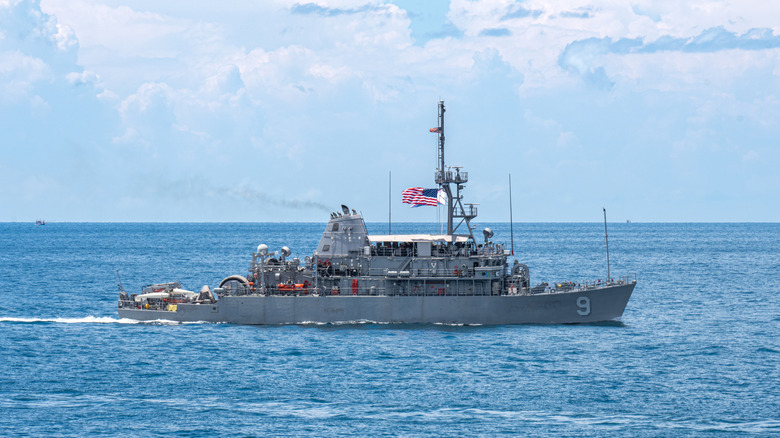
Superiority at sea has long been important for peace-keeping nations to maintain global peace, and despite problematic glitches in certain programs, technological advances have, at least from a practical standpoint, helped make keeping the peace a touch less perilous. Despite the clear advantages technology has given groups like the U.S. Navy, even it still employs a few old-school tricks in helping to maintain tactical superiority at sea. And yes, that includes the use of military vessels manufactured with wooden hulls.
In this day and technological age, it's pretty hard to believe that there are still military-grade vessels patrolling the waters of the world that utilize the same material in their make-up as those piloted by vikings. But those ships have indeed been in use since the 1980s. And even as the number of Avenger Class vessels on active duty is dwindling, a few are still in use by the U.S. Navy today. Those wood-hulled ships have long-served a vital and hyper-specific role for the Naval Fleet, operating almost exclusively as minesweeping hunter-killers.
There's a very clever reason the U.S. Navy has employed wood-hulled ships in that particular capacity over the past few decades, as they provide a tactical advantage over those that use steel and other metals. More specifically, the wooden construct allows the vessels to more efficiently avoid mines at sea, as many of those explosives are less likely to be attracted to their wooden components. Here's why that's the case.
Here's how the wood-hulled Avenger Class ships came to be
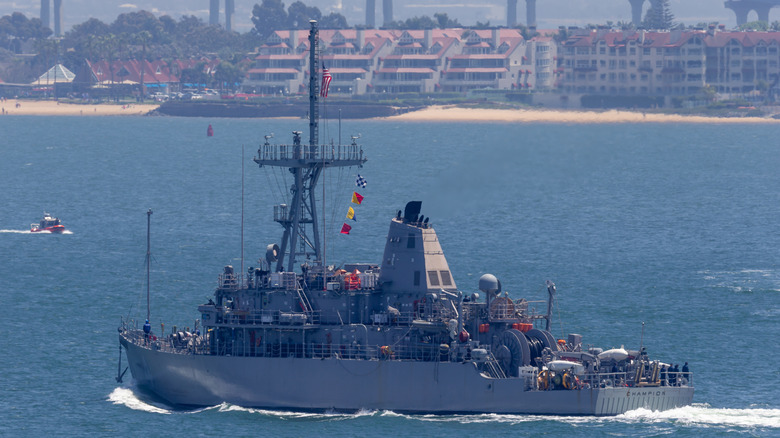
In short, navies who utilize naval mines have long employed the practice of magnetizing the explosive devices. The British military first developed contact magnetic mines in 1919 that required a collision to detonate. However, during World War I, German forces took up the mantle and designed a range of particularly deadly magnetic mines that were detonated by the mere presence of a ship's magnetic field.
Initially, the process of degaussing ships — as one might do to a hard drive — proved among the most efficient ways to keep them safe, as it essentially removed the presence of a magnetic field. That approach continued to be popular for several decades. But in the 1980s, some countries got even smarter and decided to simply limit the presence of magnetic metals in the construction of ships meant for heavy usage in waters where naval mines were present. Thus, Avenger Class vessels with their wooden hulls and fiberglass coatings were born.
In the decades since, Avenger Class sonar-equipped ships have served as one of the U.S. Navy's first lines of defense in the battle against magnetic naval mines. They've likely saved thousands of lives in the process. But as we noted, their numbers are dwindling in the U.S. Naval fleet, with a reported four Avenger Class minesweepers still on active duty and operating solely out of Japanese ports. But the days are numbered for even those vessels, with the U.S. slated to decommission them in 2026. And yes, as you've likely surmised, Avenger Class ships are being replaced by sweepers outfitted with all manner of high-tech mine-detecting/busting abilities.