

The Fatal Flaw That Killed The US Army's XM803 Prototype Tank
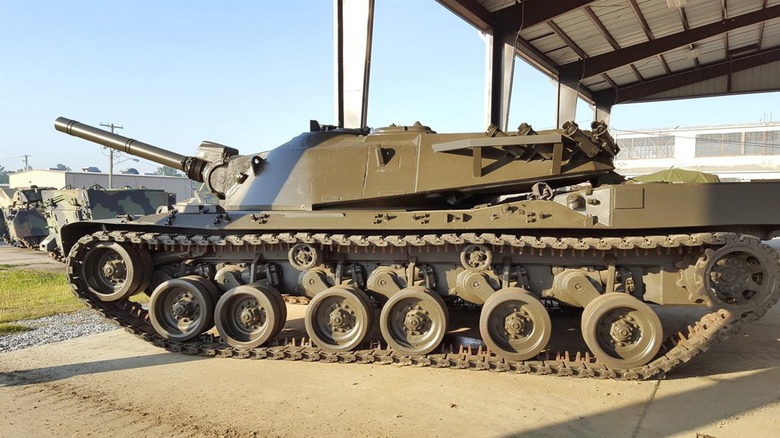
During the 1960s, the United States and West Germany joined together to develop a new main battle tank dubbed the MBT-70. The idea was to develop new platform that could counter the threat posed by those produced in the Soviet Union, which required several advancements in armament, armor, turret design, and suspension. Ultimately, the U.S. and West Germany differed over design philosophy, the choice to use metric v. imperial measurements, and other requirements, all as costs skyrocketed. The MBT-70 project ended in 1969 when West Germany backed out with only around a dozen prototypes built.
Despite this, the U.S. continued developing a new tank, which spun off as the XM803. Instead of a joint project using components from both nations, the vehicle was intended to use only those made in the United States. Development began shortly after West Germany withdrew from the original agreement, though it too was canceled due to a fatal flaw that often befalls military projects: money. Essentially, the cost of producing the tank that was designed over the project's two-year period didn't meet budgetary intentions.
Congress hoped to save around $200,000 per vehicle over the cost of the Army's existing M60 MBT, but this wasn't possible as the program continued. Resultantly, the XM803 was scrapped. All wasn't lost when the military decided to abandon the project, however; elements of both the XM803 and MBT-70 were incorporated into the designs of the legendary M1 Abrams MBT as well as Germany's impressive Leopard 2 MBT. Only one XM803 was constructed from one of the MBT-70 prototypes, and it is held in the U.S. Army Armor & Cavalry Collection at Fort Knox, Kentucky.
The XM803 — the failed tank that led to the M1 Abrams
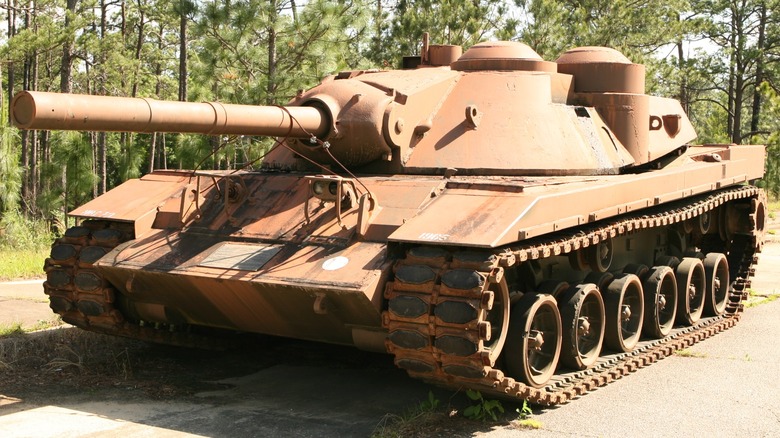
When the U.S. began working on its new design, General Motors, the contractor behind the XM803's development, took the initial plans for the MBT-70 and focused on cost-cutting. In terms of specifications, the tank weighed in at 57 tons with a top speed of around 40 mph on a paved level surface, or 14 mph on a 10% grade. It was outfitted with an XM150E6 152 mm gun that was capable of also launching MGM/MTM-51C Shillelagh missiles at a maximum range of 5,200 meters (17,060 feet).
It featured an autoloader capable of holding 24 rounds, which it could fire at approximately eight rounds per minute. It also featured an M85 heavy machine gun mounted on top alongside a remote-controlled General Electric M73 machine gun. Costs skyrocketed as development continued, outpacing the budgetary constraints laid out by Congress. While several changes were made to try to reduce the overall expense of the tank, these measures weren't successful. Instead, Congress allocated money to the XM-1 design project instead.
The new project received $20 million in funding. Once it was completed, it resulted in the M1 Abrams MBT, built by General Dynamics. Development of the M1 took several years, and the first tank wasn't fielded into the inventory until February 1980. The design of the Abrams series of MBTs was more heavily influenced by the MBT-70 than it was by its XM803 project, but it was the cancellation of the latter that ultimately funded the program that resulted in the M1 Abrams, one of the most battle-tested and proven tanks of the late 20th century.