

USS Enterprise: How Many Fighter Jets Can The Newest Aircraft Carrier Hold?
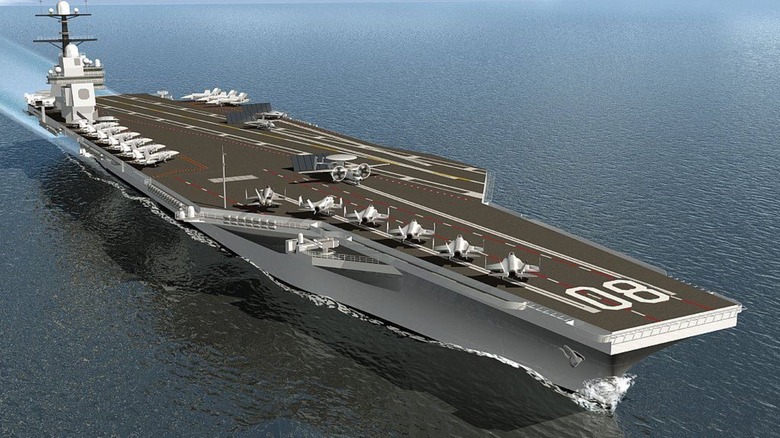
While there are many United States warships, those that are likely the best known are called "Enterprise." The U.S. Navy has been commissioning ships with that name since the first Enterprise defended American supply routes from the British in May 1775. The trend continues with the new USS Enterprise (CVN-80), the third Gerald R. Ford-class nuclear-powered aircraft carrier and the eighth ship to be thus named. The USS Enterprise was expected to launch in 2025, but it was delayed and is now expected to launch in 2030.
Because of the ship's name and the fact that Gerald R. Ford-class aircraft carriers are the largest warships ever constructed, there's a great deal of public fascination surrounding it. The aircraft carrier is massive, and once it launches, The Enterprise will be able to carry a variety of aircraft, including fighter jets, helicopters, and various drones. In terms of combat aircraft capacity, the Enterprise should be able to accommodate between 70 and 90 aircraft, but this depends on a variety of factors, including the type of fighter jets it employs.
The USS Gerald R. Ford (CVN-78) carries 75 aircraft, operated by the Carrier Air Wing Eight . It consists of three squadrons of F/A-18E Super Hornets. These are being replaced over time as more F-35C Lightning IIs (the U.S. Navy carrier variant) are brought onboard. Because the Enterprise is the same model and because it won't be ready until 2030, it's likely that its Carrier Air Wing will consist of the same number of squadrons, though with more F-35Cs than its predecessors.
The aircraft of the USS Enterprise (CVN-80)
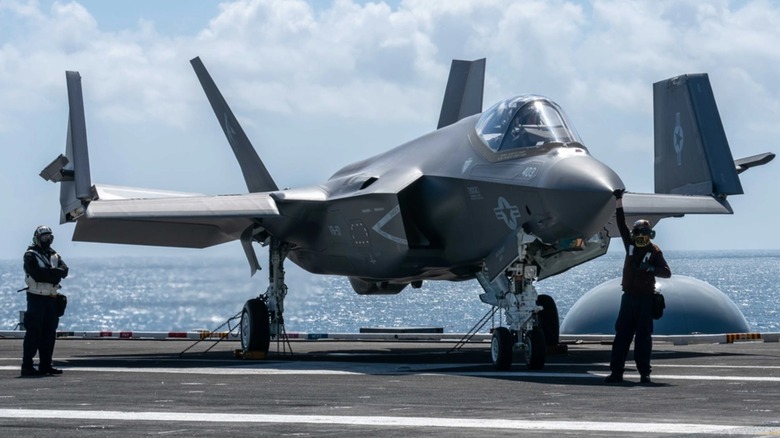
The number of fighter jets that a U.S. aircraft carrier can hold is dependent on several factors. Nimitz-class carriers, which are being replaced by Gerald R. Ford-class ships, carry around 56 fighter jets and other aircraft. The USS Enterprise will likely have the capacity to hold 90 aircraft, though not all of them will be fighter jets. In addition to the F-35C, the Enterprise could also be home to several F/A-18A/C and F/A-18E/F Super Hornets, which are highly capable multirole fighters employed throughout the U.S. Navy's 11 active aircraft carriers.
When the USS Gerald R. Ford was launched, it paved the way for the vessels that followed, but there were issues with several of its systems. The lessons learned from the Ford helped guide changes to the Enterprise's design, accommodating the F-35C and its upgraded Enterprise Air Surveillance Radar. As a result, the two ships are different in some aspects, though they're fundamentally similar. The F-35C differs from the A and B models, as it's designed to utilize the Enterprise's Catapult-Assisted Take-Off Barrier-Arrested Recovery (CATOBAR) system.
The F-35C features larger wings with foldable wingtips. This makes it possible for the Enterprise to hold more F-35Cs than other models, as foldable wingtips allow for a smaller storage footprint. While the U.S. Navy isn't in the habit of detailing the specifics of its Carrier Air Wing composition and capacities, given the size and attributes of the USS Enterprise and the F-35C, it will likely carry a minimum of 75 fighter jets. Some estimates indicate the number could be as high as 90, but this is unlikely, as room must be made for non-combat aircraft as well.