

Sony's New WF-1000XM6 Earbuds Put Fantastic Sound In A Frustrating Package
We may receive a commission on purchases made from links.
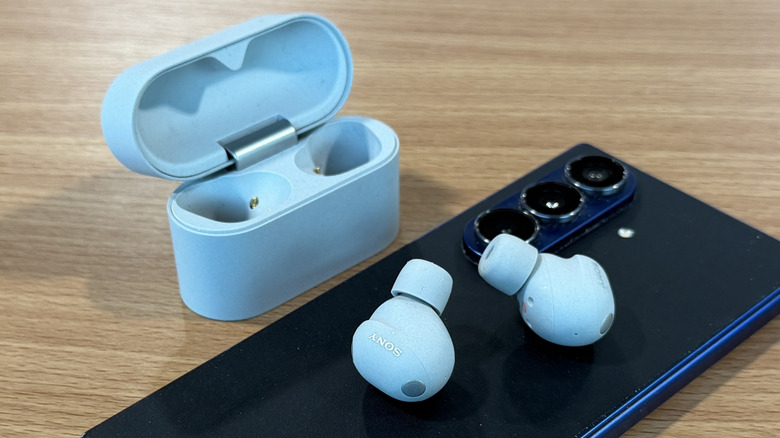
Of all the earbuds I've tested in my career — and there have been a lot — Sony's always hold a special place in my heart. The Sony WF-1000XM6 earbuds are among the best you can buy in personal audio. Nearby competitors include the Bose QC Ultra 2 earbuds and the Apple AirPods Pro 3. The XM6 earbuds can stand toe-to-toe with either of those brands in many ways, and that's great.
But Sony also has a few things it still needs to work out. In this day and age, great sound is one thing, but putting together the whole package remains a challenge for the audio company. The issues I have aren't major, but when the buds command as high a price as these do, compromise can't be taken lightly. It's the 6th generation of this series and, to be frank, these things should've been worked out by now.
Nonetheless, these buds are still class leading in the same fields, so in many ways they're the buds to beat. I've been using a pair of Sony WF1000XM6 earbuds provided by Sony for about 10 days.
Growing hardware
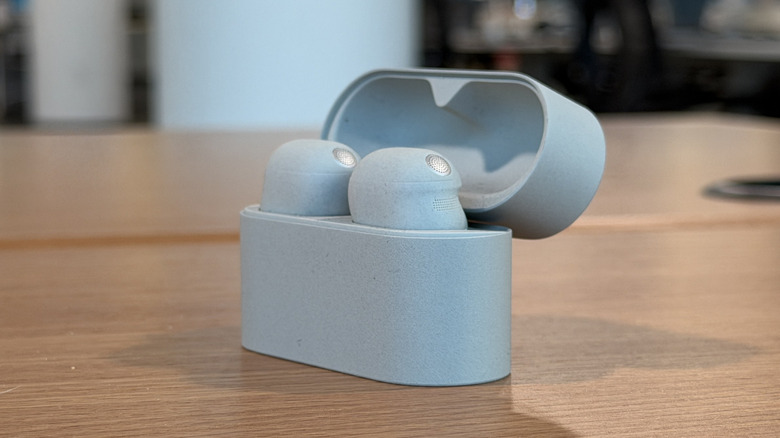
One of the more notable differences between the XM6 earbuds and their XM5 predecessors is the size — and not in a good way. Both the earbuds and their case got noticeably bigger. That wouldn't be a problem except the expected tradeoff for an increase in size — better battery life — is not there. Both generations of earbuds have similar battery life: eight hours for the XM6 with active noise cancellation on, and 24 hours total with the case.
The XM6 earbuds have more microphones and redesigned driver units, which is cool, but not only are the earbuds and the case chonkier, but the case has sharper angles to it as well. That makes it annoying to carry in my pants pocket: the previous-generation XM5s had a slimmer, shorter, and more rounded-profile case, which slipped into a pocket easily and didn't dig into your knee while walking around. It seems like a minor design change, but it's definitely a minus in my book.
Sony also stuck with foam ear tips, which I think is a good move overall. Most earbuds opt for a silicone ear tip to help form a good seal with the ear canal. Foam can do that, but silicone feels more secure overall. However, silicone can also irritate the ear canal making your ears itch. I haven't had that problem with Sony earbuds of late, which is a big win.
Speaking of foam
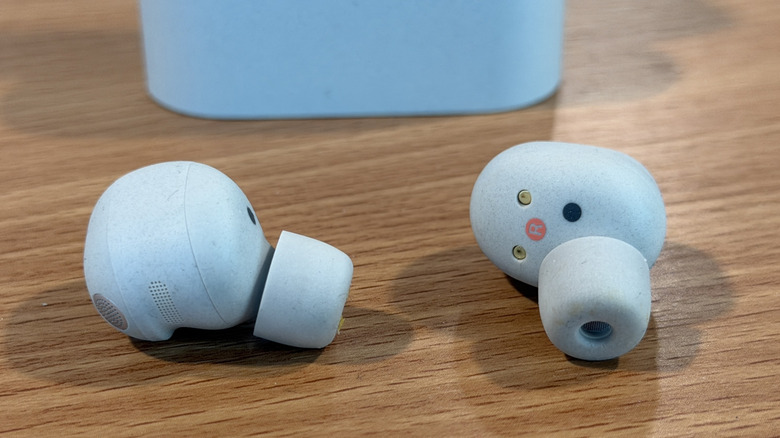
The main attributes by which all earbuds are judged are comfort and sound, of course, and foam helps with both. From a comfort standpoint, these earbuds are lovely. Long-term listening sessions are great: there's no itching in the ear canal, nor do they cause fatigue over the long term. I generally don't have marathon listening sessions, but I tested these for a few hours at a time while working, and I never minded wearing them in the slightest.
Sony's choice of foam also helps form a better seal in your ear canal than silicone-using rivals, at least in my opinion. Since foam can be squished and will expand back into its original shape, it can fit your ear canal better than silicone. How much of a real difference this makes in terms of sound is up for debate, of course. This is more of a personal preference.
Cone of silence
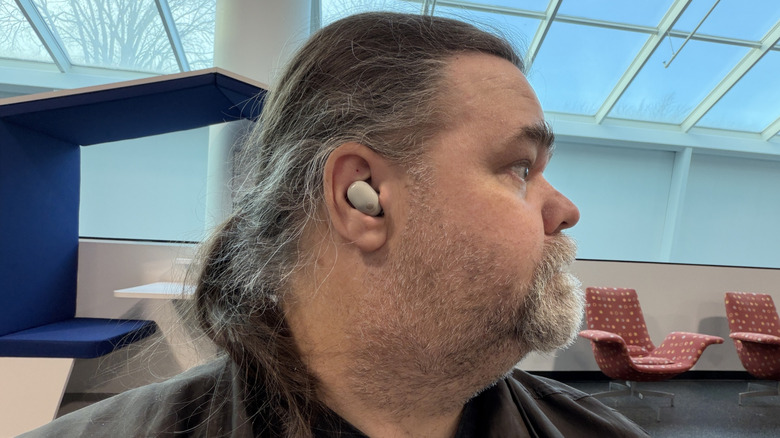
Up until now, Bose's Quiet Comfort Ultra earbuds have held my personal crown for the best active noise cancellation (ANC) you can buy in a pair of earbuds, with the AirPods 3 Pro being a very close second. Well, Sony has entered the chat. The ANC that these earbuds are capable of is right in the middle of the conversation as well. It's hard to definitively declare who is doing the best job here; airplanes are usually my go-to for determining the best ANC, but my travel plans didn't line up with the testing period here.
In day-to-day life, though, the XM6 are impressive in their ability to eliminate noise around you. That includes both droning sounds — like of a car engine — but also sudden noises, like people talking to you. The latter is by far the hardest to eliminate, and these buds do that as well as either of the other two options. It's a big step for Sony; you used to have to be content with amazing sound and ANC that was good, but not great, and that's no longer the case.
The earbuds still have a decent amount of side-tone to them, the amount of your own voice that reverberates in your head when you're wearing headphones or earbuds. Bose still does a better job in that regard. But these still aren't bad at all.
Exquisite sound
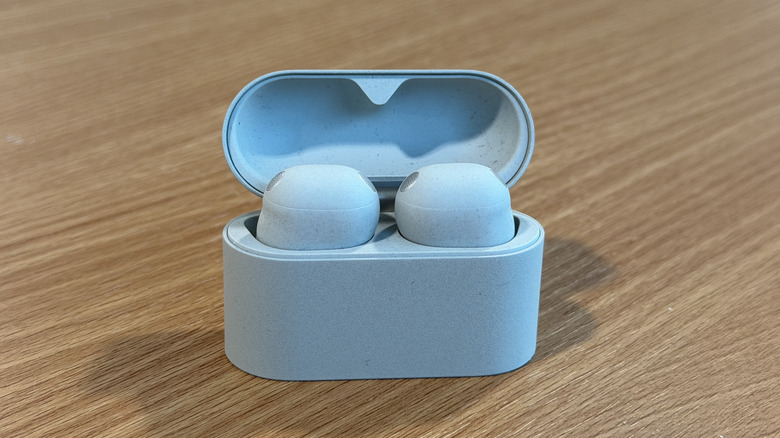
These earbuds sound really great. The XM6 have newly redesigned drivers tuned by grammy winning musicians, which is promising, and overall they're capable of nuance that I don't normally hear in my earbuds. That's saying something because my ears are also damaged from a misspent youth in a metal band.
Picking out individual tones that I simply don't hear with other earbuds is a remarkable experience. I mostly listen to podcasts, and these earbuds are a particular kind of overkill for that listening experience. But, while I was working, I took in music for several hours at a stretch, including the likes of Scorpions' "Alien Nation", Lindsey Stirling's "Roundtable Rival", and Ozzy Osbourne's "No More Tears" among others. From the deepest bass line to the highest violin, the XM6 manage a lovely range of tones throughout the spectrum.
The earbuds ship with a pretty flat equalizer, as they should. You have your choice of five different presets for the 10-band equalizer, and you can have up to three other custom EQs. I didn't need to tweak the EQ too much to find my sweet spot. The buds just have remarkable sound without having to adjust settings in that regard, but that brings us to arguably the biggest downside in the Sony earbud experience.
Sony's software is not great
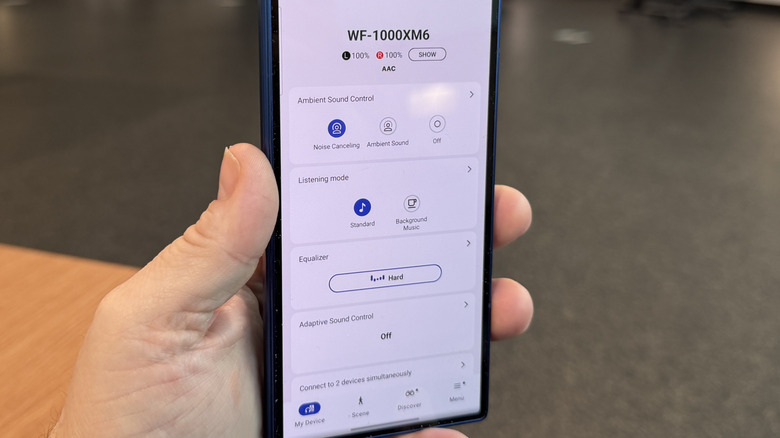
A while back, Sony shipped Sound Connect in an effort to consolidate its various apps into one experience. It should've taken the opportunity to revamp its software at the same time. My biggest gripe is how you take these earbuds that are amazing in just about every way, and nerf them by compromising the controls.
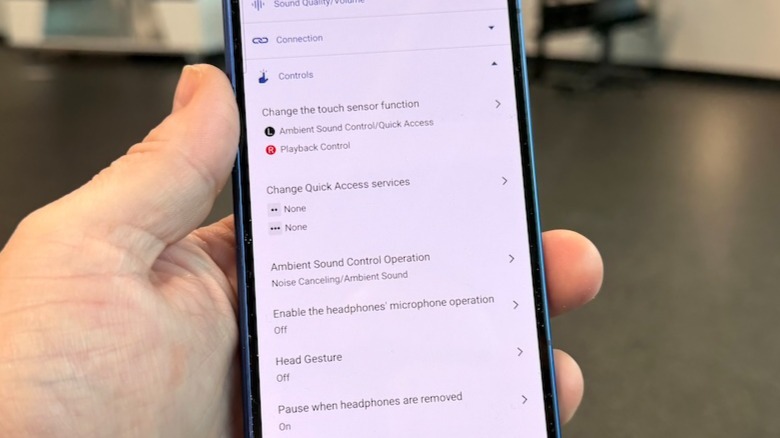
Within Sound Connect, you can adjust what touch controls do on each earbud, but you can only cycle through three preset options for the earbuds: one tap activates ANC, two taps skips to the next song, and three taps goes back, for example. That's mostly the extent of the customization, with one exception.
 Adam Doud/SlashGear
Two or three taps of an earbud can optionally launch a music service of your choice, with what Sony calls "Quick access services". You can have two taps launch YouTube music, for example, while three taps launch Spotify. That's it, the full extent of the customizations Sony's flagship earbuds offer.
Even before Sound Connect, this was a pain point in Sony's earbuds. There's really no reason why you shouldn't be able to configure your earbuds for whatever you want; if I want to play my music with a single tap, adjust volume with two taps, and summon my assistant with three taps, that's my business. All Sony's doing here is limiting options and it's arguably the one thing that sours the listening experience.
Sony WF-1000XM6 earbuds verdict
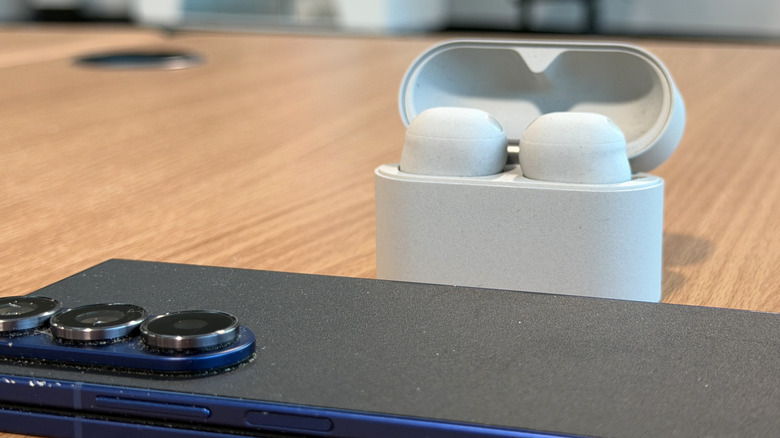
The Sony WF-1000XM6 earbuds are priced at $329. That's more than the AirPods Pro at $249, and even Bose's $299 QC Ultra 2 earbuds. Is it a fair price? That's arguable. Sony's sound performance is better than either of those rivals, but Apple in particular makes a strong argument with extras like hearing aid functionality.
All that being said, there's a reason why an update to Sony's WF-1000 series is something I look forward to year after year. For 2026, there were some noticeable steps back in terms of design, yet when it comes to sound quality these are still the earbuds to beat. You just enjoy a fuller sound than you get with any other mainstream set of earbuds. True, there are audiophile earbuds out there that might get you more nuance and detail, but if you want the best sound you can buy in this price range, there really isn't competition.