

Are Portable Jump Starters As Good As Traditional Jumper Cables?
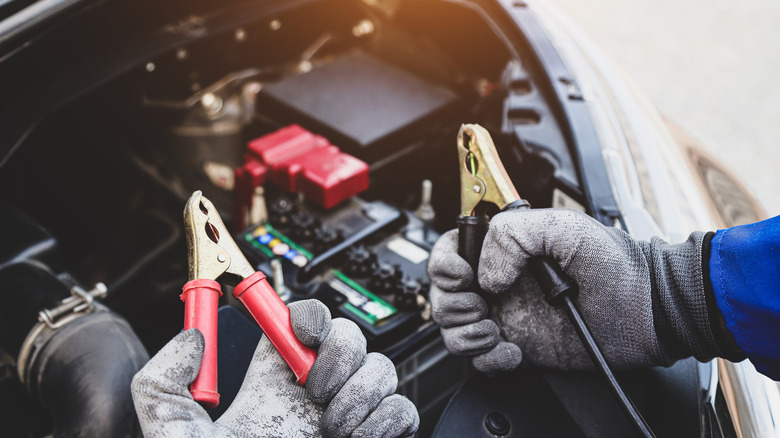
If you have more than a few years of driving experience under your belt, then you've likely faced this situation: you turn the key or hit the start button, and your engine doesn't turn over, no dashboard lights appear, and you hear a clicking noise or just total silence. Your car battery is dead or dying, and you're stuck. You may be well-prepared with an emergency set of jumper cables in the car, or you may have to call a friend or AAA, but it's not a situation you can handle alone unless you happen to have a portable jump starter in your car.
A portable jump starter is a compact battery pack with a positive lead and a negative lead that you easily connect to the terminals on your dead battery. They vary in price from under $40 to several hundred or more, depending on the type of battery, their power capacity, and additional options, such as built-in air compressors and LED lights for nighttime use. You can purchase a set of jumper cables for less than $15 at Harbor Freight, so is a portable jump starter worth it?
For most people, the answer is yes, it's worth the investment for several reasons — it will allow you to jump-start your car battery properly by giving it enough juice to get your car running, and you don't have to rely on a family member, friend, or stranger to help you. In fact, some may say they're even better than jumper cables due to their safety features, though there are a few drawbacks as well.
Jumper cables versus portable jump starters
If you've never needed a jump start, here's how it works with jumper cables: you need another car to park close enough to the disabled vehicle so that the cables can stretch between them. You connect one end to the functional battery and the other to the dead vehicle, but you have to be careful — one connector must be attached to an unpainted metal surface on the dead car's engine block, not the battery.
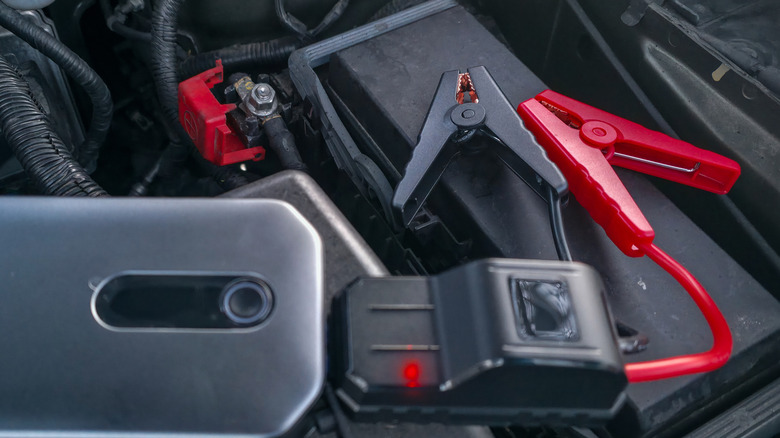
Jump starters eliminate that risk and the need for assistance. After charging your jump starter and storing it in your vehicle, you simply attach the red cable to the positive post on your battery and the black cable to the negative post. Some jump starters have an indicator light to tell you if you connected it correctly. Then turn it on and start your engine. Most cars require a jump starter with about 1,000 amps or less, though diesel engines need more oomph. Both jumper cables and portable jump starters should be enough to start a completely dead battery, but remember, you still need to have that battery checked and potentially replaced.
If you're on the fence about jumper cables versus a jump starter, compare cost, maintenance, and ease of use. Jumper cables are more cost-effective and can be stored and forgotten, unlike jump starters, which must be charged occasionally. There are several highly-rated jump starters available on Amazon if you decide to go with that option. Plus, you won't need assistance from another driver if you have a working jump starter, and some function as multi-tools, allowing you to charge via USB cables or even power 110-volt household devices.