

The Subaru Hybrid You Might Not Know Uses A Toyota Electric Motor
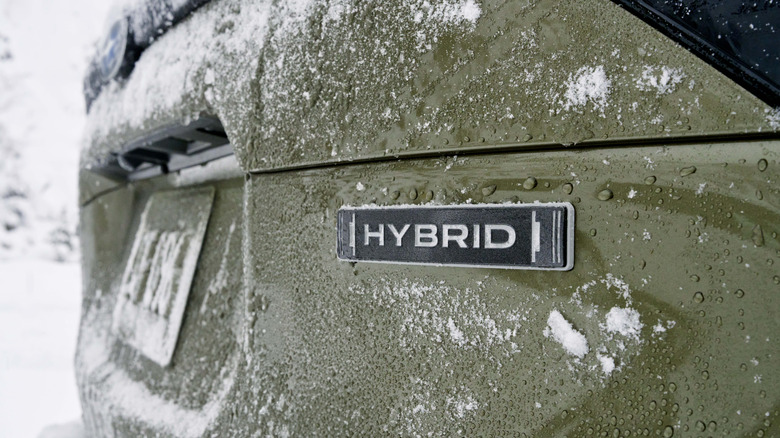
For car enthusiasts and casual followers of the auto industry, the most high-profile collaboration between Toyota and Subaru is likely the twin Toyota GR86 and Subaru BRZ sports cars. These were jointly developed by the two automakers, sharing both an assembly line and a Subaru-built flat-four engine.
The BRZ and GR86 coupes, however, are not the only fruits of the growing partnership between Subaru and Toyota, which has owned a 20% stake in Subaru since 2019. Toyota and Subaru have partnered on new electric vehicles since then, but the two brands' most important partnership may be in Subaru's hybrid Crosstrek and Forester SUVs, which use Toyota's hybrid motor technology to boost fuel economy and performance.
Obviously, the addition of hybrid powertrains further strengthens the appeal of the already-popular Subaru Forester and Subaru Crosstrek CUVs, which lagged behind some of their competitors in fuel economy. However, just because Subaru uses Toyota-derived electric motors in its hybrids does not mean that the Forester and Crosstrek have identical or even similar powertrains to comparable Toyota crossovers like the RAV4 or Corolla Cross Hybrid. And that's likely how both companies want it, with their respective vehicles maintaining their own engines and AWD systems that appeal to different types of buyers.
Toyota tech with Subaru personality
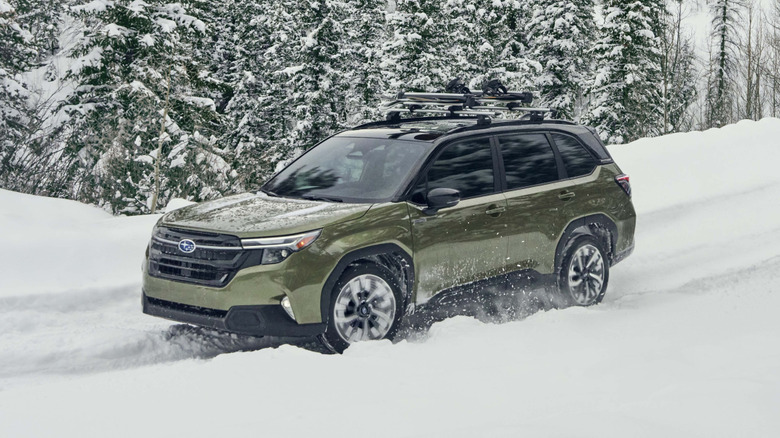
Though Toyota and Subaru have shared a close relationship since 2005, when Toyota first took a stake in the company, Toyota does not own Subaru outright. Instead, Toyota currently owns 20% of Subaru; this gives it a say in determining Subaru's direction, but Subaru remains an independent automaker. That's actually a pretty good descriptor of the new Subaru Forester and Crosstrek Hybrids themselves, as they remain fully "Subaru" in many ways — just with a dash of Toyota tech in their electric motors.
It's worth noting that there's a very distinct difference in how the two companies' AWD hybrid crossovers operate. Toyota's own FWD-based hybrid AWD system, used in vehicles like the RAV4, Corolla Cross, and Camry, does not have a rear differential; instead, it uses a separate, rear-mounted electric motor to provide four-wheel traction when needed.
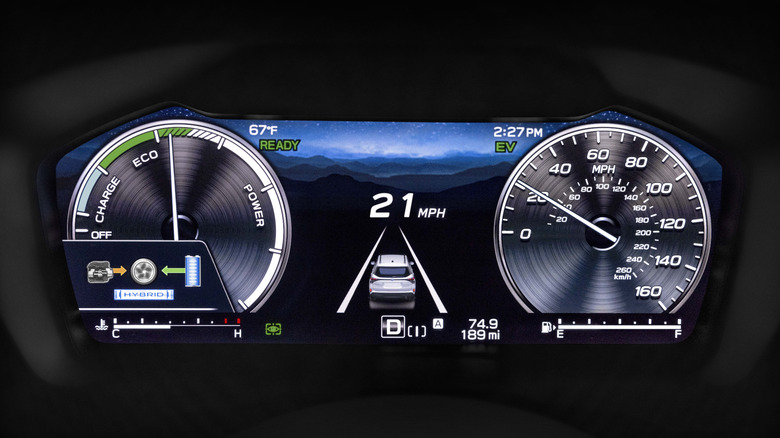
The Subaru hybrid system, meanwhile, uses a pair of small electric motors inside the transmission, but the AWD system itself remains mechanical and permanently engaged. And that's crucial, because the Subaru's standard, symmetrical AWD system is at the core of its popularity among buyers and, to many, gives its vehicles an edge over the competition when off-roading or in inclement weather. As we found in our review of the 2025 Forester Hybrid, Subaru's new hybrids add a battery and a bit of electric boost to their proven and popular foundation without re-inventing AWD.
More Subaru hybrids to come?
Subaru isn't the only company utilizing Toyota's hybrid tech in its crossovers. Toyota also shares its technology with Mazda, in which it also owns a small stake. Unlike Subaru, however, which integrated Toyota's electric motor tech with its homegrown powertrains, the Mazda CX-50 Hybrid essentially uses the entire powertrain from the RAV4 Hybrid. The Mazda's engine, electric motors, and AWD system are all nearly identical to those of its Toyota competitor, although the CX-50 itself rides on Mazda's own platform.
Whether it's the CX-50, the BRZ and GR86, the twin Subaru Solterra and Toyota bZ electric SUVs, or this latest Subaru hybrid technology, we only expect the Subaru-Toyota-Mazda relationship to grow in the coming years. In fact, all three companies announced plans to work together on a new generation of engines for future electrification projects in 2024.
For now, Subaru offers the Forester and Crosstrek with both hybrid and non-hybrid powertrains. However, given that the hybrids have no major compromises and offer a boost (albeit a small one) to fuel economy, we wouldn't be surprised to see these models go hybrid-only at some point in the future, which is exactly what Toyota has done with the 2026 RAV4. One could also expect to see the tech come to other popular Subaru models like the Outback or Ascent once Subaru gains more experience with hybrid powertrains.