

'Offline And Unusable': EV Driver Finds Major Flaws In Nevada Charging Network
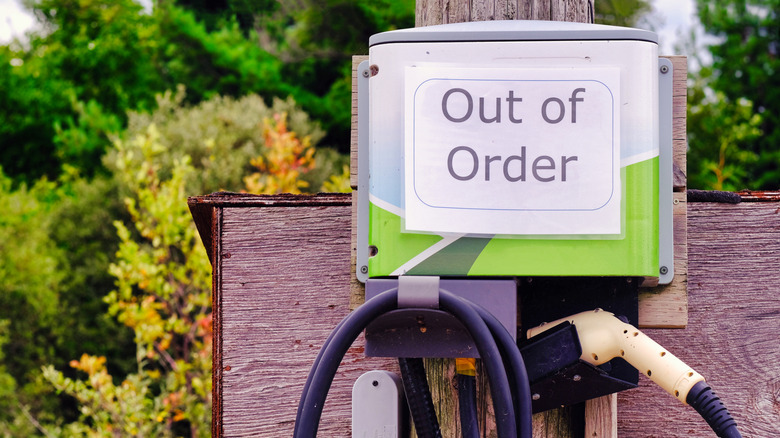
Despite slowed growth in 2025, there are still millions of electric vehicles on the road in the U.S. Many of those drivers charge their EVs at home, but not everyone has a home charger. And of course, you need to be able to charge your EV on long car trips — the average range of an electric vehicle is about 280 miles. A robust public charging network is vitally important both for current EV drivers and for continued growth in the industry.
It was a booming year for EV infrastructure, with more than 18,000 new DC fast charging (DCFC) stations deployed across the country, resulting in more than 70,000 DCFC stations in total by the end of 2025. But those charging stations are only useful if they're operational. One driver in Nevada, Scott Allison, recently found that less than 25% of fast charging stations were working when he surveyed them at the end of 2025.
On his website dubbed "Scott Explains," the author blogged about his experience in a post titled "Nevada Built an EV Highway and Then Abandoned It." He owns a Kia EV9 and checked out 29 charging stations that were built as part of the Nevada Electric Highway project. Only seven of them were operational. How does what he found impact drivers in Nevada, and what does it mean for EV drivers across the country?
Reliability issues in Nevada
Nevada resident Scott Allison thought he'd have an easy trip in his EV due to the highway project that helped build out charging infrastructure in rural areas. Through a combination of physical visits to charging stations and the use of PlugShare, where EV drivers report the status of charging sites, and Google Maps, Allison was able to determine that the majority of those stations are not functional. The failures leave dead zones along some major highways, including a 232-mile stretch from Las Vegas to Ely, Nevada.
The Nevada Electric HIghway project was launched to electrify major corridors in the state and was primarily funded by the U.S. Department of Energy's (DOE) State Energy Program (SEP). The seven functioning charging stations that Allison surveyed are all owned by a company called EV Connect. Other operators included Shell, which ceased supporting third-party charging stations in 2025.
Nevada is far from the only state with chargers that are "offline and unusable," as Allison succinctly put it. In late 2024, Green Car Reports detailed problems in several states, including Alaska, Hawaii, and Washington, DC, with more than 10% of their chargers non-operational. Federal funds for charging stations remain embroiled in court rulings and political changes, but it's not all bad news everywhere, including Nevada, where Scott Allison found that charging networks around Las Vegas and interstates 15 and 80 remain robust. In California, where the federal government in 2026 canceled millions in grants for EV chargers, the state recently invested more than $55 million to install new public charging stations.