

Why Diesel Fuel Is So Much Cheaper In The US Than Europe
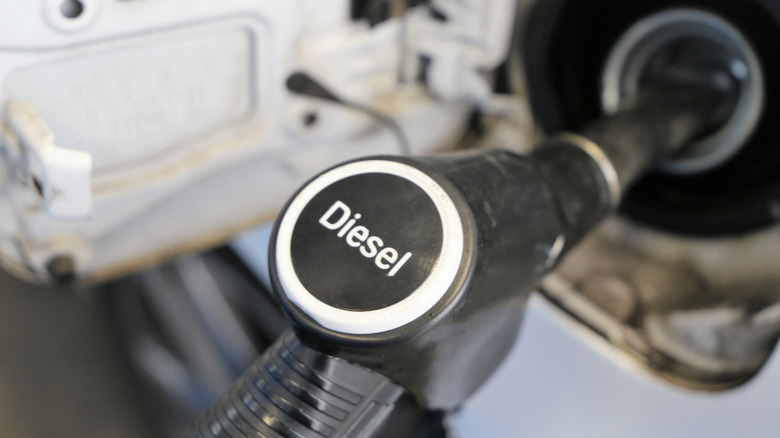
While most of us ride around in cars powered by gasoline, diesel discreetly powers armies of trucks and even some cars, too. Diesel, with its unique smell and the throaty engine hum it creates, never supplanted gasoline as the dominant fuel in the U.S. And contrary to what you may have heard, it is cheaper here — on the whole — compared to what Europeans pay, despite them having a much broader contingent of automobiles using it. To highlight the difference, the proportion of diesel cars on the road in the U.S. was very low at around 5 % in 2025, compared to Europe with 18 % as of 2023. This becomes apparent quickly when visiting the old world, where smaller, more fuel-efficient diesel cars pepper the landscape, navigating narrow roads and dense city centers perhaps more easily than, say, a Chevy Tahoe or Suburban.
The difference in fuel price between the U.S. and Europe is largely driven by taxation, reliance on imports, and geopolitical instability. According to the U.S. Energy Information Administration (EIA), the current U.S. gasoline price sits at a national average of $2.87 per gallon, at the time of publishing, while diesel is priced at $3.68 per gallon. Conversely, if we consider the European numbers, we see that on average across the EU, diesel fetches $7.02 per gallon, which is roughly a 91% increase over American prices. And for comparison's sake, we note that the average European gasoline prices work out to $7.21 per gallon.
An ever changing market

If we zoom in on the primary factors driving this price disparity, we see how government involvement in the price structure is at play. The U.S. is an energy powerhouse, able to refine enough diesel to meet domestic demands and even export some surplus. Conversely, due to driving culture and more widespread adoption of diesel, Europe naturally has higher demands. Historically, this led to significant reliance on Russia, with the EU having imported 40% of its diesel from the former Soviet state, pre-2023 sanctions, for example. The Union does refine the majority of its own fuel, though, and thanks to the conflict in Ukraine, its imports have shifted towards Saudi Arabia, China, South Korea, and the U.S. What's more, taxation is higher across the EU, with diesel getting a minimum excise duty of $1.47 per gallon on average, plus a value-added tax (VAT). Meanwhile, we see roughly $0.60 of tax per gallon here, making a 223% higher tax rate for EU customers, broadly speaking.
However, as with any commodity, oil prices fluctuate widely — especially in an era fraught with so much conflict across the globe. It's already a complex ecosystem with many levers, so we can't assume that American diesel will always be cheaper, writ large, or lower priced in individual states when compared to specific EU nations. Take, for example when, back in 2022, California's diesel prices hit an average of $6.03 per gallon, while Malta, with some of the lowest excise duties in the EU, was paying around $4.58 for the same amount of fuel. This highlights how generalizing cost disparities within commodity markets is fraught with caveats, thanks to taxes, refining costs, crude pricing, wars, and distribution charges.