

This Smartphone Lets You Use Windows, But Is Far From A New Windows Phone
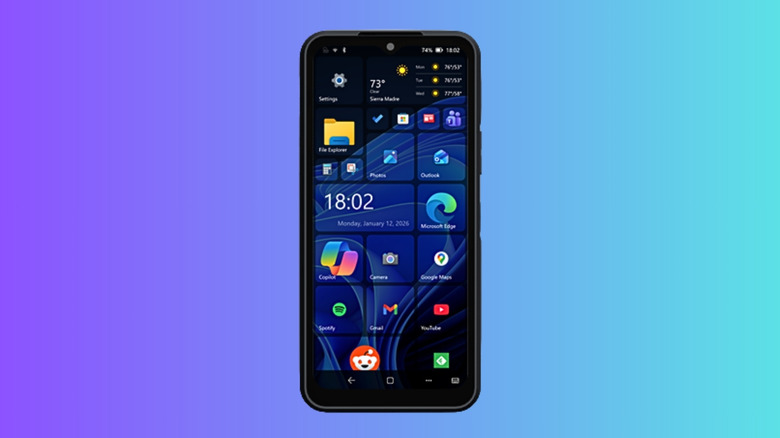
Microsoft pulled the plug on Windows Phone all the way back in 2017, a move that CEO Satya Nadella came to regret years later. Even though some enthusiasts are trying to keep their aging Windows Phone devices alive, the project is dead at Microsoft, and there's no official consumer-friendly route to put desktop-class Windows OS on a phone either. Nex Computer is attempting just that by offering Android, Linux, and Windows 11 on a phone, which is now up for pre-orders as the NexPhone.
When you put Windows on a smartphone, which seems to be a popular passion project for enthusiasts, the full-fledged desktop experience opens on the screen. The icons are too small, the orientation is odd, and the performance tanks. Nex took a rather different approach, one that looks pretty similar to the Windows Phone UI. "We built our own Mobile UI from the ground up to make Windows far easier to navigate on a phone," writes Emre Kosmaz, founding chief of the company.
Instead of the staggered icons occupying the edges of the screen, the custom UI is modeled after Windows Phone. The Windows 11 UI on the NexPhone is pretty similar, and the core purpose of this design is to make the UI user-friendly for touch-based interactions. But when you connect the phone to an external display, the full-fledged Windows 11 UI pops open, offering a proper computing experience.
The NexPhone also offers a Linux app, which launches Debian. All three operating systems have desktop modes. But despite lofty ambitions, the device faces serious problems — including a complete lack of cellular connectivity under Windows — that might put some users off.
The deeper picture
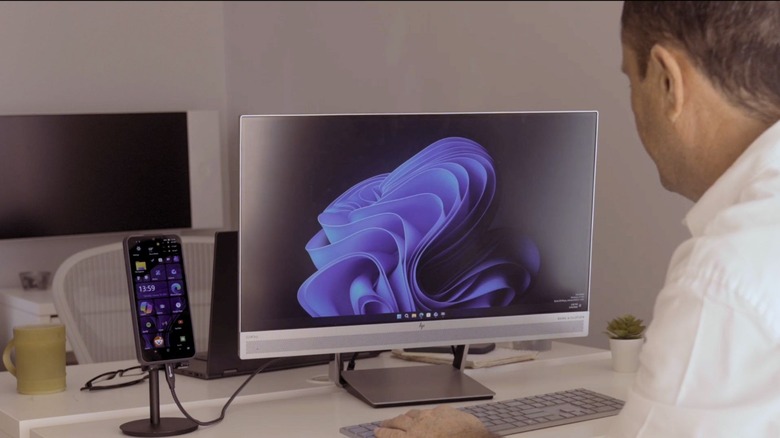
The pitch for NexPhone is rather curious. The company says it is not going to replace your daily driver smartphone, and it should be purchased with the intent of backup or secondary phone. But when you look at what this phone can accomplish, which is essentially serving as a Windows-ready dock, it transcends into the realm of computing within a pocketable form. But you must keep your computing expectations on the lower end of the performance scale.
The phone's hardware is not quite in the same league as a workhorse laptop. The phone draws power from Qualcomm's DragonWing QCM6490 chip, but performance tests (via AndroidAuthority) suggest that it's performance is closer to the Samsung Exynos 1380 chip powering Samsung's mid-range Galaxy A54 5G phone from 2024 and the Tensor G2 silicon inside2022's Google Pixel 7. The Qualcomm chip is accompanies by 12GB of RAM and 512GB of onboard storage.
The technical specifications aren't going to beat an average laptop, but for stop-gap or 11th hour work where you simply need access to a Windows-based machine, the NexPhone could be adequate. If you are someone who relies on a virtual Windows machine for unexpected work situations, but tired of the latency woes, high costs, or the requirement for a stable high-speed internet connection, NexPhone puts an offline PC in your pocket.
Also, it's worth keeping in mind that this is Windows on Arm you're dealing with, and not the mainstream x86 flavor of Windows that you will on devices powered by Intel and AMD processors. Microsoft has done some impressive work with the emulation layer that allows x86 apps to work well on Arm machines with minimal performance hit, but you might still run into some compatibility issues.
A network hiccup
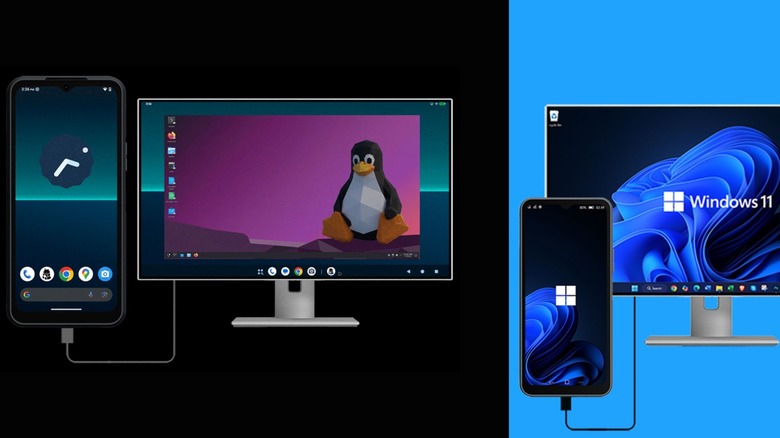
Booting into Windows mode using a phone sounds utterly convenient, and way more productive than using Samsung's mobile-first DeX system. But there's a steep connectivity price to pay with running Windows. Kosmaz tells SlashGear that when the device boots into Windows mode, you won't have access to cellular calling or SMS functions. Essentially, if you want to use cellular features like calling, texting, or internet, you need to use it in Android mode.
When in Windows mode, you do have Wi-Fi access, so you can use third-party solutions such as WhatsApp for voice or video calls, and texting. But you must return to Android every once in a while, because WhatsApp logs you out of connected devices after 14 days of inactivity — and you may need a second phone for initial setup.
Linux on the NexPhone also has serious problems, and the company's demo video showed the lightweight fastfetch utility crashing out while trying to show system information.
NexPhone is pretty rugged, offering an MIL-STD-810H military-grade build with IP68 and IP69K clearance for dust and water exposure. You also get a 120 Hz 6.58-inch screen, a 64 MP main snapper, and a 5,000 mAh battery. It's priced at $549, and it's now up for reservations.
Nex is not selling its phone as a do-it-all replacement for your daily driver phone. Broadly, you have a mini-desktop ready in your pocket. All you need is a monitor, input peripherals, and a USB-C cable to go from mobile usage to Windows-based work. Nex hasn't given a detailed demo of just how well Linux and Windows 11 will run when connected to an external PC, especially given the modest innards at hand, so you might want to wait for it before booking a unit.