

China's Underwater Data Center Is Doing A Lot More Than Just Computing
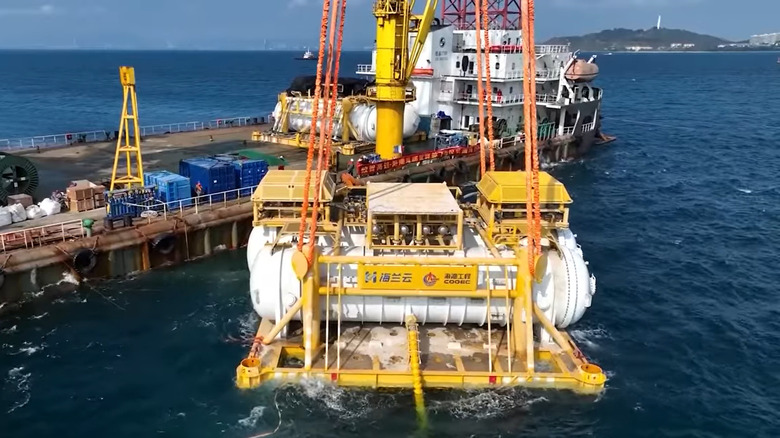
The high water demand of data centers causes significant problems. Large volumes of often potable, drinking-quality water are used for cooling, putting pressure on local water supplies and competing with households and agriculture. One way around this is to do what China has done — place data centers in a location where they're literally surrounded by non-potable water — the ocean. There have been several experimental underwater projects — like Microsoft's Project Natick, which concluded in 2020 — but currently, the only operational, commercial underwater data center in the world is in Hainan Province in China.
Over the past few months, this data center has begun operating as a large-scale artificial-intelligence computing facility, like DC's "AI Alley". Sealed inside steel capsules placed on the seabed near Lingshui, rows of servers now perform the same kinds of tasks as those in conventional data centers — processing data, running cloud services, and training AI systems — but are cooled naturally by surrounding seawater rather than by energy-intensive air-conditioning. This recent shift toward high-density AI computing marks the most advanced stage of a project that aims to combine computing power with lower energy use and a smaller land footprint.
The facility itself is not new. The first underwater modules were deployed in 2022 and entered commercial operation in 2023. The additional modules and upgraded hardware enabled it to take on far more demanding AI-focused tasks, transforming an already operational facility into a full-scale computing hub. China has another underwater data center – still under construction — near Shanghai.
What are the environmental impacts?

The positive environmental impact of such an undertaking is pretty clear. Conventional data centers use a lot of electricity to keep cooling systems running. Underwater facilities use the surrounding seawater as a heat sink, thereby eliminating most air conditioning and reducing overall energy use. Underwater data centers also reduce the impact on people. They don't require the clearance of large tracts of land, and there are no neighbors disturbed by noise pollution, repairs, or fuel deliveries — all reasons why many U.S. states are trying to delay AI data centers from being built.
However, this type of undersea structure remains new, and its environmental impact may not yet be fully understood. While the water is cooling the data center, the data center is ever-so-slightly warming the surrounding water. Although data from Microsoft's Natick project showed that temperature increases were highly localized and measured in fractions of a degree, even small temperature changes can have substantial effects on temperature-sensitive species. A report from researchers at the University of Johannesburg said that it "poses risk to aquatic biodiversity due to ocean deoxygenation". Any effects will be greater if more underwater data centers are built in the future. There is also the possibility of leaks, corrosion, or other damage.
Would marine life adapt to datacenter pods? Some studies have shown that the structures may act like artificial reefs, attracting fish and invertebrates. Microsoft's Nantick project included cameras that monitored and recorded the marine life outside the data center. Future underwater data centers could incorporate this tech to aid marine research. Unfortunately, there's no indication that this is something currently being implemented in Hainan.