

Who Has Nearly 90% Of The World's Nuclear Weapons?
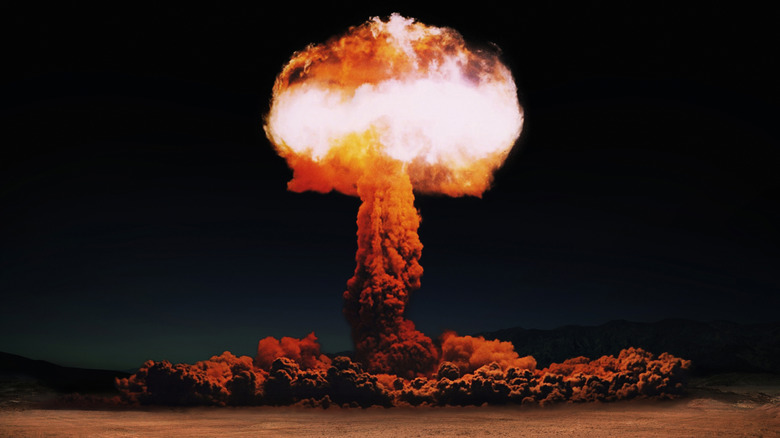
Several military technological innovations have changed the course of history. From the sailing ship to the stirrup, these advances have pushed the world into new directions, and chief among them is nuclear weapons. The first nukes were some of the most notorious weapons developed during World War II, used in the attacks on Hiroshima and Nagasaki, Japan. After the war, nuclear weapons became the tentpole of military and foreign policy, and other nations have followed the U.S. in developing their own arsenals.
As of writing, there are nine countries with nuclear weapons: Russia, China, the United Kingdom, India, North Korea, France, Pakistan, Israel, and the U.S. It should be noted that Israel has never confirmed whether it has nuclear weapons, despite most international agencies believing that it does. Additionally, Israel is not a signatory to the Nuclear Non-Proliferation Treaty. Regardless, there are numerous nations with weapons of all kinds, and together, these account for more than 12,300 warheads, 9,600 of which remain in active military stockpiles.
While that's a lot of nukes, just two countries collectively hold 86.8% of the world's nuclear weapons, with the remaining split between the other seven. Those two nations are the U.S. and Russia, the latter of which has more than the former. These stockpiles represent the legacy of the U.S. policy of Mutually Assured Destruction, which ensured that both the U.S. and the former Soviet Union maintained enough firepower to wipe out the other should either deploy a nuclear weapon in combat.
America's nuclear weapons stockpile
While the Cold War ended decades ago, the United States still maintains a large stockpile of nuclear weapons. This is in line with the U.S.' nuclear triad, which is a policy requiring three nuclear deployment methods at all times: submarine-launched ballistic missiles, intercontinental ballistic missiles, and aircraft-dropped nuclear weapons. While the stockpile has decreased significantly since the end of the Cold War, the U.S. maintains 5,177 warheads, according to the Federation of Atomic Scientists' 2025 Status of the World's Nuclear Forces report.
The weapons are broken down into three categories. Deployed warheads are those on ballistic missiles and those at bomber bases, and the U.S. has 1,670 of these. It has 1,930 stockpiled warheads, which are available for use when needed. Finally, there are the retired nuclear warheads, accounting for 1,477 of America's total. These are weapons that aren't intended for use, but have yet to be dismantled. This leaves the U.S. with a total of 3,700 usable nuclear warheads.
The U.S. continues to develop nuclear weapons technology, though testing is heavily restricted via numerous treaties. Several defense contractors and government agencies manufacture the nation's nuclear missiles and their warheads, with modernization efforts carried out at multiple facilities in Texas and Tennessee. These ensure that the nation's nuclear capabilities are spread out and maintained in a constant state of readiness should the need arise.
Russia's nuclear arsenal
When it comes to nuclear warheads, Russia and the former Soviet Union reign supreme. The Soviet Union developed and tested the largest nuclear weapon ever tested, the Tsar Bomba, which detonated at an estimated 50 megatons. Of course, that's only one of many, and when the U.S.S.R. collapsed, its constituent nations retained some weapons. Ukraine briefly held the third-largest stockpile before denuclearization, and other nations followed suit. These days, Russia has a stockpile of 5,459 total warheads, according to the FAS' 2025 report.
Russia's weapons break down to 1,780 deployed warheads, 2,591 stockpiled, and 1,150 retired, leaving a usable total of 4,309. As a result, Russia maintains 609 nuclear warheads more than the United States, but the difference means little when you're talking about weapons capable of total annihilation of the world in a nuclear war. Like the U.S., Russia maintains its weapons for use in numerous ways, as the nation has nuclear-armed submarines, strategic nuclear bombers, and ICBMs ready to go should the unfortunate need arise.
While Russia and the United States have a lot of nukes, accounting for almost 90% of the total world stockpile, they're nowhere near the numbers of the past: There were an estimated 70,374 nuclear warheads worldwide in 1986. It took a long time to dismantle and draw down from that amount, and treaties continue to push nations to reduce their total number of deployable weapons. Unfortunately, neither the U.S. nor Russia is a signatory to the Treaty on the Prohibition of Nuclear Weapons.