

Europe's Meteor Missiles Pack The Tech (And Power) To Back Up The Name
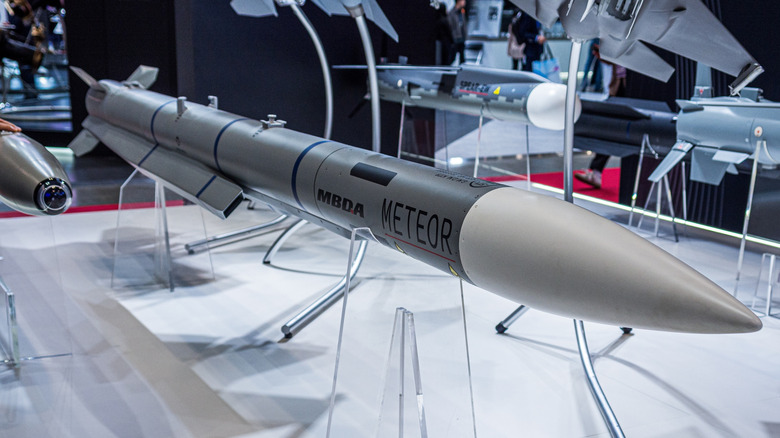
When it comes to missiles in modern combat situations, the air-to-air missile you usually hear about is the AIM-120 AMRAAM, or its shorter-ranged compatriot, the 70-year-old AIM- 9 Sidewinder, which is still in frontline service. The AIM-120 was developed during the Cold War and entered service in the 1990s. It's the most popular choice among the U.S. armed forces. But across the pond, over in Europe, there's a different missile that may surpass the AMRAAM in one very specific and important way. That missile is simply called the Meteor.
Developed by Europe's MBDA Inc., this missile came around a bit later than the AMRAAM for a very specific reason. Both missiles fall into the category of BVRAAM, or Beyond Visual Range Air-to-Air Missiles. As the name suggests, they can both be fired at targets that are only picked up on radar, and they both have sensors that can detonate the missile on impact or when in proximity of a target. But the Meteor was developed specifically to address one key limitation that the AMRAAM missile has. It's called the NEZ or No-escape zone.
The No-escape zone is a rough perimeter around the missile where, once the missile locks on, it's difficult, if not impossible, for an enemy aircraft to escape. The exact NEZ varies based on target conditions, evasive maneuvers, etc., but MBDA claims that the Meteor's NEZ is roughly three times the size of the AMRAAM missile for one key reason — its propulsion system.
It's all about how it gets there
There are two factors to consider when it comes to missile range. While the exact numbers remain highly classified, it is believed that both missiles boast similar range, which is good. But a missile's range is really only relevant if the enemy aircraft isn't doing anything to avoid impact — no evasive maneuvers, for example. That's why shooting the "longest known" AIM-120 AMRAAM shot is cool, but not terribly informative. NEZ is a better statistic for measuring a missile's effectiveness.
The AMRAAM missile has a solid rocket booster that basically expends all of its fuel in the initial burst to gain speed and altitude while heading to the target. From there, it can maneuver to track a target, but it can't sustain its speed while doing so. This makes the missile less effective at tracking a target at closer range — hence the smaller NEZ.
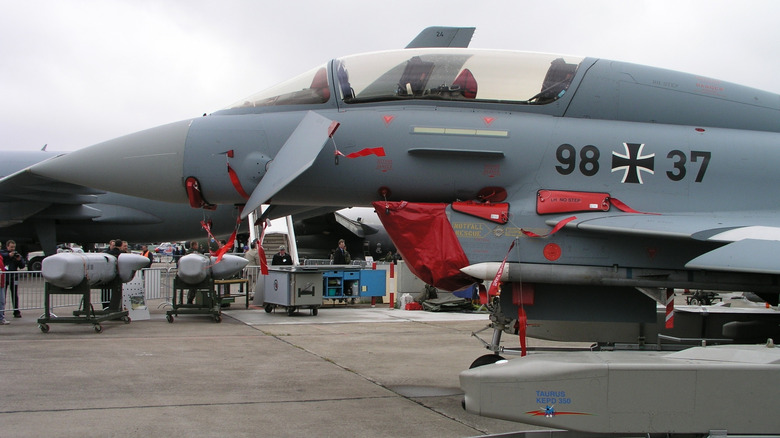
The Meteor missile, on the other hand, uses a solid fuel ramjet propulsion method, which sustains its thrust during its flight. This allows the missile to be more maneuverable and better able to track its target even at closer range. This is why the missile has a larger NEZ. If the missile can not only track a target and maneuver, but also maintain thrust, it's a lot harder to get away from. The Meteor is compatible with the Rafale, Eurofighter Typhoon, Gripen, and the F-35 fighter jets. It's also worth mentioning that, to date, the Meteor missile does not yet have a combat kill, so definitely stay tuned on that front.