

Indian's New Chief Vintage Could've Been A Gimmick, But One Ride Convinced Me Otherwise
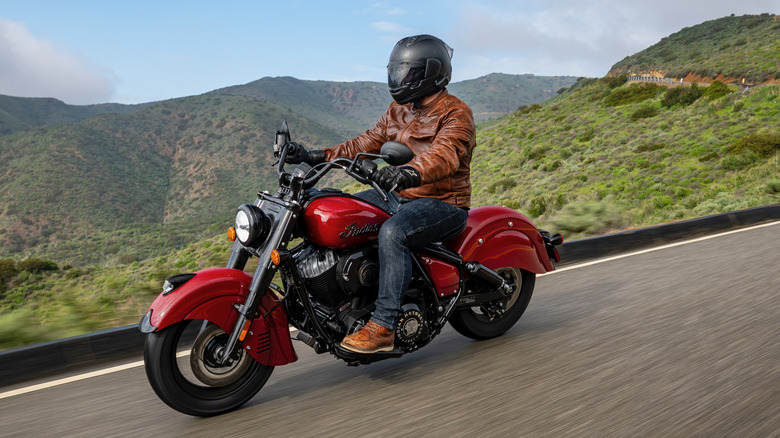
To celebrate their 125th anniversary, Indian Motorcycles has launched a new bike called the Chief Vintage. An exercise in classic styling and paying homage to history, the Chief Vintage has big power, flowing valanced fenders, classic wire wheels, and a floating seat that looks like it came out of a catalog from the 1940s.
As a part of the launch, Indian hosted a ride of the new bike, and they invited me to take it out on the road. More than just a sheet-pull and a few miles around town, the ride wound through the Southern California mountains for a full day, and it came paired with admittance to their 125th-anniversary party in Los Angeles.
On the surface, the bike is a tribute to tradition, but underneath, it's a pretty modern machine. And while it wasn't quite the perfect bike for curving California canyon roads, it's an excellent cruiser with a ton of style.
With a big bike comes big power
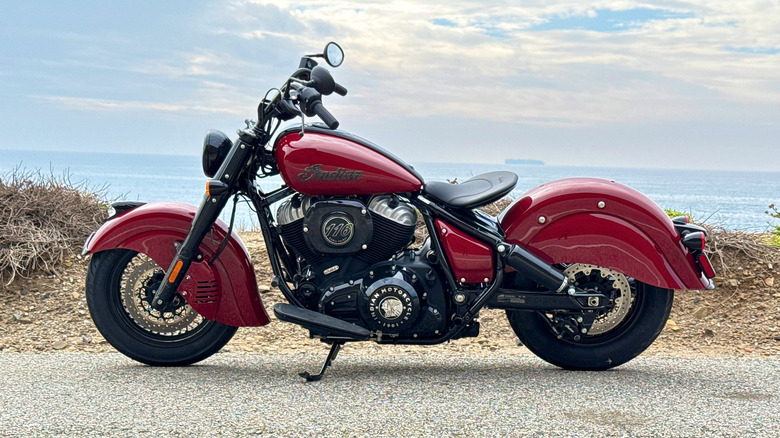
Powering the Chief Vintage is the air-cooled Thunderstroke 116 engine. It's a 116 cubic-inch (1,890 cc) V-Twin that produces a massive amount of torque: 120 lb-ft according to Indian's spec sheet. Horsepower isn't quoted for the Thunderstroke, but estimates have it between 90 and 100 hp. The Thunderstroke 116 doesn't feel like it produces much in the way of top-end power, but hitting that maximum torque number at just 2,900 rpm gives it a powerful but relaxed feel. Even loping along at 35 mph in 4th gear, I was able to twist the throttle and double my speed in no time.
The three available ride modes (Tour, Standard, and Sport) made slight adjustments to throttle sensitivity, but the differences weren't drastic. Standard was the mode I used for almost all the cruising we did, and Sport was engaged a few times in the twisties, but the changes it made were minor.
The classic American rumble of the V-Twin makes its way back towards the exhaust with a satisfying growl, but it's not loud enough to be considered abrasive. The six-speed manual transmission delivered crisp shifts, with light action from the hand lever. I found neutral by accident more than a few times, but it just reminded me to assertively move the foot lever instead of treating it like a modern quick shifter, and that problem went away quickly.
Riding in the wet
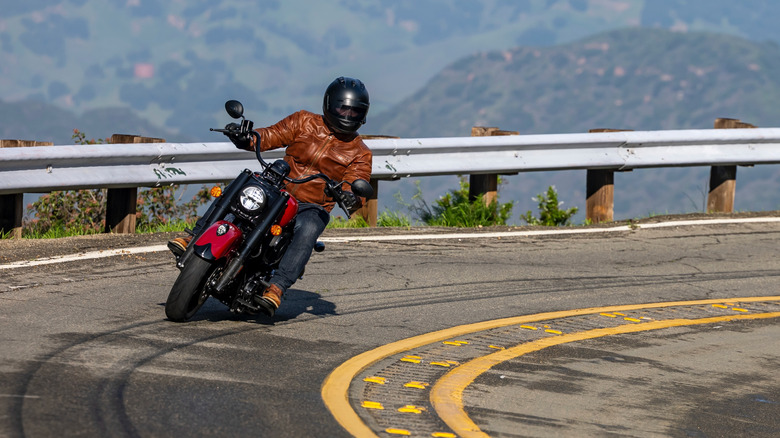
Riding a big, unfamiliar motorcycle in the rain, on wet and dirty canyon roads, isn't the sort of environment that instills a lot of confidence. Unfortunately, those were the riding conditions on the day the ride was scheduled. Naturally, this meant I didn't exactly test the Chief Vintage's limits. Throw in the fact that it's an expensive, brand-new motorcycle that hasn't hit the dealership showrooms yet, and there was even more pressure during the ride. Still, the Indian staff did a great job guiding us around and setting a reasonable pace throughout the day. And, thankfully, there were some dry bits of road throughout the day where the Chief Vintage could stretch its legs — those bits were rewarding.
According to Indian's specs, the Chief Vintage has a max lean angle of 28.5 degrees, so tight corners had to be managed with care, and it wasn't particularly eager to change directions in back-to-back corners. Where it really shined was on the big stuff. The Chief Vintage felt stable and smooth through long sweepers. It was calm, collected, and predictable. For such a big bike, the Vintage felt relatively light on its feet at speed. A multi-state coastal run would feel great on this bike. Anything more than some mild lean through those sweepers, though, and the floorboards would scrape a bit, so speedy riders will need to dial in a bit of extra caution.
It's big, and it feels it
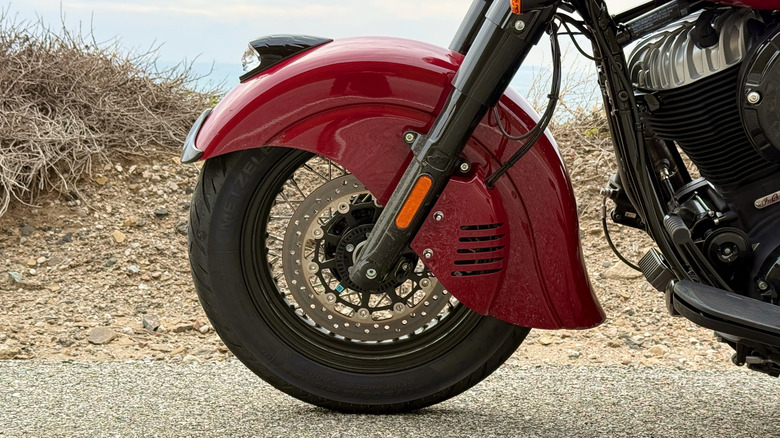
Braking was a two-input process on the Indian. With a bike that weighed 721 pounds before I even climbed on, and was much closer to a half-ton than I'd like to admit once I was seated, a single front brake simply wasn't enough to bring the speed down to zero in a hurry. Sure, the front wheel gets a large 298 mm (11.7-inch) rotor and a four-piston caliper, but there's only so much that one brake can do in a battle against the weight of the bike.
Thankfully, the combo of front-and-rear brakes together gave the Chief Vintage enough stopping power for the kind of pace it could carry in the canyons. The rear brake also uses a 298 mm rotor, but with just a 2-piston caliper. The meaty Metzler Cruistec tires (130/90/16 up front and 150/80/16 in the rear) stayed stable under heavy braking and heavy throttle, though I did accidentally toss a bit of gravel reward at one point while making a u-turn in a dirt lot.
Lots of style paired with discreet modern tech
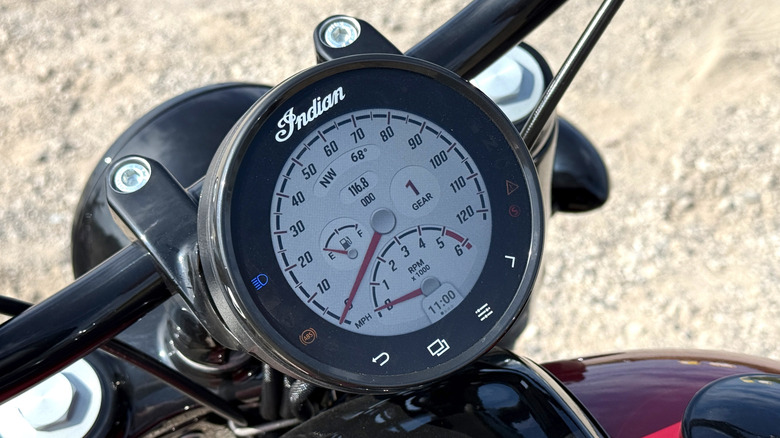
In-between the short and long stretches of riding, at the launch event, and at the various food stops, I was able to really take in the design cues and styling of the Chief Vintage. Even with my predilection for naked and full-fairing sportbikes, I can objectively say that the Chief Vintage is stunning.
The flowing lines of the valanced fenders draw your eyes in, then the small, subtle louvers reward a closer gaze. The contrasting finishes on the engine give it depth, and the Motorcycle Red paint looks excellent whether you're riding the bike or staring back at it while you walk away.
 Travis Langness/SlashGear
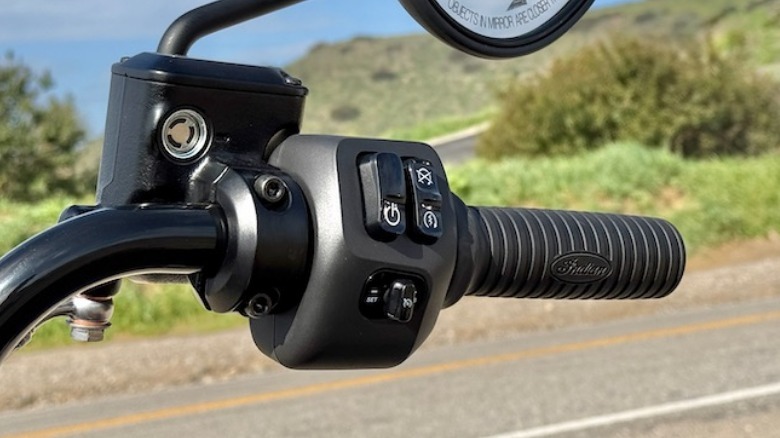
The Chief Vintage doesn't feel minimalist, but it does hide its tech pretty well. The round 4-inch rider display is simple, small, and easy to use. The screen responds quickly to touch inputs, and it has large, legible fonts. I did take umbrage with two specific things, though: The large button housings and the location of the cruise control buttons.
The large button housings distract from the bike's clean looks, but they can be explained by the necessary electronics. The cruise control buttons on the right handlebar were harder to understand. Engaging cruise control, via a button, is hilariously difficult when you're using the same hand to control the throttle. Almost without fail, every time I engaged cruise control, I'd lose or gain a few mph by taking my thumb off the throttle or twisting it too far.
Comfort for the long rides
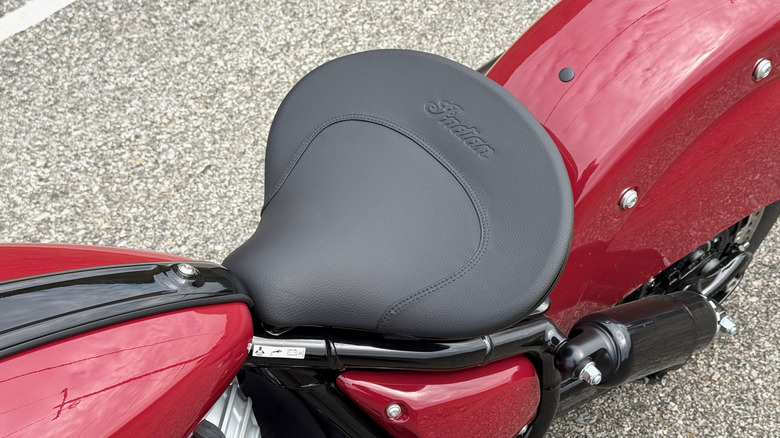
With a seat height of just 27 inches, most average-height adults should be able to swing a leg over the Chief Vintage without any issues. But the seat itself had me doubting the potential for comfort on the Chief Vintage. It looked way too simple and thin to be a comfortable place to sit. To my pleasant surprise, the seat was almost perfectly shaped, contoured in just the right ways, and with enough support to have me sitting relatively upright for a full day of riding.
Small bumps mid-corner were dealt with easily thanks to 46mm front forks and the dual rear shocks. The location of the swept-back vintage-style handlebars meant I could easily reach all the controls without straining, and the height of the bars was just right for my 5-foot-9 frame. There are some optional storage accessories for the Chief Vintage: if I were building one out, I'd certainly add side cases or bags of some sort, because this bike would be great for road trips.
2026 Indian Chief Vintage verdict
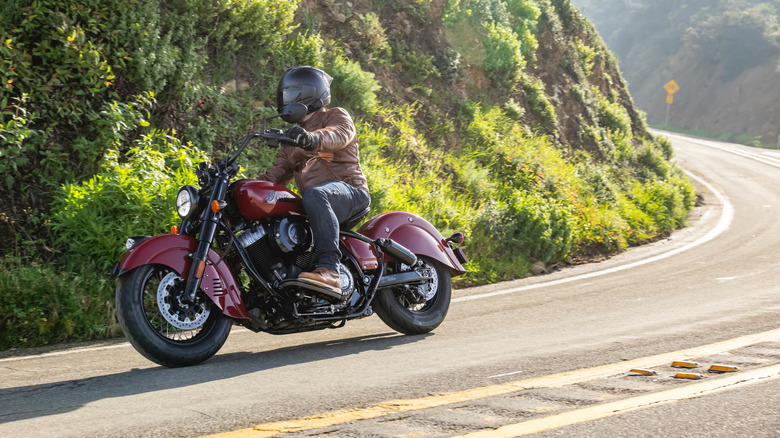
The Chief Vintage is a show-stopper. It will give you immediate status at just about any bike night and especially high levels of street cred amongst the Indian Motorcycle crowd. Even considering the small issues I had with button size and placement, the Chief Vintage was impressive and enjoyable. It's comfortable, powerful, and easy on the eyes. It's also priced relatively well amongst the other Indian bikes.
The standard Chief sits at the top of Indian's Cruiser lineup, priced above bikes like the Scout Sixty and standard Scout. The new Chief Vintage is one of the top trims for the Chief, slotting in their lineup just below the big baggers like the Chieftain and Challenger.
Pricing for the Chief Vintage starts at $19,999 (not including destination fees). That's a direct match for the more-modern Sport Chief, which comes with a few more features, but a much more modern style. The Chief Vintage is also a bit pricey when it's compared to the standard Chief and Chief Bobber ($14,999 and $17,499, respectively), but those bikes are both powered by the lesser 111 cubic-inch engine. The Harley Heritage Classic offers similar power for the same price as the Chief Vintage, but the two bikes are not quite in the same styling category.
Post Script: Counting the Indian logos
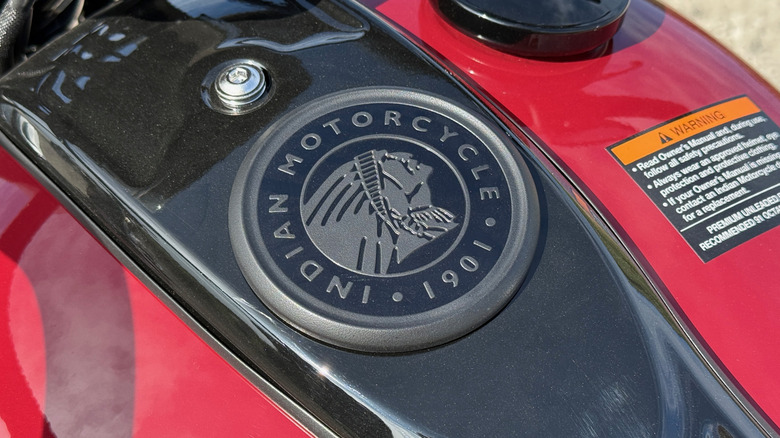
If you're a regular here at SlashGear, you'll know I've been counting logos for a while. On four-wheeled transports like the Ford Expedition and the Cadillac CT5-V Blackwing, there are all sorts of opportunities for brand logos. Wheels, brake calipers, seats, engine bays, and fenders each give a chance to do some boasting about the brand. But never in my wildest dreams did I imagine that a motorcycle would out-brand-log them all.
 Travis Langness/SlashGear
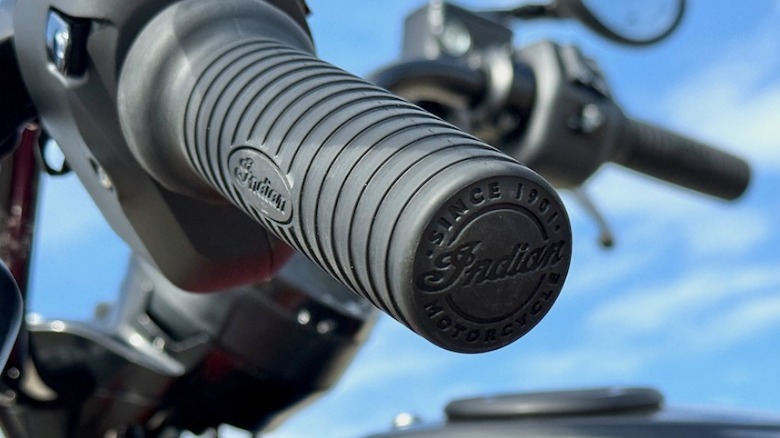
The Indian Chief Vintage has, as far as I can tell, 38 logos or full "Indian" identifiers on the bike — a new record amongst the vehicles I've been testing in the last 14 months or so.
 Travis Langness/SlashGear
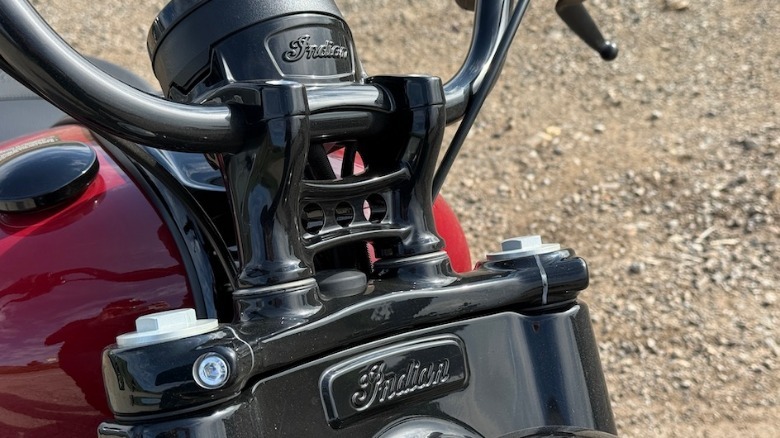
Logos are on: each mirror, each front fork, each side of the gas tank, the top of the gas tank, the oil filter, oil dipstick, the seat, and the handlebar grips (three logos on each grip).
 Travis Langness/SlashGear
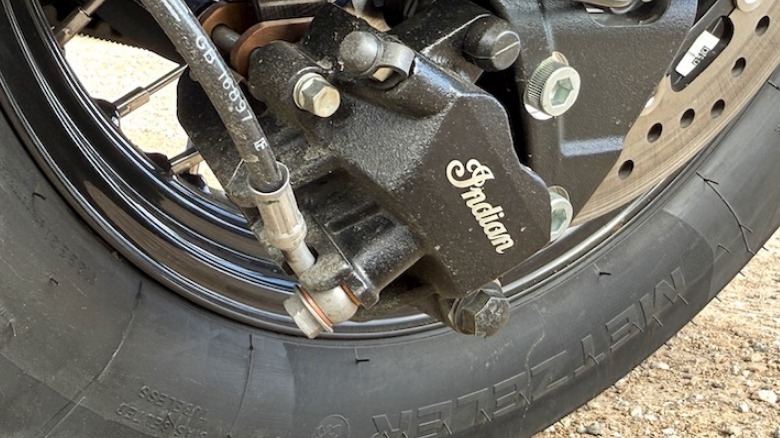
They're also on the engine, floorboards, brake fluid reservoirs, brake calipers, headlight surround, and rider screen. If you ever forget what kind of bike you're riding, just look an inch to the left or an inch to the right, and the Chief Vintage will remind you.