

No Radar Or GPS: How US Aircraft Carriers Can Navigate If Their Tech Goes Down
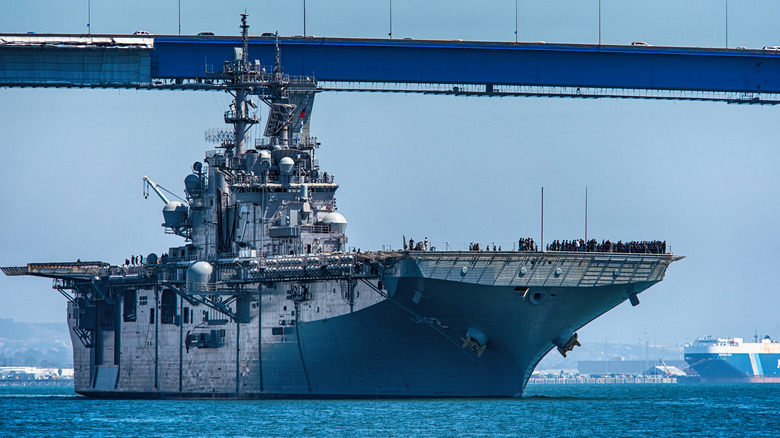
Aircraft carriers are massive and incredibly complex pieces of machinery with hundreds of thousands of moving parts that all work in unison to get moving. For navigation, GPS and radar systems are vital for ensuring that firepower, humanitarian aid, manpower, or aircraft can arrive anywhere in the world on short notice and accurately.
But what happens if those navigational tools are no longer available? After all, the United States Naval Institute posits that if war were to ever break out and an aircraft carrier were to get involved, GPS would likely be the first thing to go. Once you understand how anti-satellite missiles work, it's easy to see why adversaries would target satellites.
In that case, what is a ship to do? Well, it requires going back to the basics of seaborne navigation; that is, using the sky. Ships and boats have been crossing the ocean for thousands of years before the advent of electronics, and ancient sailors still got where they needed to go (for the most part), so why not apply that same idea to modern ships?
Using the sky to sail

This isn't a hypothetical question or exercise either. In 2022, the USS Essex, an 844-foot-long amphibious assault ship (not to be confused with the Essex-class aircraft carrier), sailed from Oahu, Hawaii to San Diego, California, using only the sky to navigate. The navigators weren't allowed to use any tools that required electricity and only used old-school paper charts, compasses, sextants, pens, and paper, straight out of the 18th century.
The mission went off without a hitch (after a bit of a learning curve), with the Essex remaining within one nautical mile of where it was supposed to be for the majority of the five-day, 1,800 nautical mile (2,071 miles).
Exercises like this keep sailors at the top of their game when it comes to navigation and keeping the vessel on course. Obviously, GPS, radar, and the ship's onboard STELLA (System to Evaluate Latitude and Longitude Astrometrically) software suite are nice things to have and vital for a modern navy, but being able to look at the sky and determine where you are on the open ocean is a skill that can become quite important if the lights go out. This skillset proved to be so important that the U.S. Navy reinstated celestial navigation training in 2016.