

Scientists Have Turned Lead To Gold By Recreating Big Bang Conditions On Earth
Alchemy has been around since ancient times, when people believed that they could turn base metals into gold. While this was, of course, nonsense and alchemy has long been seen as pseudoscience, that's not entirely accurate. Lead was most often chosen as the base metal for transmuting into gold, and if you look at the periodic table, you'll see why: gold has an atomic number of 79, while lead's is 82.
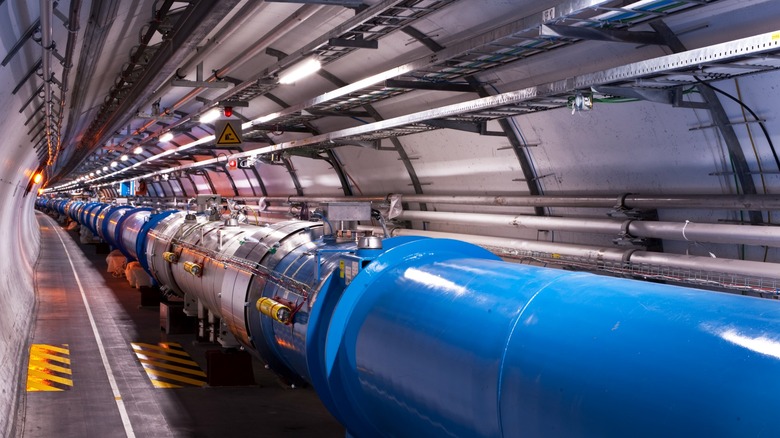
An atomic number is the total amount of protons in an atomic nucleus, so, in theory, if you could remove three protons from a lead atom, it would transmute into gold. Doing so isn't easy, and while it seemed like an impossible task, it turns out that you absolutely can transmute lead into gold by removing those three protons, as researchers at the Large Hadron Collider recently discovered. While conducting ALICE (A Large Ion Collider Experiment), lead atoms were accelerated at incredible speed in an effort to recreate the state of the universe in the immediate aftermath of the Big Bang.
When the lead atoms collided, protons were dispersed, resulting in the transmutation of several atoms into gold. The result was around 29 trillionths of a gram of gold. While that sounds infinitesimally small, and it is, it amounts to around 86 billion atoms, which is a significant achievement. Still, while this won't reduce the cost of gold anytime soon, it proves that alchemy, of a sort, is actually possible, taking the practice somewhat outside the realm of pseudoscience.
Transmuting lead into gold

While it's easy to say that smashing lead atoms together at high speed produces gold, there's a ton of science behind the process. Protons are held together by the strong nuclear force, which is the most powerful fundamental force in the universe. When you smash the atoms together, they are completely destroyed, so the goal in ALICE was to achieve a near-miss. Doing so generates the electromagnetic force, causing the field to decay as one object (a lead atom) moves away from another.
This pulls a proton, which is electrically charged, resulting in an interesting change. If things go exactly right and a lead nucleus comes almost into contact with another, it creates a massive electric field. The rapid exchange between the two nuclei results in vibrational motion. This, in turn, can occasionally result in proton removal. If a lead atom's nucleus happens to dump three protons, it's transmuted into a gold atom.
The new gold atoms cannot be directly observed, so scientists use equipment to detect the gold nuclei. The researchers conducting ALICE believe they produce around 89,000 gold nuclei per second, but this is not actually what the experiment is all about. The gold nuclei smash into the walls of the collider, making them more of a nuisance to research than the Holy Grail of accidental alchemical "science." In addition to gold, ALICE produced thallium and mercury after removing one and two protons, respectively.