

4 Features ChatGPT Needs To Get In 2026
ChatGPT has only been around for a little over three years, but has already become a household name. If you're looking for an AI chatbot in 2026, ChatGPT is likely going to fulfill all your requirements. It's free, fast, and is continually improving when it comes to accuracy. Other features of ChatGPT include Deep Research, custom GPTs, and support for third-party app integration. You can create images, videos, or even ask the chatbot to produce documents for you.
All of these features aren't unique to OpenAI's solution. Contenders like Gemini, Grok, and Claude also offer a similar feature set. With such fierce competition and AI models that seem to one-up each other every couple of weeks, there have been instances of ChatGPT falling behind. Yet, a couple of weeks and a major update later, it's another AI model that has to deal with the pressure. As it stands, ChatGPT is a great tool for a variety of use cases, including programming, research, academics, and creative writing.
That said, there's always room for improvement. For starters, there's the never-ending quest among all AI models to become more accurate with information. Apart from reducing instances of the chatbot hallucinating and delivering false information confidently, here are four features we would love to see arrive to ChatGPT in 2026.
Ability to add multiple profiles

ChatGPT has a couple of tiers you can pick between. The free version limits the number of messages and media you can upload, but is generally enough for casual use. The paid subscriptions unlock advanced reasoning models, higher message limits, and extended memory. However, one thing that all tiers lack is a profile switcher. It's understandable if OpenAI doesn't want multiple users to share the same premium account, but that's not the only use case that the ability to add additional profiles brings.
If you use ChatGPT extensively for different distinct interests — say programming and interior design — it's easy for your chats to get jumbled up. You can create projects and organize your chats in folders, but this is a less elegant way of separating your workspaces. A different profile could also have its own instruction prompt and chat colors.
If you head to ChatGPT settings, you will find a "Personalization" tab that lets you adjust the chatbot's base style and tone. For instance, some may prefer friendly responses while others want ChatGPT to be concise. You can also edit information about you within this tab. This includes your nickname, occupation, and interests. Being able to have another response style and feed in other bits of information about you in a different profile can be useful. Even if a ChatGPT account is being shared by multiple people, OpenAI can simply calculate the total usage across all profiles to prevent unfair use.
Option to pick different models
We've grown accustomed to seeing the launch of new AI models every couple of weeks. Updated models bring improvements in speed, accuracy, and capabilities. By default, users are redirected to the newest model available, which is ChatGPT 5.2 at the time of writing. Certain legacy models can also be accessed by clicking on the drop-down arrow at the top. This is handy if you've found an older model of ChatGPT particularly useful for certain tasks.
However, when we say we wish we could pick different AI models in ChatGPT, we mean models from competitors as well. With so many AI chatbots available, each specializing in something unique, it can get annoying trying to shuffle between different tabs. ChatGPT's familiar interface providing you the option to pick different AI models could solve this.
Perplexity does this already. A single premium subscription gets you access to the latest AI models from Google, OpenAI, Claude, and others. This is in addition to Perplexity's built-in AI model. As much as we'd love to see this feature pop up in ChatGPT, we realize that inviting rival models onto its own platform is a tough ask from a competition and licensing point of view. Still, for end users, being able to compare results from the best AI models under one roof would be nice to have.
Improved agentic AI and OS-level integration

From text-based replies to realistic video output, generative AI is improving at an incredible rate. The next big feat every AI model is attempting to nail is that of agentic AI. LLMs like ChatGPT generate responses based on input provided by the user. Agentic AI hopes to streamline this further. ChatGPT can already perform tasks on its own when instructed. For example, if you ask it to search for and bookmark flight tickets for a specific destination, it will open up its own browser and start acting upon your request.
However, agentic AI is still a ways away from being reliable. For starters, it's rather slow at performing tasks that would otherwise take you a couple of seconds to do on your own. It also runs into hurdles quite often. An improvement in this regard is much needed. We would also love to see some form of OS-level integration for ChatGPT. Gemini on Android is a good example of what you can accomplish.
Apart from basic device control features, Gemini can control your smart home devices. Google demoed Project Astra a few months ago, which depicted just how useful Gemini can be for performing complex actions on your phone hands-free. Of course, this is possible largely due to the fact that Google owns both Android and Gemini. ChatGPT is baked into new versions of iOS and macOS, but it's mostly just a quicker way to start conversations as opposed to full-blown device control.
Better learning tools
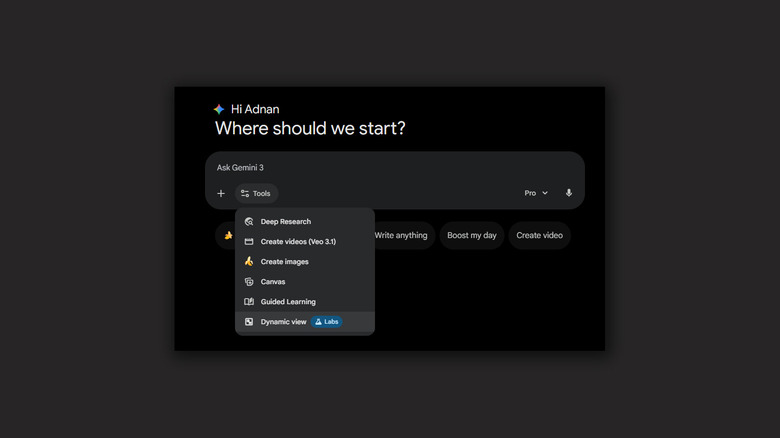
If you've recently used Gemini, you may have seen a tool labeled "dynamic view." It's designed primarily for exploring and learning concepts that are better explained with images or interactive elements. When selected, it will attempt to build a whole experience surrounding your question. Google says dynamic view uses agentic coding to design and create single-purpose modules that you can interact with.
It can be an effective way of learning complex engineering concepts, for example. ChatGPT does have a dedicated "study and learn" tool, but it still relies on text or image generation to answer your queries. A feature like dynamic view can make the ChatGPT experience a lot more interactive. For instance, we asked both Gemini and ChatGPT how a steam turbine works. While both of them covered the fundamentals quite clearly, Gemini produced an interactive visual that let us adjust the inlet pressure and see how a turbine works in real time.
Since you have the ability to share conversations, a dynamic view response generated by Gemini instantly becomes an interactive web app that you can pass around. ChatGPT has a "Quizzes" feature that works quite well and generates quick card-style quizzes on any topic you desire. Something interactive like this, but expanded to be more dynamic, would be a great tool to have.