

Why Harley-Davidson Motorcycles Have 'Underpowered' Engines
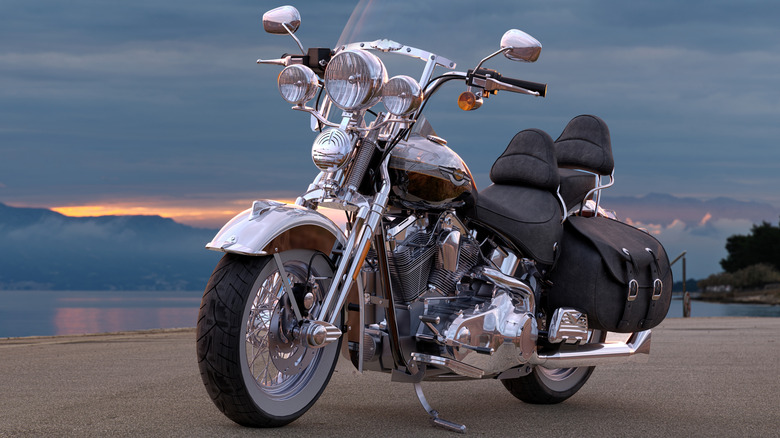
The name Harley-Davidson alone has a connotation of raw Americana. These are brutish and big bikes that you hear coming long before you see them. The aesthetics alone turn heads with gorgeous twists of chrome pipe, swept bars, and — more often than not — accents of black leather and buffed fairings. Harleys have a strong cultural cache, appearing as formidable and powerful bikes, with models like the Sportster seemingly made to fit this description. However, if we zoom out and consider Harley-Davidsons within the broader context of bikes, they could be perceived as underpowered. It's a known fact that these motorcycles will get you off the line quickly with a deep well of torque to draw from, and for most fans, the low-end torque is the entire point. Its stock engine designs actually preclude massive horsepower potential by nature.
The lack of power is by design, built-in to these 45-degree V-Twins as a bug — or feature, depending on how you see it. To wit, Harley's engines are "under square," which means that the stroke — how far the piston moves — is longer than the bore (the width of the cylinder). Thanks to this geometry, it means that the pistons in a Harley engine must travel quite far with each rev, so that piston speeds become high, while the RPMs are relatively low, restricting power potential. In essence, these bikes are meant to get you up to speed comfortably — imagine sitting back on a Street Glide on the freeway — as you cruise along at safe speeds.
Power isn't the point
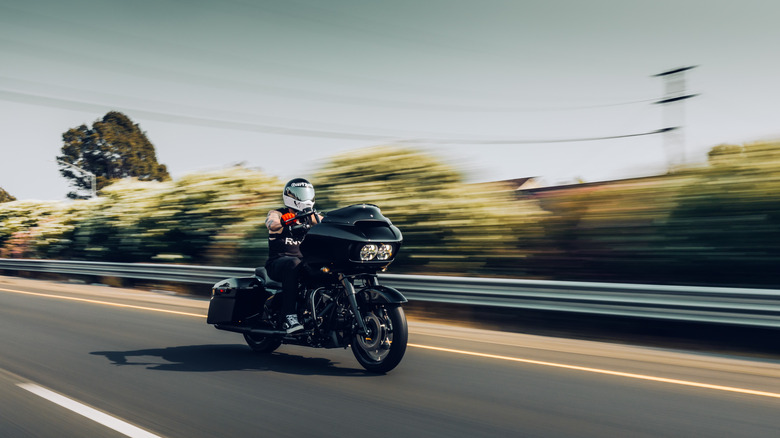
If you're looking for face-distorting thrills with snappy throttles revving to 15,000 RPM, you're probably not going to a Harley dealership to find it. Milwaukee brawn is more of a lifestyle and less about raw power, despite the overtly muscular posture of these gorgeous bikes. Take, for example, the 2020 Road Glide Special — a massive cruiser with an eight-valve V-Twin for touring with ease. It has a wide array of modern enhancements like its Drag-Torque Slip Control System (DSCS) and Cornering Enhanced ABS (C-ABS), but only tops out with 76 horsepower at 4,810 rpm. Granted, the bike has torque in spades, with an impressive, almost flat line showing on the dyno, hitting a peak of 108 pound-feet at 2,670 rpm.
If we do a quick calculation of the power-to-displacement ratio, we see that the Road Glide Special's 114 cu in motor puts out 0.66 hp/cu in, compared to a liter bike like the Ducati Panigale V4. This vicious Italian sport bike does 3.58 hp/cu in via the 60.9 cu in motor that produces 218 horsepower. This motorcycle is the closest you can get to simulating MotoGP scenarios on the streets, with perhaps too much power available. The takeaway here is that while Harley-Davidson might have a fair amount of competition, most enthusiasts aren't buying these bikes for eye-watering power, but rather because they're just cool bikes to comfortably cruise on, period.