

Changing A Semi-Truck Tire Is A Lot Harder Than You'd Think
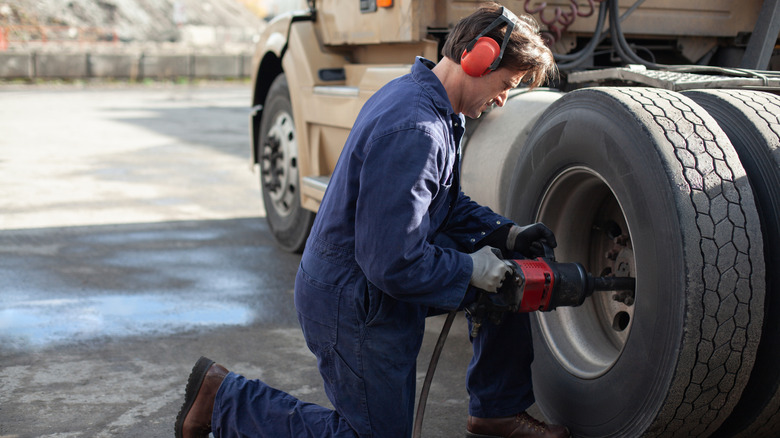
Getting a flat tire can be a major headache, especially if your jack isn't cooperating. But things can actually get worse, as many new cars don't even have spare tires anymore. For semi-truck drivers, changing a flat tire can be exponentially harder because it's on a much larger scale. It's so challenging that many drivers may hand the job off which uses professional-grade specialized equipment to ensure everything is handled safely and correctly.
A roadside tire change can be difficult, that the process itself is dangerous and should only be done by trained individuals. wheel chocks to keep the truck from moving. A heavy-duty hydraulic jack is then used under the axle to lift the wheel, which is no small task given the truck's weight. A large impact wrench or torque wrench using hundreds of foot-pounds of force is used to loosen and remove the lug nuts. The tire, 100 pounds, is removed, then its replacement is lifted up and positioned onto the axle. The lug nuts are tightened in a star pattern, and once the tire is securely attached, the chocks are removed and the driver is good to go.
It's worth noting that there are several videos and how-to articles online detailing how "easy" this entire process can be. But the coordination, balance, and careful handling required, especially if the driver doesn't have experience, makes it much more demanding than it may appear.
Replacing a semi-truck tire and avoiding catastrophe
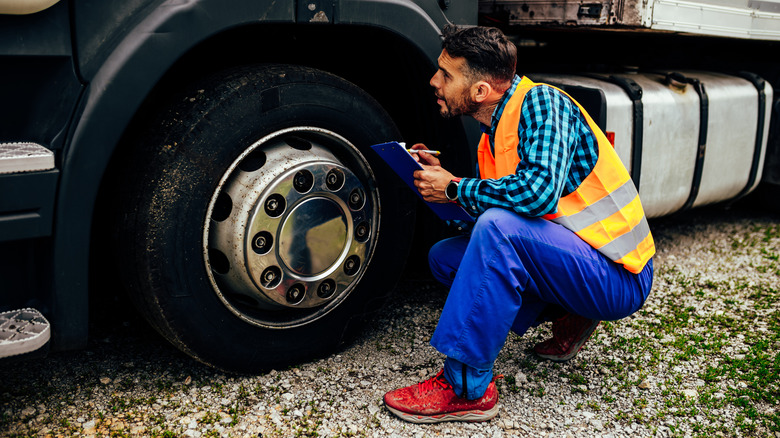
Changing a semi-truck tire is challenging enough, but things can get even more complicated if the tire from the rim. First, the tire must be completely deflated if it isn't already flat. This is especially true if the truck has an automatic tire inflation system. Then the bead, or the area where the tire sits flush against the rim, must be broken. OSHA notes that this move alone can cause serious injury if done incorrectly.
is removed, the new one is positioned onto the rim, and inflation is done from a safe distance, preferably while using a restraining device like a metal cage. The tire is then inflated to the correct air pressure before the wheel is installed back onto the truck. But even after a semi-truck tire has been safely replaced, there's still a risk of something going wrong.
For example, enough, the wheel can actually separate from the truck as it's in motion. This can also happen if the surface beneath the lug nuts is rusted, as this compromises their ability to securely hold the wheel in place. A wheel separation can create a serious road hazard, endangering both the driver and any nearby vehicles. This is why every installation must be followed by an inspection, to ensure that any potential catastrophes are avoided.