

Commercial Jets May One Day Look More Like B-2 Bombers
If you're not in the aviation industry, you might struggle to tell an Airbus model from another, or even an Airbus from a Boeing. Despite the fantastic technology in commercial aircraft, which would have been unimaginable just a few generations ago, they're not the most distinctive of aircraft, typically speaking. They're long and quite thin, with the Boeing 757 embodying those traits to such an extent that it came to be nicknamed the Flying Pencil. They're also generally plain white, with little more distinctive than an operator logo on the body.
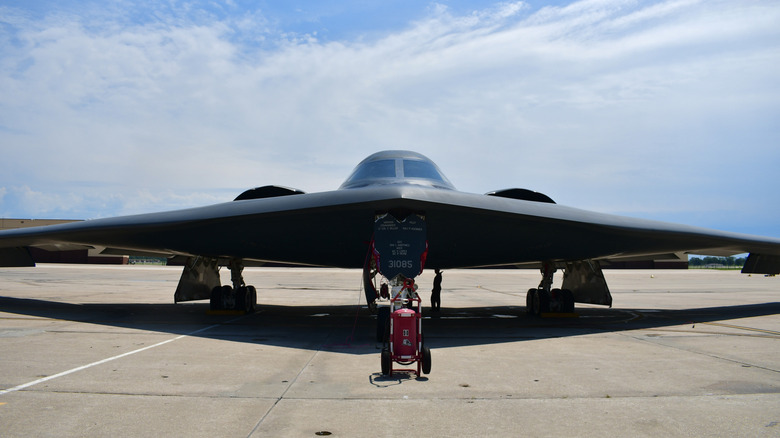
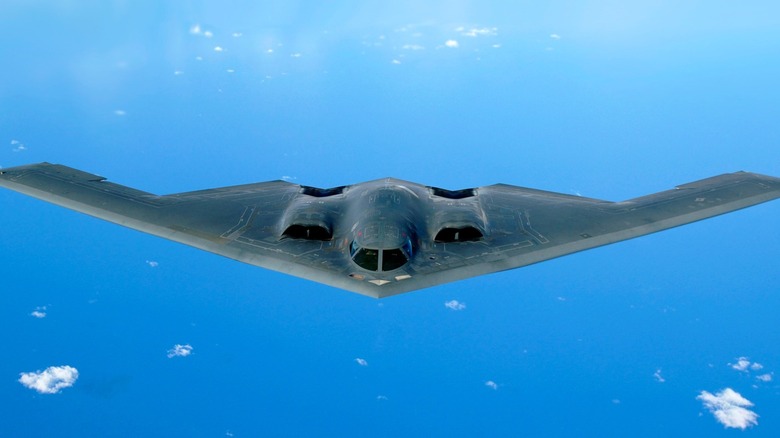
By contrast, fighter jets and bombers, by virtue of their specialized roles and advanced capabilities, have very distinctive designs. The wonderfully triangular B-2 bomber, for instance, has a flying wing design, which is more practical for an aircraft of its type but looks worlds apart from a commercial aircraft that could seat 100 people or more. This is why it's so interesting that Guillaume Faury, the CEO of European aviation titan Airbus, believes that commercial models will look much more like the B-2 bomber in the not-so-distant future. Speaking to the German outlet Bild in December 2025, Faury predicted (in a translation from AS) "we may see fundamental changes in aircraft architecture" within the next forty years or so. He suggests that, by that time, commercial aircraft may "no longer have a fuselage with two wings, but rather one large wing in which the passenger cabin would be integrated." It probably sounds very strange, but there are some practical reasons why aircraft operators might make such a radical change to their fleets. Let's take a look at the advantages of a blended wing design, as well as the aircraft that already use it and why this might happen.
Why the B-2 bomber adopted its distinctive flying wing design
One challenge with achieving efficient flight possible is aircraft weight. Wings are critical in both achieving and maintaining lift and supporting the fuselage. This is part of the answer to how airplanes fly, but they don't necessarily do so in the most efficient fashion. The fuselage doesn't contribute lift and indeed adds weight and increases resistance to make the wings work much harder. Both blended wing aircraft and fixed wing aircraft are attempts to circumvent this issue, but despite their similarities, they're not exactly the same approach. The most important thing is that there's a fuselage on blended wing models, while a flying wing aircraft is essentially just that: a model in which the entire aircraft has the aerodynamic properties of a wing.
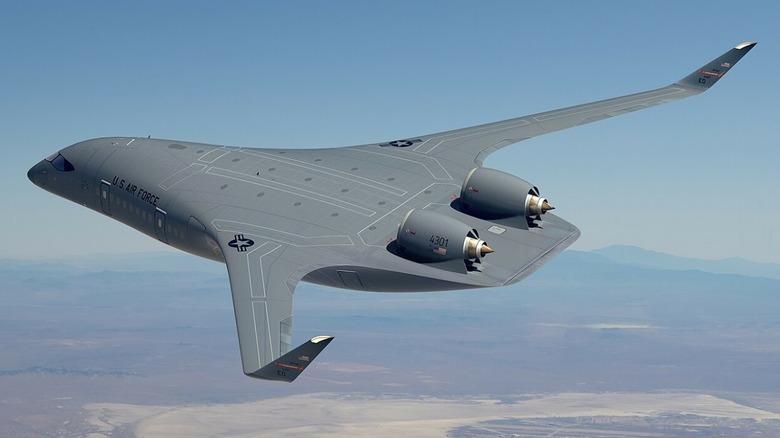
Blended wing models and flying wings alike have another advantage, in that they are more difficult to detect via radar. For a stealth model like the B-2 Spirit Bomber, this can be of critical importance, and it's a functionality that future military models may be able to make excellent use of too. In November 2024, MTU Aero Engines analyst Claus Zeumer explained to AeroReport, "the U.S. Air Force has repeatedly expressed an interest in having a tanker aircraft with a reduced radar signature. An appropriately designed BWB is better placed to achieve this than conventional configurations." Northrop Grumman adds that a demonstrator created by JetZero (concept art pictured above) shows the potential for a model that's more maneuverable, boasts more lift and approximately 30% less drag, a larger capacity and "the potential to achieve 30 to 50 percent fuel savings over a comparably sized tube and wing aircraft." The blended wing also has the potential to provide more room for storing cargo or accommodating passengers.
The challenges of bringing a blended wing model to the commercial market
You might question why there isn't already a glut of commercial blended wing aircraft reaping advantages. The answer is simply that there are downsides to the configuration as well. Airlines, naturally, focus very heavily on keeping their aircraft as profitable and as safe as possible, but sometimes it has to be more about what customers will be happy with than what will be cheaper. One of the primary issues with a blended wing layout is that, as Airbus CEO Guillame Faury put it to Bild (translated by AS), "there would be no windows to the outside." There will be some travelers who won't mind this compromise, particularly as Faury goes on to note that "the aircraft would be significantly more efficient than today's models," but others will find it very difficult to stomach. The view from a window seat is a huge comfort, whether simply for the view or as relief from the enclosed feeling that comes with a long flight. Though JetZero proposes solutions like digital windows and real, more spaced out ones, there's also the problem that control issues also prevent current flying wing models from breaking the sound barrier.
The Director of the Institute of System Architectures at the German Aerospace Center, Björn Nagel, explained to AeroReport that the design is not conducive to being equipped with a pressurized cabin. "The aircraft's shape makes it particularly unsuitable ... you need a tube with cabin pressure on the inside, while you have the aerodynamic contour shape on the outside," Nagel said, making for a steep challenge for engineers. Nonetheless, as we've seen, the technology holds a lot of promise, and the buzz continues to develop though the U.S. ended the B-2 bomber program.