

As Satellites Flood Earth's Orbit, Disaster Is Only Ever Days Away
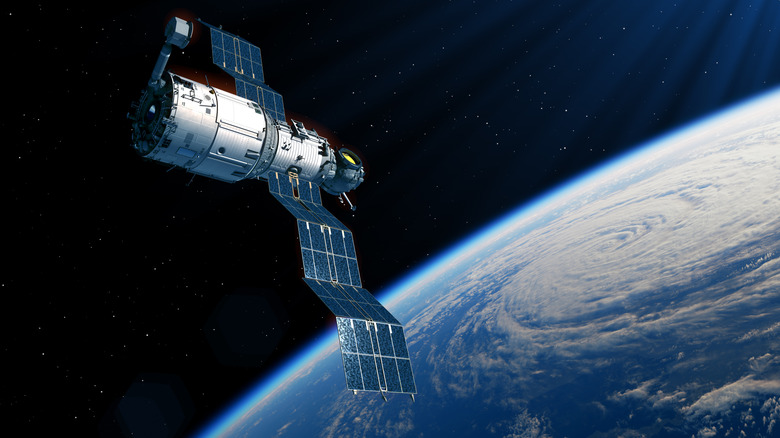
Now decades after the fabled Space Race of the 1950 and '60s, humanity's presence in space has dramatically increased. While it is remarkable that humans have so much floating around in Earth's orbit, notably thousands of satellites launched into space by different countries, it's not all positive. For instance, in a hypothetical scenario where a satellite, or satellites, lost power and their ability to maneuver, the window before disaster has shrunk immensely. According to University of British Columbia astronomer Aaron Boley, the timetable has gone from months to less than a week before satellites could collide in orbit (via Scientific American).
For more precise measurements, we can look to the Collision Realization and Significant Harm, or CRASH, Clock, which studies potential satellite crash times. Research as of June 2025 suggests that the time before collision has whittled down to 5.5 days — a dramatic decrease from 164 days as of January 2018. As it turns out, much of this decrease in elbow room for satellites can be attributed to the sudden influx of new additions, as satellite counts have jumped from around 4,000 to 14,000 since the late 2010s. SpaceX's Starlink satellite constellation alone is responsible for roughly 9,000 new satellites since the company entered the atmosphere in 2019.
While a satellite crash isn't imminent, evidently, there's less time to act than ever before should one seem likely. Thus, one has to wonder what could cause such a situation, what would the response be, and what could happen in the event of a collision?
What happens in a satellite collision situation
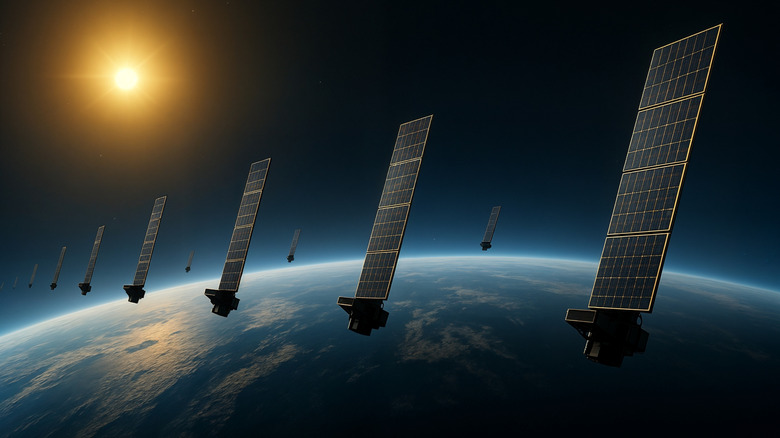
Multiple things can occur that would lead a satellite to lose power. While there are safeguards in place if a NASA satellite degrades to the point of being unusable, something like a solar storm — a charged wave of radiation that can impact satellites, power grids, and the like — is more difficult to prepare for and impossible to combat. A storm strong enough could theoretically harm satellite navigation and communication systems, thus leaving it to drift without direction. NASA did work previously to make in-space servicing a reality via the OSAM-1 program, but this was shuttered in 2024 before it could be meaningfully implemented.
With a satellite adrift, a few things can happen. In a best-case scenario, the Earth's gravitational pull would yank the satellite down, with it falling apart and burning up upon reentry. However, given the sheer amount of satellites and debris floating around, a collision is quite likely. Once this happens, more debris will be generated with the potential to collide with other satellites. This chain reaction could cause what has become known as the Kessler Effect: a state where the atmosphere becomes so polluted and collision-prone that space exploration will become virtually impossible. Efforts are already being made to prevent this, as evidenced by Japan's plan to eliminate space junk without touching it, for example.
Space exploration comes with numerous risks, even without going beyond Earth's atmosphere. Hopefully, we as a society will be more mindful of what and how much we launch out there in the future, lest we reduce the likelihood of ever being able to safely venture into the stars.