

Musk Vs. Bezos: Starlink's Rival Will Launch Over 5,000 Satellites Next Year
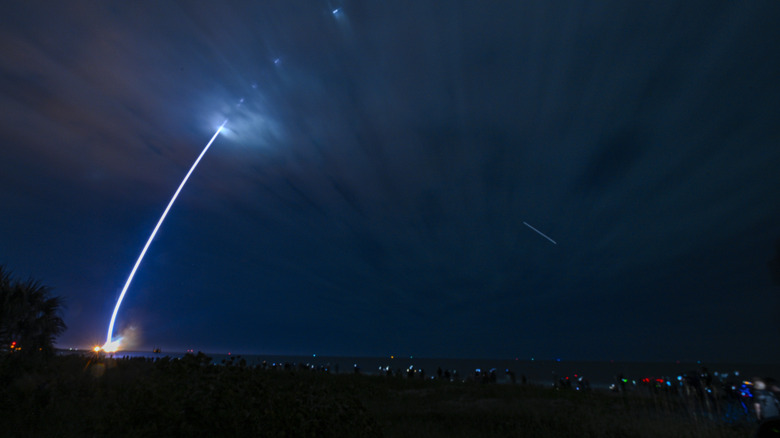
Blue Origin, the private aerospace company owned by Jeff Bezos, announced on January 21, 2026, that it's going to launch 5,408 satellites into low and medium Earth orbit. These satellites make up the company's new Terawave constellation that "addresses the unmet needs of customers who are seeking higher throughput, symmetrical upload/download speeds, more redundancy, and rapid scalability." The first of these new satellites is expected to be deployed near the end of 2027.
While this encroaches on Elon Musk's Starlink territory to a degree, Starlink also caters to residential customers. Blue Origin's big plans — for now at least — focus entirely on enterprise customers, such as data centers and government entities.
The company says that Terawave will be able to provide internet speeds up to 6 Tbps through its optical connectivity via 128 medium Earth orbit (MEO) satellites and 144 Gbps through its 5,280 low Earth orbit (LEO) satellites. Bezos is also linked to the Amazon Leo constellation — formerly known as Project Kuiper — but even with those satellites, it doesn't come anywhere close to the number of satellites Musk is linked to. After SpaceX shot dozens of new Starlink satellites into space in 2025, it is nearing 10,000 in its constellation.
What is Amazon Leo
Jeff Bezos might not be the CEO of Amazon anymore, but as the founder and executive chair, he continues to have a hand in the company's future. A part of that future was the deployment of Amazon Leo, a constellation of satellites that provides both residential and enterprise customers with high-speed internet, serving as one of the best alternatives to Musk's Starlink. Amazon Leo was known as Project Kuiper, in reference to the Kuiper Belt, but it was only a codename. After the company got its first batch of production satellites into orbit, it decided to rebrand with the Amazon Leo name, a nod to the term "low Earth orbit".
These satellites provide users with download speeds up to 1 Gbps and upload speeds up to 400 Mbps. Just as Starlink gives users a choice between several different-sized receivers, Amazon Leo can be used via the Nano, Pro, or Ultra receiver. The smallest of the three is a seven-by-seven-inch square, and the largest is 20 x 30 x 1.9 inches. Amazon has more than 3,000 Leo satellites in orbit and intends to add more as soon as February 12, 2026, with the Ariane 6 rocket.
If it were a competition between Bezos and Musk, even with Blue Origin and Amazon Leo, Starlink still comes out with more satellites in orbit.