

You Can Brick Your Turbo If You Don't Clean This Part Of Your Engine
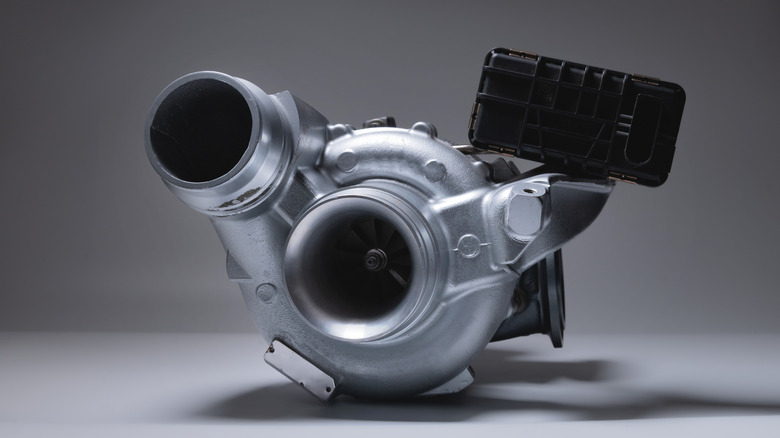
As cars get ever more complex, the process of looking after them аlso does. Wind the clock back a good number of decades, and so long as you threw some fresh oil in the vague direction of your hood, and chucked a few fresh spark plugs and filters in there every few years too, you'd be good to go. Now, however, with hybridized and boosted engines that have to jump through countless emission-related hurdles, the maintenance process is more vital than ever.
Downsizing has been a hugely popular practise in the last 10 to 15 years or so. For the uninitiated, downsizing in this context is the art of replacing higher displacement, often naturally aspirated engines with something smaller and often turbocharged. In an attempt to keep outputs and capabilities in-line with what was previously available, automakers frequently reach for turbochargers, a great example of that being the later Toyota Tundra and Honda Accord generations as proof of this in action on a mass-market scale.
That's why more and more of us are finding something boosted under the hood, and with this comes something else to look after. Now, turbochargers don't really need direct maintenance — they don't have consumables like oil or filters, but the condition of components around them do need keeping an eye on. Poor quality oil, or low levels of the stuff, can directly affect your turbo's health, but fortunately, that's something that gets replaced frequently under any vehicle's service regime, but another part directly linked to your turbo regularly goes unchecked. The part in question is the exhaust gas recirculation valve, or EGR for short. This device was introduced as an emission-reducing device, but as EGR-equipped vehicles age, the EGR transforms into a turbo-targeting destruction device.
Here's how your EGR poses a threat to the turbocharger
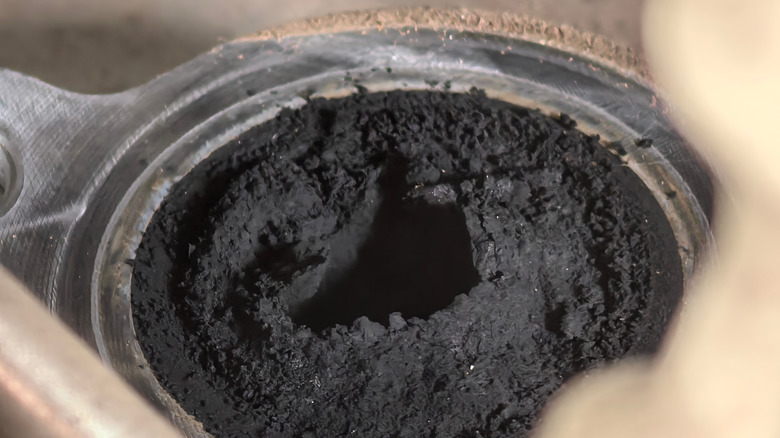
The role of an EGR is to pinch a portion of your engine's exhaust gases, and to chuck it back into the combustion chamber. Not only does this reduce combustion temperatures, but it also helps to reduce the number of harmful pollutants fired through the exhaust. The benefits are plentiful; chiefly cleaner air and improved fuel economy, but there is a downside.
See, the EGR is located within the engine's intake system, which makes sense, as it essentially forms part of this system. However, as exhaust gases are sent through it, over time, carbon begins to build-up inside the EGR. The YouTube channel Whiteface Ford demonstrates just how much carbon can attach itself to the inner walls of an EGR over time in the video below.
Not only does this build-up restrict the airflow, but it also poses a real problem for your turbocharger. It's okay while that carbon is in place, but if some of it becomes dislodged, it effectively turns into a bullet that aims straight for the turbo. Naturally, damage to the turbo's internals is expected, and then you could be looking at a serious bill — especially if shards of carbon or turbo blades make it further into your engine.
There is a solution, but it's not entirely straightforward
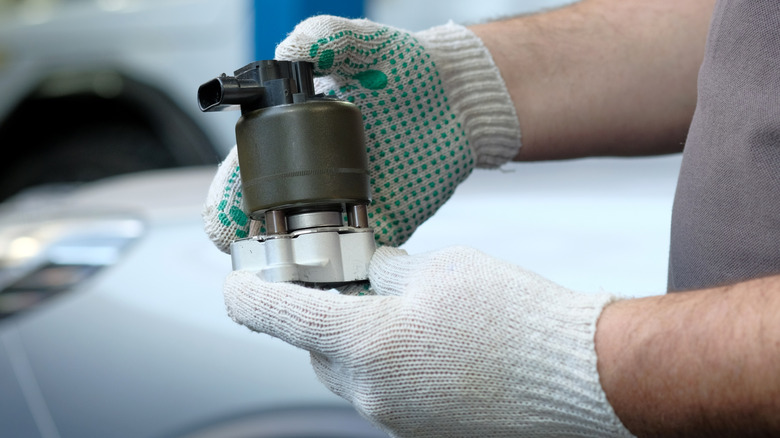
It sounds pretty scary, but don't worry, as this kind of damage can be avoided. Some will tell you that an EGR cleaner is all you need to keep on top of this, and while that certainly can help reduce the amount of carbon build-up in there, it's not conclusive. After all, with the EGR in situ, it's not possible to tell what its true condition is, so you'll not know how effective your quick-fix spray cleaner has been.
To truly get a grip on the solution, the EGR therefore needs to be removed and manually cleaned. This will be easier with some vehicles than on others; it all depends on the exact location of the EGR on your specific car. However, cleaning it can take some time, especially on older or higher-mileage vehicles. Popular methods include soaking it in diesel and scraping the carbon off, or using a more targeted product for the soak. Either which way, it's not a quick process, so you might end up with a long night in the garage, or a hefty labor bill if you're paying someone else to tackle the task.
If it's the latter, you might be better off simply replacing the EGR with a new unit — at least this way you'll know it's totally fresh, and that you've bought yourself tens-of-thousands of stress-free motoring — at least with respect to this specific issue, anyway. Typically, an EGR can be replaced for sub $500 all-in, which might sound like a better and quicker solution than paying a mechanic to tirelessly scrape away at your 10-year-old, 120,000-mile unit.