

What's The Difference Between Marine & Automotive Engines?

If there's one thing that all vehicle types, including those that go on sea and in the air, is that they all have an engine. Most cars still use engines, or electric motors in some cases, large aircraft use turbines, small aircraft use radial or sometimes piston engines, much like a car. Boats also use internal combustion engines, also known as outboards, and they can have anywhere from four to 400 hp.
From their first appearance, boats were powered by the wind, until a certain Gottlieb Daimler commissioned boat builder Friedrich Lürssen to build Rems in 1886, around the same time when that same Daimler was involved with a certain car you may have heard of. Rems was the first successful prototype motorboat. It was powered by a single-cylinder gas engine, and it proved that motorized boats were indeed viable.
Despite the fact that both cars and boats use internal combustion engines that run on gasoline, there are a few pretty significant differences between marine powertrains and automotive powertrains, including construction, operation, and movement. Let's have a look at the finer details.
Marine engines run very differently
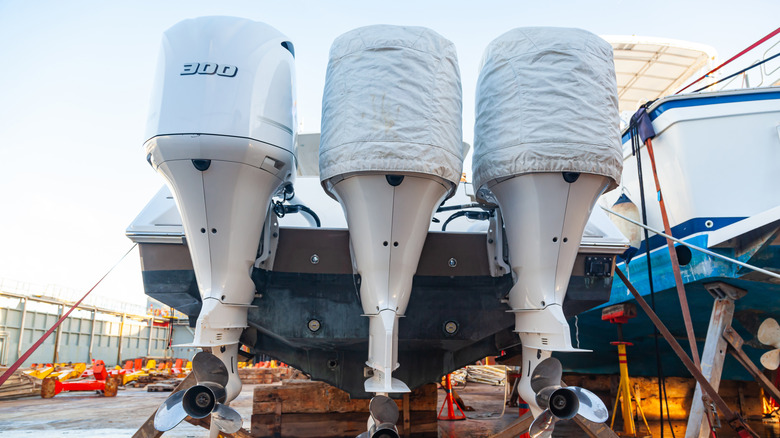
One of the most notable differences with marine engines is their rev characteristics. While a car cannot and should not maintain the same RPM for an extended period of time, and often requires a change of gear to keep running properly, marine engines can run at steady RPMs for long periods of time. Engines with marine applications have to be re-engineered to run at a constant RPM without burning out. Some marine engines have a lot of horsepower because they really do need it; it's constantly under load, no matter what's happening.
Speaking of, extra safety measures are taken to protect the engine from any sort of water ingress. This becomes especially important in the sea and the ocean. As you know, virtually no metal responds well to prolonged exposure to saltwater, so the engine has to have the proper enclosure. Of course, an obvious difference is that the engine is not connected to wheels via a driveshaft; it often simply spins a propeller that allows the boat to move on the water. If the marine engine in question is a two-stroke, it requires a special oil blend.
Interestingly, some automotive and marine engines have a few small things in common; there is a small block Chevy V8 for marine use, but that would not be suitable for automotive use, and vice versa. And no, you can't just LS swap a boat; a standard LS won't handle that. While internal combustion engines are something shared in the worlds of land and sea vehicles, the engines themselves are pretty radically different.