

OLED Or QLED – Which TV Type Lasts Longer?
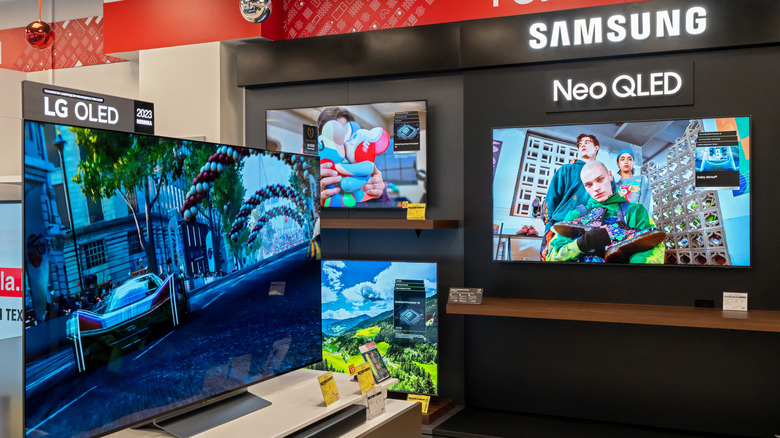
There may be a bewildering number of different acronyms for TV screens these days, with OLEDs, QLEDs, LEDs, RGB Mini LEDs, Micro RGBs, and more. But when it comes to TV screen tech, there really are only two main types: LED and OLED. LED TVs are actually liquid-crystal display (LCD) televisions that use light-emitting diodes (LEDs) as backlighting. This group includes QLED TVs, which also have a quantum dot display that produces better colors than regular LEDs. An OLED TV, on the other hand, works completely differently. It doesn't have a backlight. Each pixel on an OLED TV is self-illuminating when connected to electricity. The upshot of this is a better-quality, clearer picture with bright colors and deep blacks.
So that's the difference between QLEDs and OLEDs, but which one lasts longer? According to CEDIA, the international trade association for smart home tech, most televisions will last between seven and 10 years, and QLEDs last longer. However, consumer review site RTINGS says that when comparing the two types of television, "there's really no clear winner when it comes to longevity." How long your TV lasts depends on several factors, and while both QLED and OLED televisions should keep you entertained for years, there are still technical limitations to their lifespans.
An OLED TV's lifespan can be shortened by burn-in
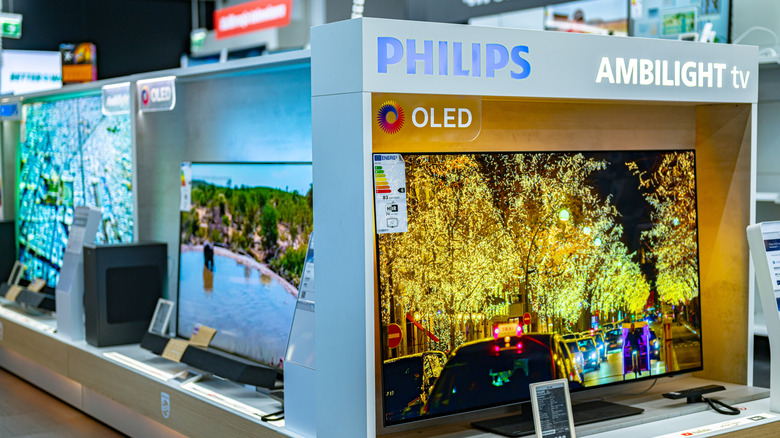
QLED TVs are sometimes thought to have longer lifespans than OLED ones. This is down to one major factor: burn-in. Because each pixel creates its own light, if an image, like a TV channel logo, stays on screen for too long, those specific pixels have to work harder than surrounding pixels. This means they wear out faster and become dimmer, leaving a permanent "ghost" or burn-in of the image.
In tests, burn-in can be easily replicated. RTINGS carried out a three-year experiment to test the longevity of over 100 different TV models, and all the OLED TVs developed burn-in. However, in this case, they weren't being used under real-life conditions. If you're regularly changing channels and avoiding using maximum screen brightness settings, you probably don't need to worry about burn-in.
It can be an issue for gamers, though, who regularly play games with static elements onscreen like health bars or scoreboards. If you're a serious gamer, you might prefer OLED over QLED due to its better motion clarity, delivering near-instant response times. So, while a QLED screen might last you longer, you'd need to decide if it's a compromise you're willing to accept. Because it uses backlighting rather than light from individual pixels, QLED is far less prone to burn-in, but it can still develop screen issues over time.
OLED TVs performed well in longevity tests
Burn-in is just one factor that impacts how long a TV usually lasts. The design, make, and model also play a role. Price, however, may not be as significant a factor as you expect. RTINGS concluded that there was no direct link between the cost of a television and how long it lasted. It reported, "Some of the cheapest models on this test have performed incredibly well with no issues, and some of the more expensive units were the first to fail."
RTINGS' longevity test provides good news for OLED TV owners. According to the brand, "OLEDs tend to last the longest and experience the fewest issues." Although the data distinguishes between OLED and LED televisions, it isn't clear how many of the LED televisions used QLED or an equivalent quantum dot technology. Of those tested, 20 TVs failed completely, including three OLEDs. The main reasons for televisions breaking down were backlight failures and the set no longer powering on. Other reasons for failure included a warped diffusor, internal component failure, and an OLED TV with dead subpixels.
Most of the tested televisions performed well for the first 10,000 hours, which is equivalent to 10 years of use in most homes. Plus, RTINGS really stress-tested those sets. Most of us will be a little kinder to our televisions and might get them to last longer than that. To keep your television healthy for as long as possible, avoid using maximum brightness, as this will wear out the pixels on both QLEDs and OLEDs. Using it less frequently could help your TV last longer, but we're not suggesting you forgo your favorite shows. Just make sure the TV isn't left on when nobody's watching, and that you power it down completely rather than using screensavers.