

This Small, Icy World Could Rewrite What We Know About Our Solar System's Past
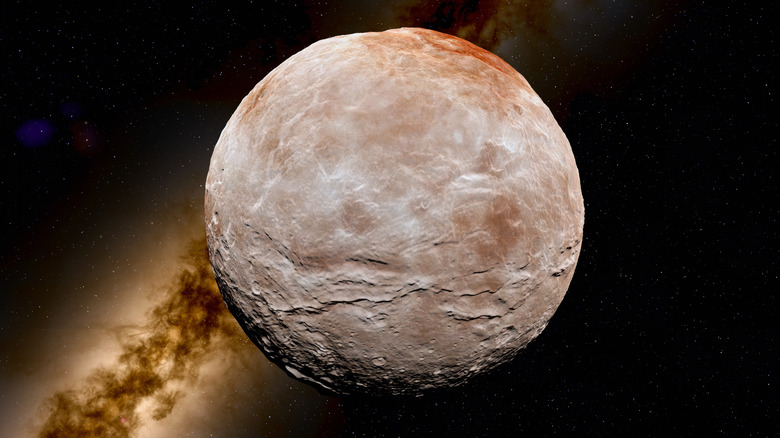
Every once in a while, the outer solar system reminds us that we've only discovered a negligible portion of it, and that the vast majority is still full of surprises. The latest example of this is a trans-Neptunian object (TNO), first spotted by the Subaru Telescope in Hawaii in 2023.
Formally designated 2023 KQ14 by an international team of astronomers as part of the FOSSIL project (Formation of the Outer Solar System: An Icy Legacy), the object came to be known as "Ammonite." But it's neither a planet nor a dwarf planet. Instead, it belongs to a rare category of trans-Neptunian objects called sednoids.
At the closest point in its orbit (perihelion), Ammonite is about 66 astronomical units (AU) away from the sun (more than twice the perihelion of Neptune). One AU is the approximate distance from the sun to the Earth, about 93 million miles. On average, the cosmic body remains about 252 AU away from the sun (about 23.4 billion miles). Based on the sunlight it reflects, the sednoid's diameter is estimated to be between 137 and 236 miles (less than a tenth of Pluto's diameter).
Due to the extreme distance, it takes Ammonite around 4,000 Earth years to complete one revolution around the sun on its highly elongated and tilted orbit. It is only the fourth sednoid ever discovered in the farthest corner of our solar system, after Sedna (found in 2003), 2012 VP113, and 541132 Leleākūhonua.
Discovery of another sednoid reignites the Planet Nine hypothesis
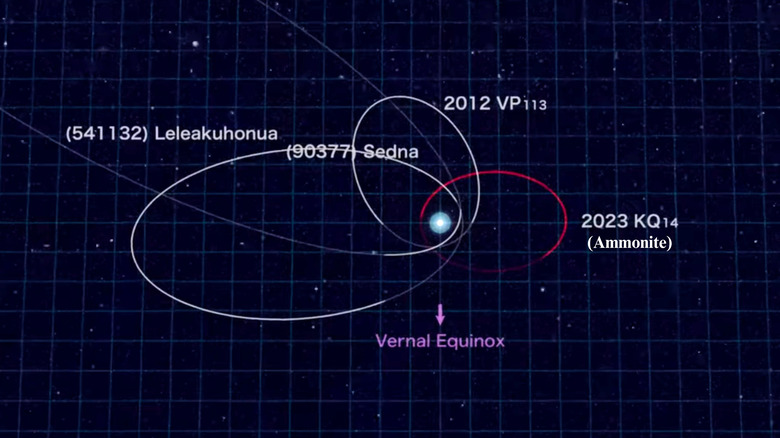
The presence of sednoids in the distant corners of the solar system contributes to the Planet Nine hypothesis. Scientists supporting the theory claim that the clustering of the small, icy bodies beyond Neptune and their unusually tilted orbits could be the result of the gravitational pull of a planet that's located beyond Neptune.
On the flip side, Ammonite doesn't really follow the observed pattern of other sednoids. Compared to the others, its orbit points in the other direction. According to a Subaru Telescope press release, Yukun Huang, who conducted simulations of Ammonite's orbit, said, "The fact that Ammonite's current orbit does not align with those of the other three sednoids lowers the likelihood of the Planet Nine hypothesis."
Huang still believes that a ninth planet "once" existed in our solar system but was later ejected, resulting in the unusual sednoid orbits. The claim originates from estimates of closer sednoid orbits around 4.2 billion years ago, and how the gravity of a passing star or the ejection of the ninth planet from our solar system, which could have placed the small icy bodies in their current, detached orbit.
Studying such objects, even though they're situated on the distant edge of our solar system, gives scientists a chance to learn about our cosmic neighborhood's history; the fourth sednoid is only a tiny piece of the gargantuan puzzle.