

Fed Up With Your Neighbor's Motion Lights? Here Are Some Things You Can Do
No matter where we call home — an apartment, single-family home, townhouse, condo, or mobile home — most of us simply want to live in peace. Our tolerance for noise and general hubbub differs depending on whether we're city dwellers or rural residents, but if we have neighbors, we simply want to get along. Unfortunately, conflict is sometimes inevitable.
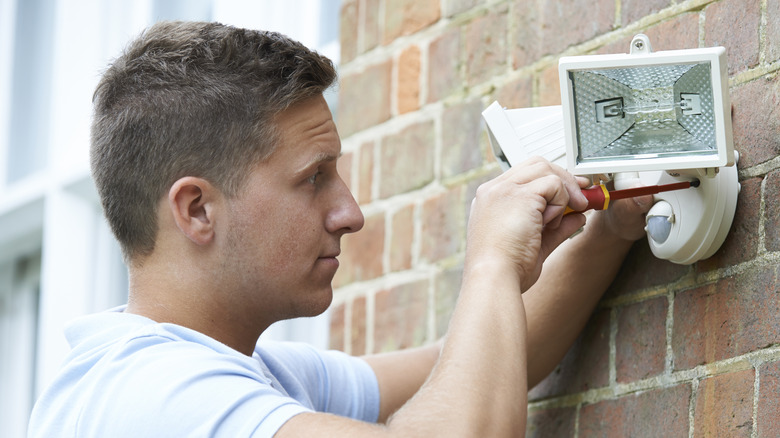
Motion-activated or motion-sensing lights, which turn on when they detect motion, are a popular choice for security purposes. They are available at many price points and in a variety of styles, from hard-wired, battery-operated, and even solar lights. Your neighbor's porch light may not be an issue, but brighter lights, or those that stray onto your property, can definitely fall into nuisance territory.
While states don't usually have legislation dealing specifically with light pollution or light trespass, many local municipalities and homeowner associations have rules to deal with this situation. Enforcement can end with your nuisance neighbor being fined — or even forced to leave their home.
Real-world scenarios

If you've never had to deal with an angry neighbor or unhappy and unyielding HOA, you may think exterior lighting is a minor subject to quibble over. However, many HOAs have restrictions on anything from air conditioning units to illumination levels and light trespass, or light that shines onto someone else's property.
The Village of Altamira, part of a larger planned community in Boerne, Texas, is a great example of an HOA with clearly defined rules and regulations regarding exterior home lighting. The HOA guidelines state that motion-detected exterior security lighting must be "mounted in such a manner that the cone of light does not cross any property line," to avoid light trespass. If the owner fails to comply, the guidelines clearly state that the HOA has the right to legal action, and even has the right to remove or modify "any improvement constructed or modified in violation" of the HOA's guidelines. If the property is leased rather than owned, the violator can be evicted.
The small town of Helper City's official website offers guidance on outdoor lighting for town residents that is likely similar to many small towns and cities across the U.S. This Utah town requires that "all light fixtures, including motion sensing fixtures and security lighting," be aimed in such a way that the light does not cross the boundaries of your property. If residents fail to comply, they'll receive several warning notices before being required to appear before a town official to discuss compliance. After 12 months with no compliance, residents may be fined up to $750.
What to do about disruptive motion-activated lights
Rules and penalities will differ depending on your local ordinances, and remember, an immediate resolution is unlikely. Sometimes, the guilty party may decide to simply pay the fine and not take down or adjust the offending light. That being said, if you are the homeowner installing lights, there are steps you can take first to ensure that your neighbors don't become enemies.
If you have a good relationship with your neighbor, talk to them before you install new exterior lighting. Let them know it's ok for them to ask you to reposition or remove the light. Remember, if your light goes against local ordinances or HOA guidelines, you may be in for a fight.
To avoid conflict, try to aim your lights downward by at least 45 degrees so that they don't shine in your neighbor's windows. You can also add a shield to the light so that it illuminates your yard, but not everyone else's. Don't install lights that are brighter than your needs or illuminate past your property lines. Finally, it pays to maintain a good relationship with your neighbors so the HOA or local officials don't have to get involved.