

This HEMI Was Made For Nascar, But Made Its Way Into Some Rad Muscle Cars
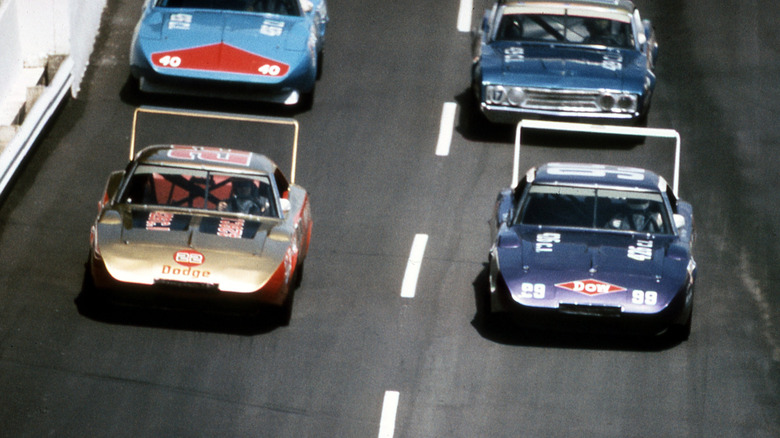
The Chrysler HEMI V8 is one of the most iconic engines ever built, with a legendary reputation on the street and a long list of accomplishments in motorsport. The Chrysler (now Stellantis) HEMI is also an engine with a long lineage that stretches from its origins in the early 1950s all the way to the current era, where HEMI engines power Dodge's modern muscle machines. But when it comes to HEMI history, it was during the mid 1960s when the Chrysler HEMI evolved from being a simple V8 with hemispherical induction chambers into a mythical engine of muscle car legend.
It was during these years that the new 426 cubic-inch 'Street HEMI', as it was known, made the words '426 Hemi' into a household name. The high-displacement, high-horsepower V8 made its way into many different Chrysler muscle cars during the late '60s and early '70s, where it'd become one of the most feared engines on the street and drag strip alike. But it wasn't just in Detroit engineering rooms or in the drag racing scene where the 426 HEMI's story took shape; it was on the high-banked ovals of NASCAR.
Given the HEMI's wide-reaching impact and the ever-present aura around 426-powered muscle cars, the engine's distinct stock car racing origins are actually an overlooked part of the story. It's a tale that calls back to a time when NASCAR competition and road vehicle engineering were much more connected than they are today.
From Daytona to the streets, and back
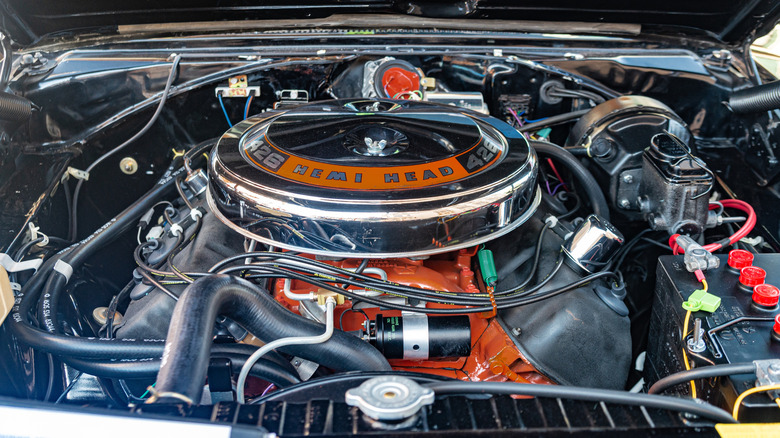
By the mid 1960s, NASCAR stockers had begun to get faster and more purpose-built than their street car counterparts, but there was still a close tie both the look and the engineering, particularly when it came to the engines. For the 1964 NASCAR season, Chrysler wanted to extract more horsepower from its existing 426 'Wedge' V8, so it dug back to its 1950s DNA and worked up a set of hemispherical 'HEMI' heads for the 426, creating the first 426 Race Hemi.
The engine was an instant winner, propelling Richard Petty's Plymouth to victory in a dominant '64 Daytona 500 result for Chrysler. NASCAR would then end up banning the 426 Hemi for the 1965 season because the engine was not available in a production car. Chrysler's solution was to introduce the A102 426 Street Hemi for the 1966 model year. The rest is history, with the HEMI returning to NASCAR and continuing its winning ways, while Street HEMI-powered muscle cars became legends of their own.
The issue with the HEMI wouldn't be the last time NASCAR took action against Chrysler for an 'unfair advantage'. In 1969 and 1970, the Dodge Daytona and Plymouth Superbird famously looked to achieve dominance on NASCARs' super speedways with radical aero bodies and massive rear spoilers. Even though there were street versions to go with the race versions, NASCAR still banned the wild-looking Daytona and Superbird after just two seasons.
The NASCAR HEMI comes full circle
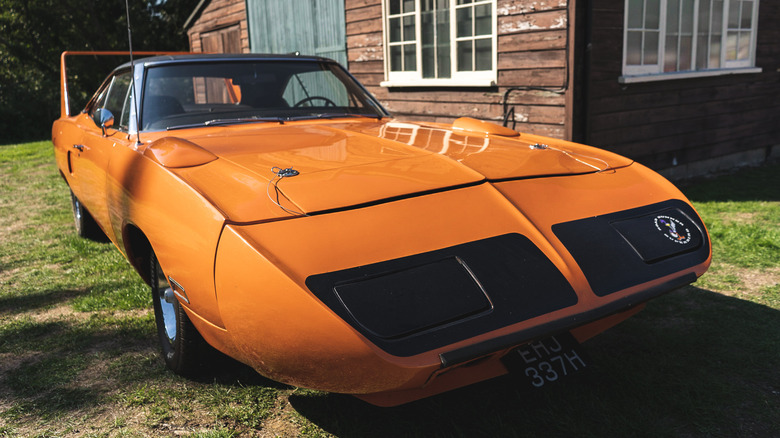
On the muscle car side, the 426 Street HEMI option would be offered in various Chrysler models until 1971, when new emissions rules spelled the end not just for the 426 but for the muscle car era in general. In NASCAR, the sport had mandated smaller engines and standardized rules for them by 1975. Eventually, NASCAR would reach the point where stock car engines had nearly nothing in common with production motors. For example, the current Toyota Camry is a sensible four-cylinder hybrid sedan, while the NASCAR Cup Series Camry race car is powered by a 358 cubic-inch, overhead valve TRD V8 not used in any Toyota production vehicle.
From a marketing standpoint, though, there's still at least some connection between stock car racing and a company's production vehicles. In a way, things have actually come full circle for RAM (formerly Dodge), which is reentering the NASCAR Truck Series for the 2026 season as it brings back the modern HEMI V8 to its production pickups.
The legacy of the 426 Hemi engine ended up going far beyond NASCAR and into the pages of American muscle car history, but without the highly competitive, free-wheeling environment of 1960s stock car racing, we might never have had this wonderful muscle era engine.