

Is It Worth Paying Extra For An OLED TV? Here's What You Need To Know
We may receive a commission on purchases made from links.
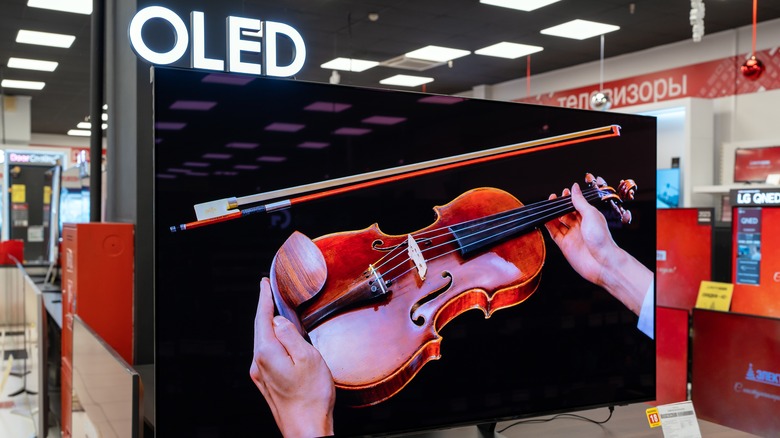
Organic light emitting diode (OLED) televisions generally sit at the high end of the market. With a reputation for being pricey, OLED TVs are a big investment for many shoppers, who may find themselves choosing between OLED or mini-LED, the latter of which is often cheaper and can still produce a stunning image.
To get us up to speed, OLED differs from standard LED in that each pixel is self-emissive — meaning it produces its own light — whereas LED displays work by shining backlights through whole swaths of pixels. Mini-LED TVs push that concept further. They can have thousands of dimming zones to narrow the gap, but OLED will always be superior in certain ways. For example, OLED has a theoretically infinite contrast (the difference between the lightest and darkest part of an image) because black pixels are turned off entirely. But OLEDs do have downsides. They are generally less bright, harder to view during the daytime, and more prone to burn-in (a phenomenon in which an image left on screen for too long leaves an echo of itself that never goes away).
Having owned displays ranging from IPS to mini-LED, in addition to OLED, I can't dispute the superiority of the latter. In fact, the best case I could make against buying an OLED is that once you do, other displays will always seem disappointing by comparison. But picture quality isn't the only priority for every TV shopper. Some may prioritize size, features, and of course, price. So, here's what you should consider before dropping what could be a significant amount of extra cash for an OLED TV.
OLED is a worthwhile investment for cinephiles and gamers
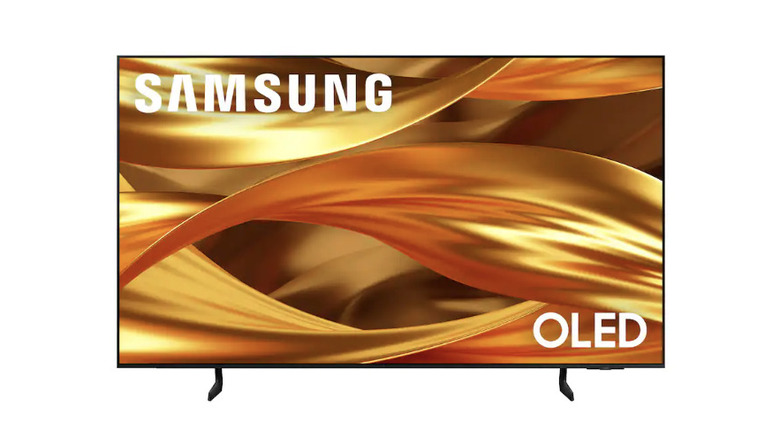
If you consider yourself more than a casual gamer, or if you're a self-proclaimed cinephile, you might be the kind of person who would benefit from an OLED TV. Although you can spend less money on a mini-LED or other type of TV — not to mention a larger screen for a similar price — those who prioritize picture quality above all else are more likely to appreciate the benefits of an OLED. For HDR content or special formats like Dolby Vision, there's no beating the true blacks and vivid imagery an OLED can produce. And you won't see the backlight bleed typical of LED displays, which makes for better display uniformity.
These benefits also translate to gaming. If your console supports HDR (or you're the odd PC gamer who plays on a TV) will generally find OLED sharper and more vivid. Assuming you're in a low-light environment, OLED can also reduce eye strain over long gaming sessions since it does not tend to flicker at low light levels. However, if you like to watch TV in the daytime with the windows open, OLED is known to produce more screen glare. And since they struggle to get as bright as LED panels, you might not be able to overcome the glare off an OLED panel, even at full brightness.
Still, minding your wallet is crucial. You don't wind up writing about tech unless you're the sort of person whose idea of a good time is reading spec sheets. Add an obsession with movies, and you get me: the sort of person who should buy an OLED. But I sold mine for a cross-country move several years ago, and although I pine for another, I've made due perfectly well with an affordable mini-LED.
Not everyone should get an OLED TV
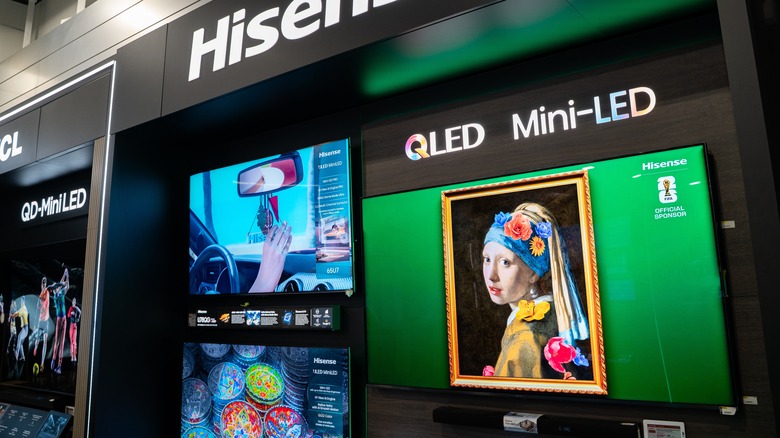
Smart money shoppers choose mini-LED, assuming they're prioritizing value over bleeding edge technology or technically superior image recreation. If you're looking for a high quality image at a price that won't sting, and you're not the kind of person who's obsessed with seeing movies exactly as the director intended, you will likely be very happy with a mini-LED or QLED TV. You can put the savings toward a soundbar, buy up to a larger screen size, or pocket the difference. Many modern mini-LEDs can get quite close to the picture quality of an average OLED, with the only OLED benefits they can't recreate being infinite contrast and complete display uniformity. Sure, you'll notice the difference when comparing an OLED to a mini-LED or QLED side-by-side, but you'll also notice the significant price gap.
If you plan to put the TV in a bright environment such as a living room with large windows, OLED can be a hassle thanks to its penchant for screen glare and peak brightness levels which are, on average, lower than those of mini-LED. So if you like to keep something on in the background during the daytime, that's another point in favor of mini-LED. Add another point if you're the sort of person who's likely to pause a movie and fall asleep with the TV on, which could lead to screen burn on an OLED panel. And then there are the myriad other things that go into choosing a TV: the operating system and smart features, viewing distance and screen size, support for HDR 10+ or Dolby Vision, port selection, and so on. Ultimately, OLEDs are the best choice if money is no object and you have the proper environment. Otherwise, affordable alternatives are the safe choice.
Methodology

The opinions in this article are based on personal experience with OLED and LED televisions and displays and accompanying subject matter expertise. In addition to hands on testing of multiple different televisions and displays with differing panel technologies, other testing and firsthand journalistic perspectives were considered, as were technical documents related to OLED and LED panel technologies.