

Mazda Purposefully Tanked Sales Of Its Entry-Level SUV
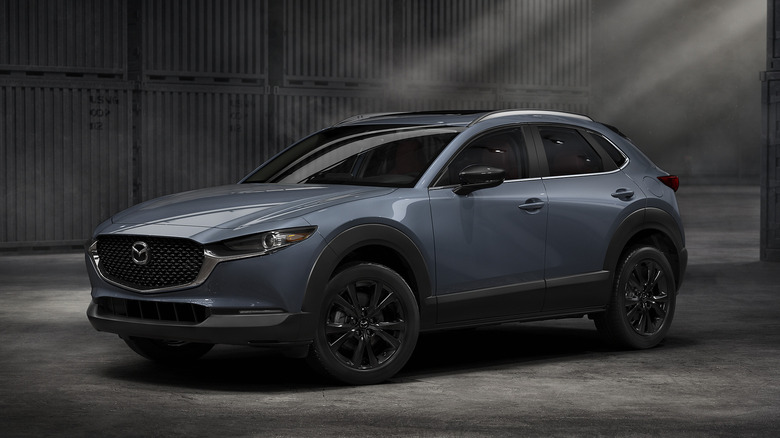
The athletic and award-winning Mazda CX-30 is a popular subcompact crossover that typically sells very well. We gave the 2025 model high marks for its sporty look, long list of standard equipment, luxury cabin, and dynamic drive. It's also won a laundry list of safety awards in recent years, including the Insurance Institute for Highway Safety (IIHS) Top Safety Pick six years in a row. It's often touted as a great pick for families, and it's hard to beat its starting price of $25,975 for the 2026 model year, before the destination charge. Why then did sales plummet in 2025? According to Mazda, as reported by CarBuzz, it wasn't quality or design that turned people away — it was the automaker's own strategy.
2025 was a noteworthy and rather unpredictable year in the automotive world. The average price of a new car hit a record $50,000, the growth of the electric vehicle market in the U.S., long expected to continue in leaps and bounds, plummeted in the second half of the year, and Tesla lost its crown as the bestselling EV manufacturer. And then of course there are the tariffs. Mazda builds the CX-30 at a plant in Mexico. Amid the tariff chaos and uncertainty, the automaker elected to limit production of the crossover SUV. Ultimately, Mazda sold 56,684 CX-30 vehicles in 2025, a more than 40% drop from the 96,515 sold in 2024. Here's why it was still probably a wise move.
How tariffs affect cars made in Mexico
It was impossible to keep up with the whirlwind of tariffs and changes, so if you don't know where the car industry finally landed in the turmoil, we don't blame you. It's more complicated than Common Core math, but here's where the U.S. stands with vehicles manufactured in Mexico. Many vehicles coming to America from Mexico are currently subjected to a 25% tariff — but not all. If at least 40% of the parts and materials that make up the vehicle are from the U.S., the 25% tariff does not apply to that portion of the vehicle. Even if only a portion of the CX-30 was subject to tariffs, the price could increase substantially. While the base price of the 2026 model is only about $780 more than the 2025 model, buyers must also pay a $1,495 destination charge.
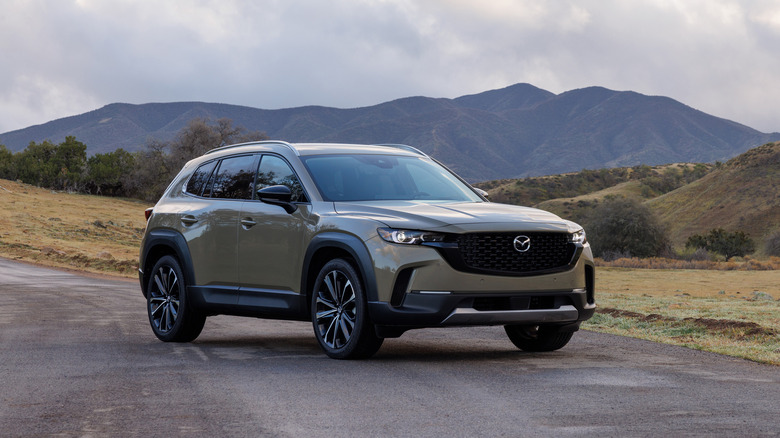
As a result, Mazda told CarBuzz, "[W]ith ongoing uncertainty around U.S.–Mexico tariff agreements, we made a strategic decision to scale back production of this model." It's not clear if this signals a long-term shift in Mazda's strategy, but for now, if you were interested in purchasing a CX-30, you may want to explore other options, though the CX-30 may still be available at your local dealership. Mazda's website states at the time of writing, "2025 Model Inventory Remains Unaffected By New Tariffs." If you have a little wriggle room in your budget, check out the Mazda CX-50. This larger SUV boasts a price under $30,000, an athletic ride, and more cargo space than the CX-30.