

These Are The Only Ships Able To Reach The North Pole
The North Pole has long been considered the home of old Saint Nick. Interestingly, the singular form of the name suggests there is only one, sitting all by its lonesome at the top of the world. Sounds like the perfect location for Santa Claus to do his thing in secret, right? In reality, that's not the case at all; there are actually several different "North Poles."
North Pole, Alaska, is a small city (with a static location) less than 14 miles southeast of Fairbanks. Meanwhile, the geographic "true north" pole is where all the longitude lines on a map come together. The magnetic north pole is where compass needles point, but it's inching its way towards Siberia, Russia, at about 22 miles a year. Because the Earth wobbles as it rotates on its axis (the "Chandler Wobble"), the instantaneous north pole doesn't have a fixed address either. Then we have the north geomagnetic pole, a confusing concept that refers to Earth's magnetic field as a bar magnet, only useful to those in space (per the U.S. Geological Survey).
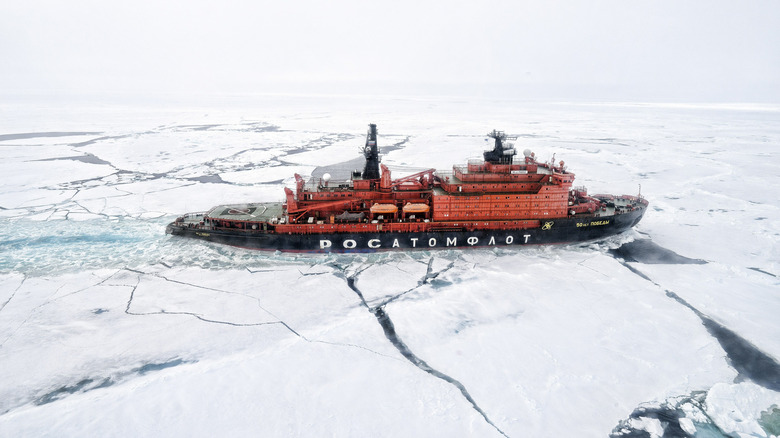
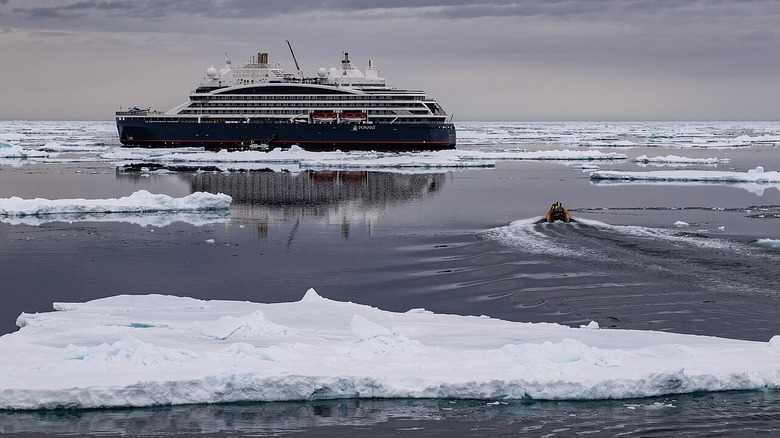
Lastly, there's the North Pole of Inaccessibility (POI), a physical location so challenging to reach that only two ships can take you there. The "50 Years of Victory" is a nuclear-powered Russian Arktika-rated icebreaker. Meanwhile, the French-flagged "Le Commandant Charcot" is a Polar Class 2-rated luxury expedition ship powered by a hybrid electric engine fueled by liquefied natural gas (LNG). Interestingly, the USS Nautilus — the first nuclear-powered submarine — made history when it passed under the North Pole ice cap for the first time on August 3, 1958.
The ships are impressive
The North POI is located in the Arctic Ocean and is full of multiyear layers of ice that move, thaw, and refreeze. These mega slabs can be anywhere between six and 25 feet thick, making it impossible for anything but icebreaker ships (very different from normal ships) to attempt without getting crushed.
The "50 Let Pobedy" ("50 Years of Victory") is the fifth of six Arktika-class icebreakers built by the Russians for commercial use. First launched in 2007, it's built with a double hull and an 18-foot-wide stainless-steel belt capable of withstanding the harsh environment. Two nuclear reactors generate 75,000 horsepower, and the 20-inch thick spoon-shaped steel prow can break up nine feet of ice. 30 feet below the surface, hull-mounted jets spray hot steam to help dissolve ice. It can accommodate 124 passengers, complete with a restaurant, gym, and library; it even has a pool and two saunas.
The French "Le Commandant Charcot," rated at Polar Class 2 (PC2), is a significantly larger ship that launched in 2021. It's the first-ever purpose-built icebreaking "cruise ship" and can carry 245 guests and 215 crew members. It isn't as resolute as Arktika-class ships, but it can still punch through eight-foot ice floes and 32-foot compression ridges. Six liquefied natural gas-powered engines (four 7,700kW and two 5,500kW) drive two pod-mounted 17,000kW electric propulsion motors, giving it an open water speed of 15 knots. It can stay in place without dropping anchor, run silently for two hours with no emissions, and remain autonomous for roughly 45 days. The POI can only be reached when the ice is thinnest, but for only $38,510, you can visit it too.