

Do US Navy Pilots Use Autopilot To Land Jets On Aircraft Carriers?
In December 2025, California demanded that Tesla stop calling its cars 'self-driving' because, at the most literal and technical level, the vehicles (that retail at the time of writing) require attentive drivers at the ready to step in should they be needed. Similarly, aircraft of all shapes and sizes have developed autonomous functionality that eases pressure on pilots. However, dispensing with pilots entirely would be all but unthinkable. Human oversight and expertise remains critical across different industries, so any autopilot features on an airplane do not mean that they are operating entirely by themselves. In fact, this is one reason why the Federal Aviation Administration specifies that, according to KHON2 News, "there must always be at least one other crew member with a pilot in the cockpit."
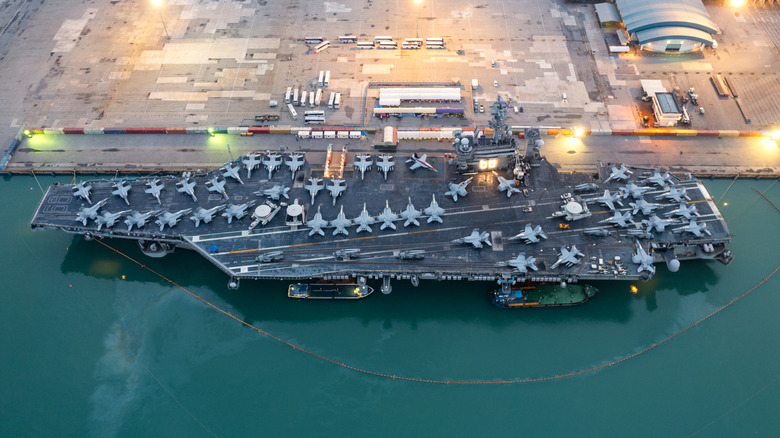
Of course, these are rules for larger commercial airlines and are not necessarily applied to the likes of U.S. military jets. Nonetheless, a similar overall principle is applied: Human control and oversight is critical to maneuvers, and the missions that military aircraft undertake are often far more unpredictable and perilous than those performed by their civilian counterparts. For instance, you wouldn't see a commercial airliner landing on an aircraft carrier, but a Navy jet will perform such a feat relatively often. Needless to say, even in the calmest waters, a vessel is not immobile, and balancing all of that with the demands of the weather conditions, other aircraft present, and so on, makes for a daunting task that can push even the greatest pilots to the limit. For all these reasons, then, pilots do not use autopilot systems that take over entirely and land the aircraft on a carrier for them. However, there are systems that aid in the process, primarily software like Precision Landing Mode.
The evolution and nature of 'Precision Landing Mode'
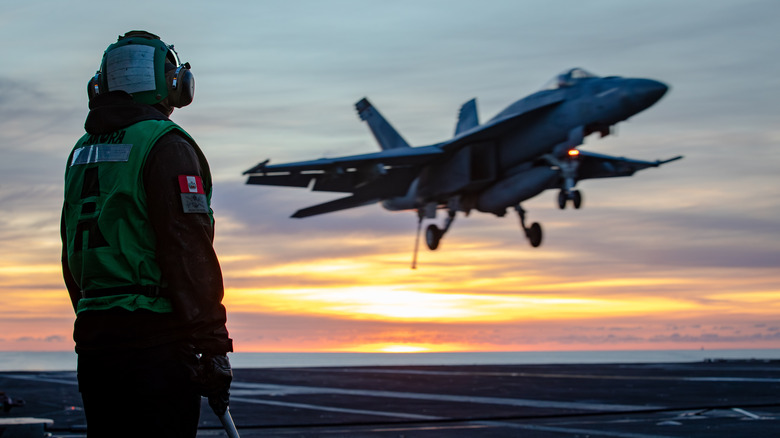
In many fields, the key with the development of AI technology is that it can do a fantastic job when it's augmenting and supporting our abilities to perform certain tasks. This, is the concept behind Precision Landing Mode: It will not take the reins itself during the most dangerous maneuvers, but will minimize the number of complex smaller actions the pilot has to perform during. The project began in 2015, under the name of "Magic Carpet" (Maritime Augmented Guidance with Integrated Controls for Carrier Approach and Recovery Precision Enabling Technologies). USNI News notes that, while it joined fleet operations two years later, there were still issues with the software, because there were initially a lot of situations that could render it nonfunctional.
Thanks to a software update, though, the system has been refined and, as of 2021, is starting to be used to aid in the training of newly qualified pilots. It's embedded in the software of jets such as the F-/A-18E-F Super Hornet, which is just such a specialized naval model that might rely on this sort of functionality. In the U.S. Naval Institute's "Proceedings," Ensign Zachary Bell notes that, as the EA-18 or F/A-18 comes in to touch down, the pilot may need to make 300 small tweaks to the various controls to achieve a safe and stable landing. The system's job is to take some of those responsibilities off of the enormous list. It can, for instance, keep the aircraft's nose level, simplifying the task of managing lift and ensuring that "the pilot does not have to worry about maintaining an optimal angle of attack for the tailhook to catch the arresting gear wire."
The sheer difference the system can make to a pilot's experience
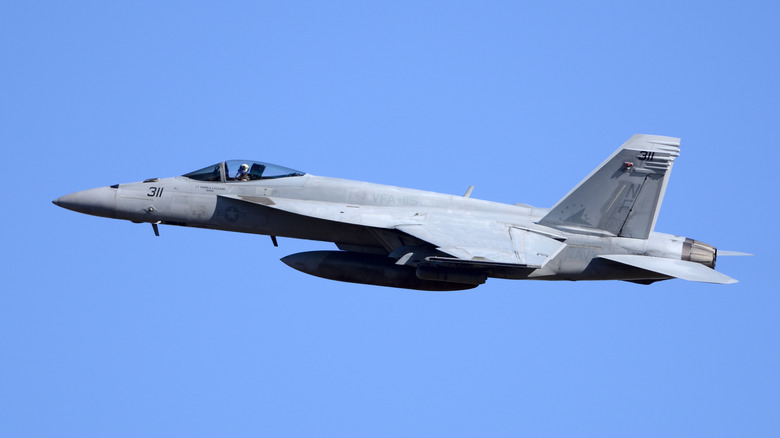
The interaction between the tailhook and the arresting wires is a critical element of planes landing on an aircraft carrier. The wires, on the deck, bring the aircraft to a stop, necessitated by the limited landing space available on a carrier. There's very little time to perform this maneuver, and no margin for error. If the approach isn't perfect, the pilot must make for another attempt at best and put themselves and other personnel in great peril at worst. This is one major reason why Precision Landing Mode is such a huge asset. The 300 tiny adjustments a pilot would make to the controls in the last moments of a landing without it is cut down to less than 10 with it enabled.
In 2021, with the system newly approved for training, the difference was marked. That year, Strike Fighter Squadron commanding officer Capt. Dan Catlin oversaw some newly-qualified pilots practicing carrier landings in F-/A-18E-F Super Hornets. USNI News reports that he announced "by far the smoothest evolution, best performance we've seen from our students ever — and that's by an awful lot." There are now very limited scenarios in which Precision Landing Mode could fail, but it's vital not to lose sight of the importance of manual landings. Catlin went on to explain that, in prior command roles using Precision Landing Mode, "even the experienced aviators, myself included ... had to get what's called a manual pass or an automatic pass at some point just to maintain that proficiency in case there's an aircraft malfunction to where we couldn't actually use PLM." Now implemented on the F-35 Lightning II as well, this system is sure to become a new safety standard for Naval aviators.