

Hologram Police Are Reducing South Korea's Crime More Than You May Think
Holograms have been a fascinating centerpiece of science fiction for decades. Who doesn't remember when R2-D2 suddenly began playing the flickering holographic image of Princess Leia in "Star Wars: A New Hope," begging for General Kenobi's help in their time of need? Other examples include the prolific use of the holodeck in "Star Trek," Sam Beckett's holographic guide Al in "Quantum Leap," and Cortana in the "Halo" video game franchise, to name just a few.
Well, police in Seoul, South Korea (home to self-cleaning streets) took a page from science fiction and used the technology in a real-world application, hoping it would lower crime in the capital city. In October 2024, police in Seoul's Jung downtown district decided to experiment with a holographic police officer. Jeo-dong Park is situated in an area with several bars and is frequently bothered by criminal activity incited by drunk and disorderly conduct.
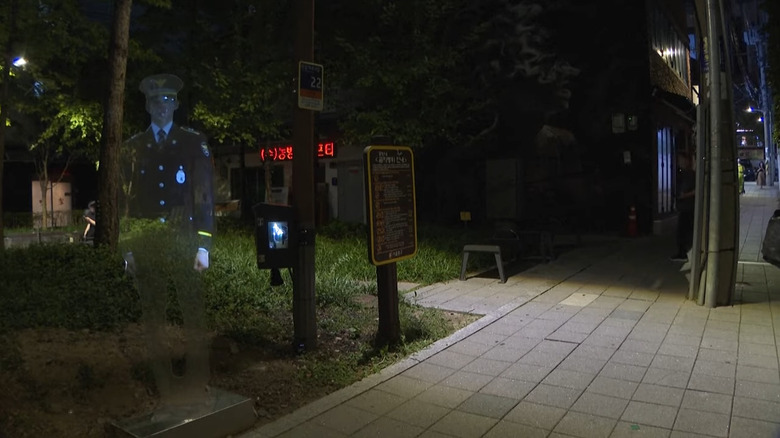
Every two minutes between 7:00 p.m. and 10:00 p.m. each night, the hologram of an officer dressed in a uniform "suitable for the entire year" comes to life and begins issuing warnings to nearby pedestrians that the area is under constant CCTV surveillance and, if needed, police will be dispatched in real time. Interestingly enough, since the appearance of the holographic officer, crime has dropped by 22% in the area. According to a statement from the police, the most significant drop has been with "impulsive crimes" usually started by drunk patrons from the nearby bar district, which is precisely what they were hoping the digital copy cop would do.
Stop in the name of the (holographic) law!
The police are fully aware of how the experiment might look. According to the South China Morning Post, police issued a statement saying, "Although it is clear upon closer inspection that the person isn't real, the mere perception of police presence has had a significant deterrent effect." And the rather astonishing drop in crime rates backs the idea that it is having, at least to some degree, a psychological impact on people. Keep in mind, this is a country that's also working on a hydrogen-powered next-gen stealth tank, so they're on the cutting edge of technology.
Crime stats were gathered between October 2024 and May 2025, then compared with those from October 2023 to May 2024, and the holographic constable did seem to reduce the crime rate substantially. However, it's unclear whether the drop was due to the novelty of the technology itself or whether, in their drunken stupor, the hologram appeared real enough to make suspects stop what they were doing. Whatever the case, its success has convinced officials not only to use it in Jeo-dong Park but also to consider installing it in other parts of the city.
Hologrammica, a South Korean tech company, developed the system. A projector is attached to a nearby pole and shines the images of a real-life police officer onto a 5-foot-7-inch transparent acrylic silhouette that displays the whole body from the top of his head to his feet. At first glance, it certainly appears realistic enough to grab your attention, especially if you're not expecting it to (literally) pop out of nowhere or have had just a tad too much to drink that night.