

This 3,500-Year-Old Covered Wagon Might Just Be The Oldest In The World
Pioneers and the Oregon Trail. The Westward Expansion that gave rise to some of the oldest roads in America. These may all come to mind when you think about covered wagons. For most Americans, our knowledge of covered wagons comes from our school-time studies of the migrants who settled the west. This type of covered wagon, called a Prairie Schooner, was pulled by horses or oxen and featured the iconic canvas top. They date back to the 19th century, but wagons had been used for centuries before those. Case in point: the History Museum of Armenia in Yerevan has six wagons on display that are more than 3,000 years old.
They date from the 15th to 14th centuries B.C., a period known as the Late Bronze Age. This is a period of history you may remember studying in middle school, a time of Egyptian, Mycenaean, and Hittite empires and an explosion of international trade. The Late Bronze Age also gave us notable examples of art and literature, like the Epic of Gilgamesh, which is still studied today, and was the period when the Trojan War is supposed to have taken place.
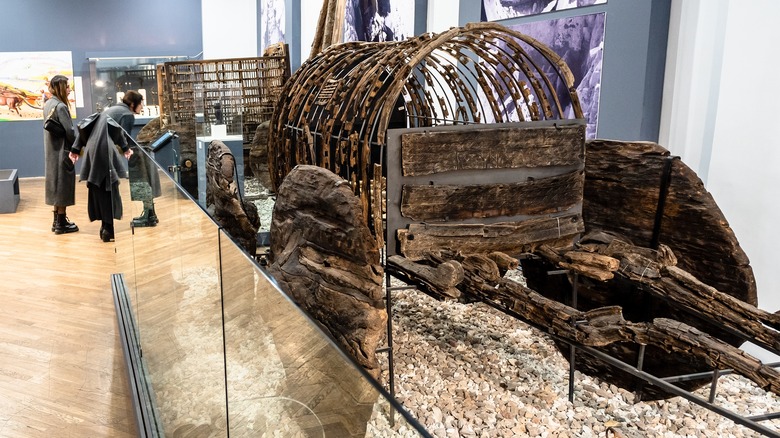
The wagons were discovered in Lchashen, near the shores of Lake Sevan. They are not a recent discovery, having been found in the 1950s when part of the lake was drained for irrigation. While six wagons were discovered, only four of them are considered covered wagons with a frame structure on top. One of these is considered to be the best-preserved early covered wagon ever discovered and has been dubbed the Lchashen wagon.
The Lchashen wagon

The Lchashen wagon is made of solid oak and was most likely a burial wagon used to transport the remains of a leader or chief. This ancient covered wagon has at least 70 parts that are joined together using an ancient woodworking technique called mortise and tenon, also used in the Japanese furniture-building method called Sashimono. The wagon exhibits meticulous craftsmanship, with the frame of the canopy alone exhibiting at least 600 mortise holes. The wagon is about 6.5 feet long, while the wooden wheels are made from slabs of wood joined together and stand 63 inches tall.
The display at the History Museum of Armenia features more than just the wagons. Visitors can also see bronze figurines from the Late Bronze Age, along with weapons and armor. The wagons were located in a Bronze Age cemetery along with more than 500 burials, and the Lchashen wagon is displayed as part of a reconstruction of a chieftain burial, including other artifacts from the tomb. Displays also include examples of goldsmithing and silversmithing, and ritual vessels found at other Late Bronze Age sites in Armenia.