

How Much Weight Can A Harley-Davidson Hold? Here's What You Need To Know
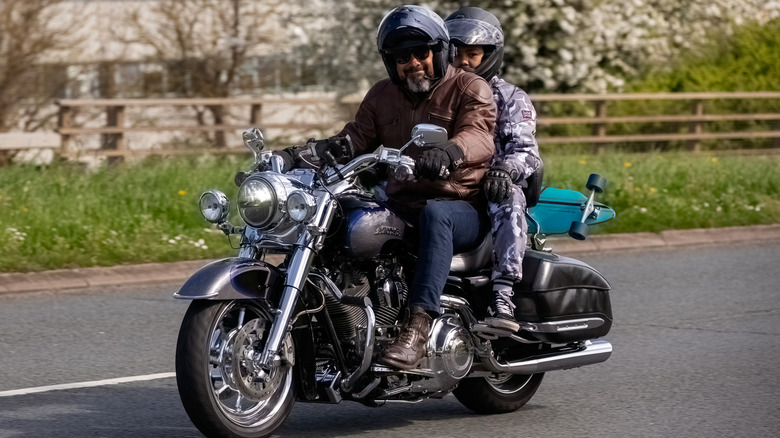
It's important for Harley-Davidson owners to know the capabilities of their bikes. After all, some models are great for street riding, while others are better equipped to handle the highway. Riders should also be aware of weight limits, as Harley uses the Gross Vehicle Weight Rating (GVWR), which is the maximum safe total weight a bike can carry. This number can vary depending on the model, and also what's being carried, including the rider, passenger, cargo, accessories, fuel, and fluids.
For example, the 2025 Harley-Davidson Street Glide Base, the best-selling Harley model, has a GVWR of 1,360 pounds. In contrast, the 2025 Harley Softail Fat Boy has a GVWR of 1,175 pounds. In both cases, everything onboard must stay under the combined total for each bike. Otherwise, Harley's safety limits have been exceeded, possibly affecting overall performance. In extreme cases, the end result could be mechanical failure or serious injury.
To understand how GVWR works, Harley owners can calculate payload capacity. This is the remaining number after subtracting the bike's running weight, or wet weight, from the GVWR. The wet weight is the bike with fuel and fluids included. For example, the 2025 Harley-Davidson Road King Special has a GVWR of 1,360 pounds and a wet weight of 807 pounds. This leaves 553 pounds for the rider, passenger, and cargo. Another example is the 2025 Harley CVO Road Glide, which has the same GVWR but a heavier wet weight of 866 pounds, leaving 494 pounds for riders and cargo.
What Harley riders should know about GVWR and GAWR
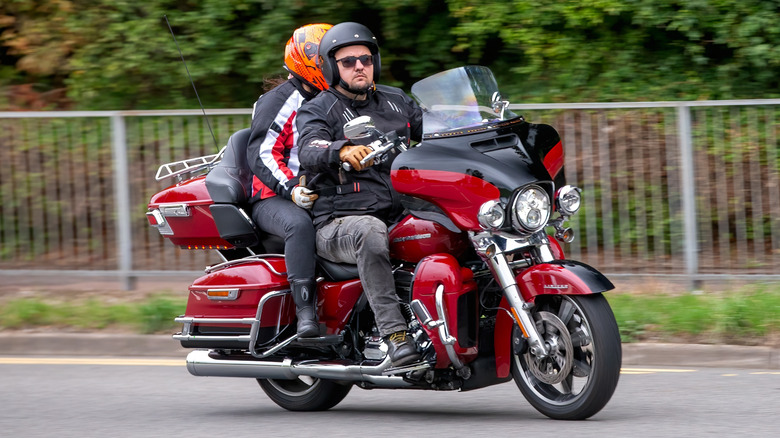
The Gross Vehicle Weight Rating (GVWR) wasn't developed by Harley-Davidson or any other motorcycle company. It's actually the federal government that requires all vehicle manufacturers to determine GVWR for their models. The U.S. Department of Transportation's National Highway Traffic Safety Administration is the agency tasked with overseeing GVWR, an important safety standard.
To find a Harley's GVWR, riders can check their model's down-tube on the right frame, which may have a decal listing that information. If it's not there, it could be located on the bike's VIN plate, and if all else fails, it's likely in the owner's manual. But even when riders know the GVWR, it's important to consider how weight placement affects handling and safety. If a biker has a passenger or additional cargo behind the rear axle, the weight distribution can be thrown off, making the bike less stable. Plus, riding with heavy loads can put extra stress on the tires and even the frame itself.
That's where the Gross Axle Weight Rating (GAWR) comes into play. GAWR specifies the maximum amount of weight the front or rear axle of a motorcycle can safely carry. Even if the total weight of the bike is under the GVWR, the GAWR is an important number to know. Like the GVWR, a Harley-Davidson's GAWR should be listed on the bike itself, or in the owner's manual.